Nanna-Sin
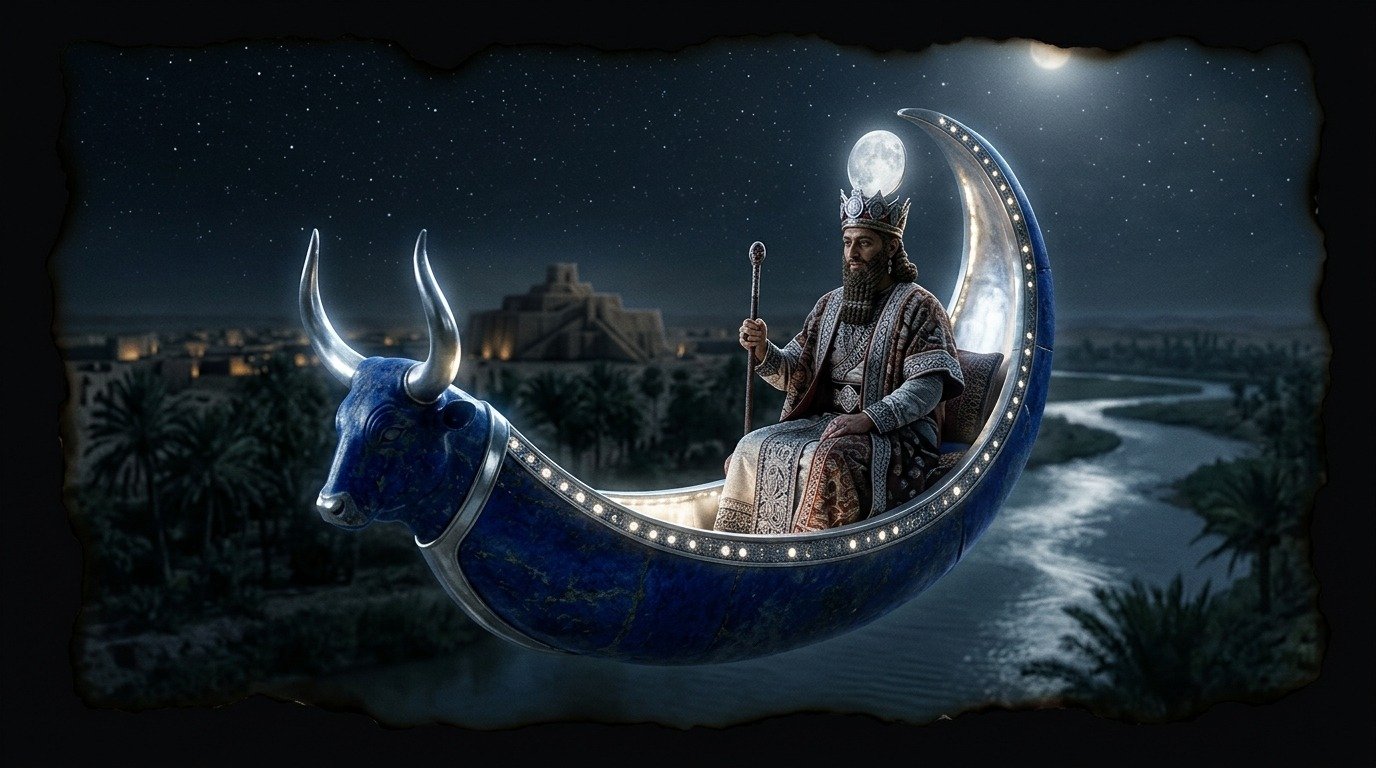
Nanna-Sin: The Silver Boat of Destiny
The Light Born of Transgression
In the most ancient times, when the world was still settling, Enlil, the god of air, took the young Ninlil by force in the sacred waters of Nippur. As punishment for his transgression, Enlil was banished to the underworld, but Ninlil, who already carried the seed of light in her womb, followed him to the realm of shadows. There, in the deepest darkness of the earth, Nanna-Sin, the moon god, was born. He was destined to shine, but his cradle was absolute blackness, which granted him a profound understanding of the cycles of loss and rebirth. Nanna-Sin is the firstborn of the great gods, the lord of time and secret wisdom. His presence manifests in the Mesopotamian night as a delicate lapis lazuli boat sailing across the celestial ocean, laden with light to guide the nomads of the desert. The edges of his boat are the horns of the great cosmic bull, a sacred animal to his cult that symbolizes the fertility of the herds and the indomitable force of nature.
The Weaver of Months and Destiny
The importance of Nanna-Sin lies in his dominion over time. With his constant waxing and waning, the god measures the days and seasons, providing scribes with the calendar needed to organize planting, harvesting, and temple festivities. When the god hides completely at the end of each month, it is said that he descends to the courts of the underworld to help judge souls, demonstrating that his influence extends beyond the night sky. His relationship with fertility is direct and vital for the survival of the cities. He is the one who fills the udders of cows with milk and makes the reeds grow in the southern marshes. His breath regulates the tides of the Persian Gulf and the flow of the Tigris and Euphrates rivers. His temple in the city of Ur, the majestic ziggurat of Egishnugal, rises toward the sky like an artificial mountain where the royal priestesses, the En, watch over the well-being of his cult through rituals of sacred union that ensure the prosperity of the entire kingdom.
The Beacon of Ur
As patron of the great city of Ur, Nanna-Sin is the pillar of Sumerian civilization. His daughter is Inanna, the morning star, and his son is Utu, the sun. Together they form the great astral triad that governs the destiny of the cosmos. Devotion to him was so great that the kings of Ur considered their crown a direct gift from the silver boat of the god. His figure is a reminder that even in the darkest night of the soul or the empire, there is always a sliver of light destined to grow until it reaches the fullness of the lunar disk.
Comments
Share information, an experience, or a source to help enrich this entry. They are automatically reviewed before being published.
Loading comments...