Ninhursag
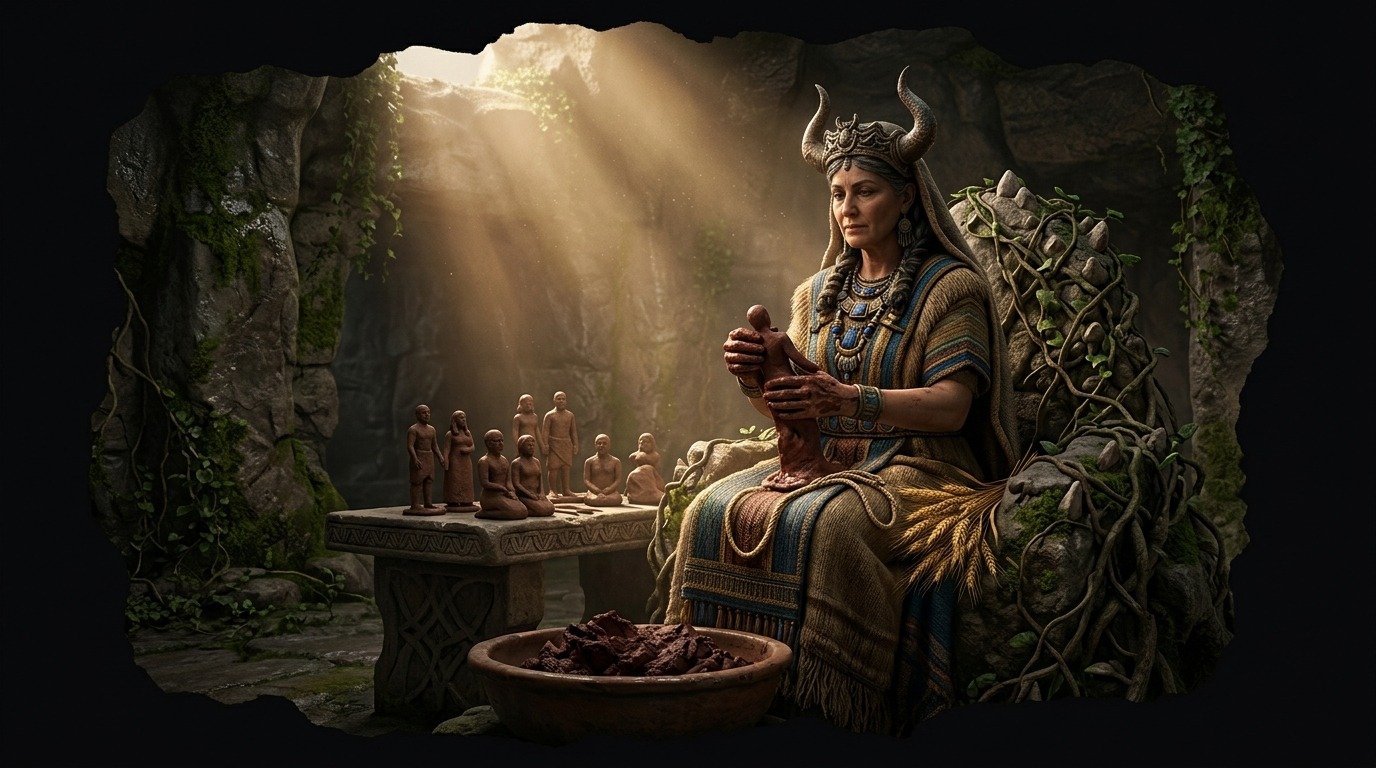
Ninhursag: The Womb of the Living Clay
The Mother of the Stony Ground
Ninhursag is the earth itself in its most fertile and wild state. Her name means "the lady of the sacred hills," but she is also known as Ki, the mother earth, or Aruru, the potter of destinies. She is the creative force that existed before cities were built and canals were dug. Her domain is not the land cultivated by man, but the mountain slopes covered in wild vegetation, the place where life springs forth spontaneously after the spring rains.
She is depicted as a mature woman of great dignity, wearing a horned tiara and holding a midwife's cord and an ear of wheat in her hands. Ninhursag is the provider of the cosmic womb, the deity who shapes the bones and flesh of all living creatures in her divine workshop, using the water of the abysses and the clay of the Mesopotamian soil.
The Molding of Humanity
The most transcendental myth of Ninhursag narrates the creation of human beings. The lesser gods, tired of the hard labor of digging river canals and piling up earth, began to rebel against the great lords of heaven. To ease their burden, the clever god Enki devised a plan and went to Ninhursag to execute it. The mother goddess mixed clay from the depths of the abyss with the blood and flesh of a sacrificed god, thus uniting earthly matter with the divine spark of immortality.
With her own hands stained with mud and blood, Ninhursag molded the first seven men and seven women who populated the world, establishing their destinies and their limitations. Every time a king or a slave is born, it is she who oversees the birth in the chamber of creation, shaping the features of the newborn and giving them the first breath of life. She is the midwife of humanity, but also the one who determines the end of their days, reclaiming their bodies so they may return to the clay from which they arose.
The Sovereign of Dilmun
Ninhursag has a complex and tempestuous relationship with the other deities, especially with Enki. On the paradise island of Dilmun, where neither sickness nor death exists, Ninhursag makes the most beautiful and sacred plants of the cosmos sprout. When Enki devours these forbidden plants to absorb their power, the mother goddess becomes enraged and curses him, withdrawing her life-giving gaze. Enki falls terminally ill, with eight of his vital organs collapsing one by one.
Fearing that the god of fresh water might perish and the earth become barren, the other deities beg Ninhursag to return. Demonstrating her immense power over life and health, the goddess sits beside Enki and creates eight healing deities, each born from the pain of a specific part of the god's body, restoring the balance of the universe. Her worship is the foundation of all medicine and agriculture; she is the mother who nourishes, the earth that sustains, and the tomb that ultimately welcomes all of her creation.
Comments
Share information, an experience, or a source to help enrich this entry. They are automatically reviewed before being published.
Loading comments...