Utu-Shamash
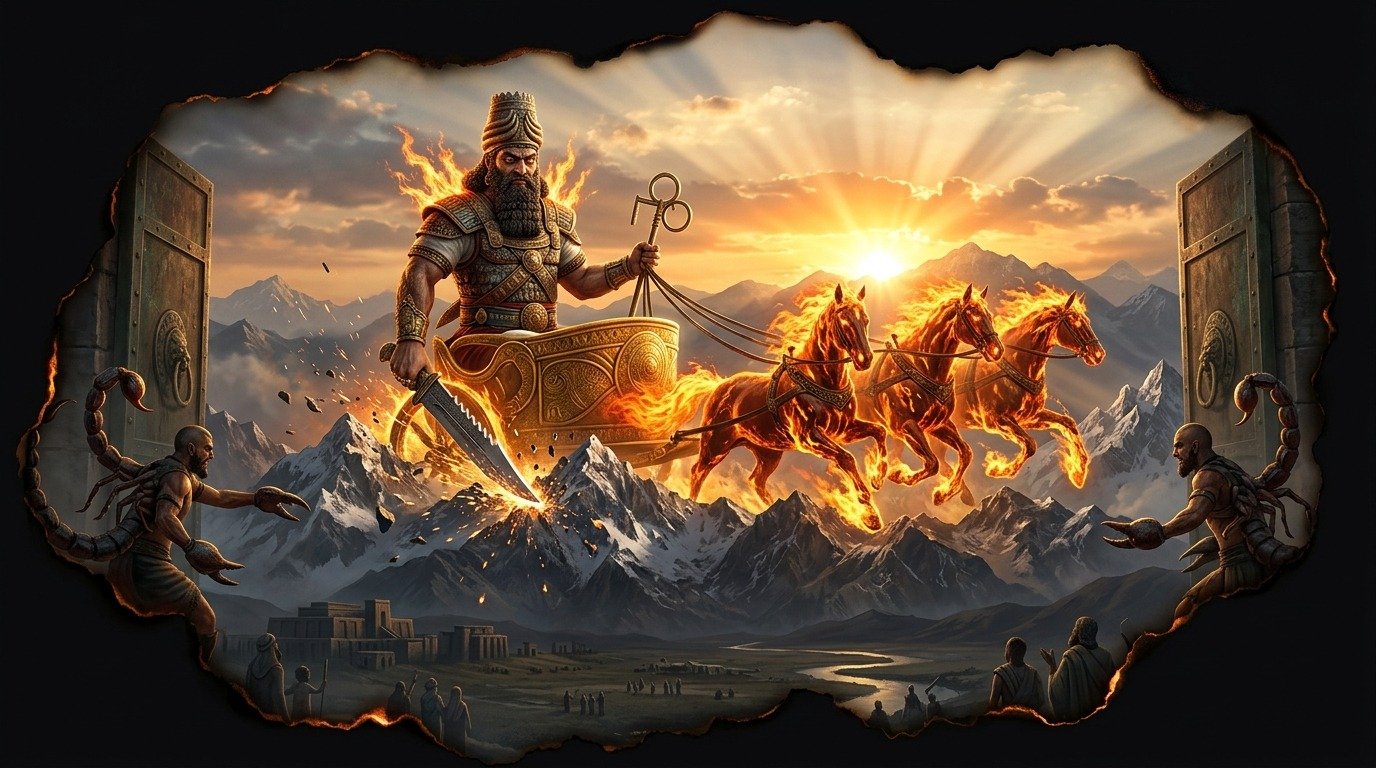
Utu-Shamash: The Light That Judges the World
The Dawn Over the Eastern Mountains
Every morning, the great bronze gates of the east, guarded by the fierce scorpion-men, open wide. From them emerges Utu-Shamash, the sun god, resplendent in his golden chariot pulled by fiery horses. In his right hand, he holds a great saw-toothed knife with which he cuts the peaks of the Mashu mountains to carve his path toward the firmament. His ascent is not merely a phenomenon of nature, but the foundational act of clarity over confusion.
Son of the moon god Nanna and the goddess Ningal, Utu-Shamash represents the cosmic order in its most active expression. His light is not just heat that ripens the barley fields, but a revealing force. Before his path, shadows dissipate and conspirators, thieves, and liars are exposed. At night, Utu-Shamash's journey does not end; he descends into the underworld through the gates of the west to judge the dead and bring light to the souls plunged into the darkness of Ereshkigal, ensuring that balance is maintained on both sides of existence.
The Scales of the Cosmos
The role of Utu-Shamash as the supreme judge of gods and men is absolute. It is he who inspires the great kings of the earth to draft the law codes that protect the orphan and the widow from the abuse of the strong. He is depicted as a man with a thick beard, seated on a throne decorated with flames rising from his shoulders, holding in his hand the ring and staff of measurement, the symbols of exact justice and geometric rectitude.
His intervention is crucial in great heroic deeds. When the young king Gilgamesh decides to march to the dangerous Cedar Forest to face the monster Humbaba, he first goes to the altar of Utu-Shamash. The god, moved by the hero's audacity and his mortality, unleashes the thirteen hurricane winds against the beast, blinding it and allowing the victory of the king of Uruk. Utu-Shamash is the patron of travelers, merchants, and judges; his gaze is the invisible witness of every oath sealed upon clay.
The Imprint of the Incorruptible Sun
The cult of Utu-Shamash is centered in the cities of Larsa and Sippar, in his temples called Ebabbar, or "the shining house." There, diviners examine the entrails of sacrificed animals, seeking the answers that the sun god writes in the visible world through patterns of light and shadow. His figure survived the falls of entire dynasties because he represented the basic principle that the universe is predictable and just. As long as the sun rises again over the eastern mountains, truth and law will continue to govern the destiny of men.
Comments
Share information, an experience, or a source to help enrich this entry. They are automatically reviewed before being published.
Loading comments...