Ashur
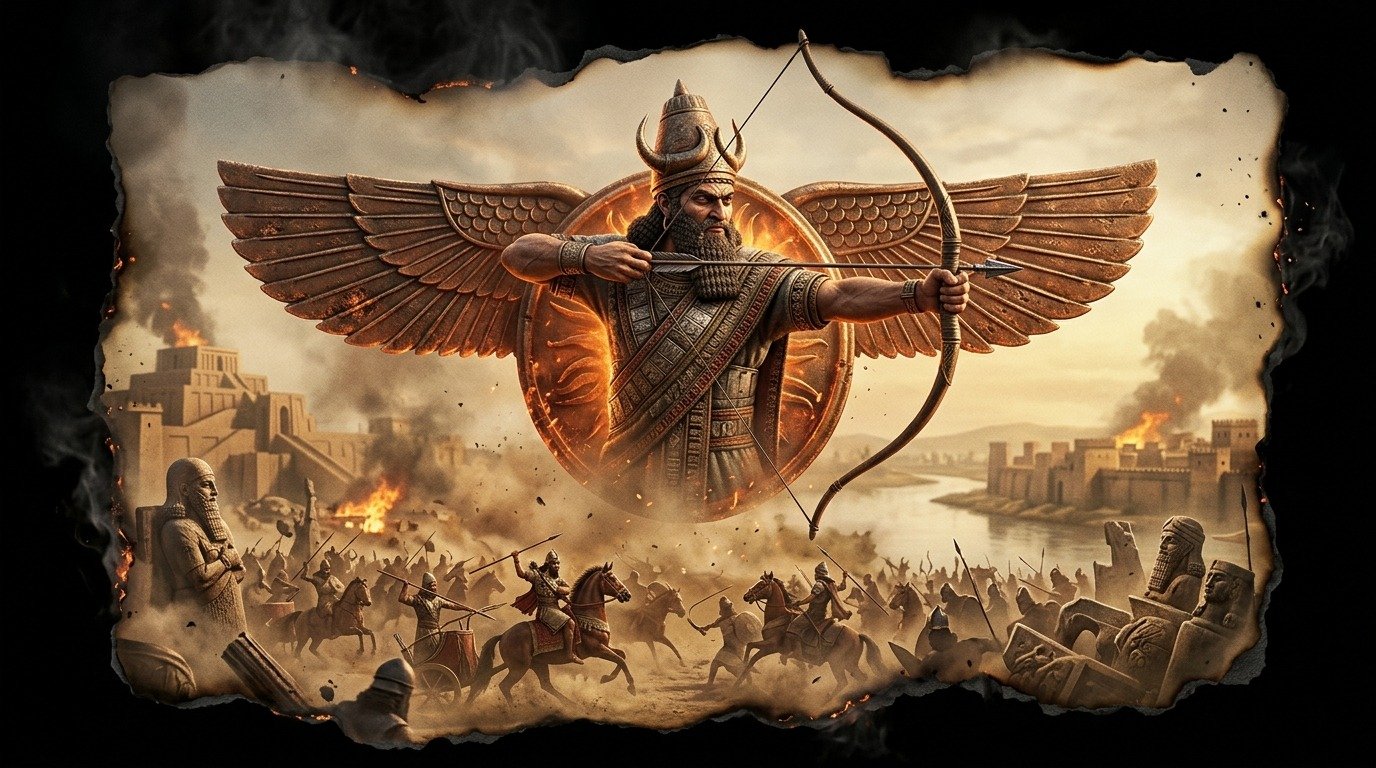
Ashur: The Bronze Sun and the Breath of the Empire
The God Who Is a City
Ashur was not born from the common dynasty of the gods of rain or love; his origin lies in the living rock. Initially, he was the mountain itself upon which his sacred city was founded on the banks of the Tigris. He was the spirit of the place, the protective presence that ensured the mud-brick walls withstood the river's floods and the assaults of nomads. As the city of Assur grew and extended its bronze arms over Mesopotamia, its god grew with it. He ceased to be a mere local spirit to become the absolute monarch of the panteon, a lord who did not need a complex family tree because his very existence was synonymous with sovereignty, order, and unyielding conquest.
The Winged Disk and the Iron Bow
When Assyrian kings marched to war, Ashur did not wait for them in his temple; he advanced at the head of the legions. He was depicted suspended in the air, emerging from a winged solar disk, with his bow drawn and his gaze fixed on the enemies of the empire. His will was not mediation or balance, but the absolute subjugation of chaos through the sword. Military campaigns were understood as religious rituals intended to pacify the wild lands under the mantle of his iron justice. Whoever rebelled against the Assyrian king rebelled against Ashur, and the deity's punishment was relentless: cities reduced to ashes, wells poisoned with salt, and deserts inhabited only by the wind.
Absolute Assimilation
To consolidate his cosmic dominion, Ashur absorbed the identities of the ancient lords of the world. His priests rewrote the origin myths to attribute the defeat of primordial chaos to him, assimilating the power of Enlil and the glory of Marduk. He was not simply one god among others; he was the engine of the universe, the invisible force that sustained the emperor's throne and gave legitimacy to the laws. His cult was the cement that bound a multi-ethnic empire under a single sacred fear. Although the temples of other deities persisted, everyone knew that their destinies were decided in the sanctuary of Ashur, where the smoke of sacrifices mingled with the dust of victorious battles.
Comments
Share information, an experience, or a source to help enrich this entry. They are automatically reviewed before being published.
Loading comments...