Anu
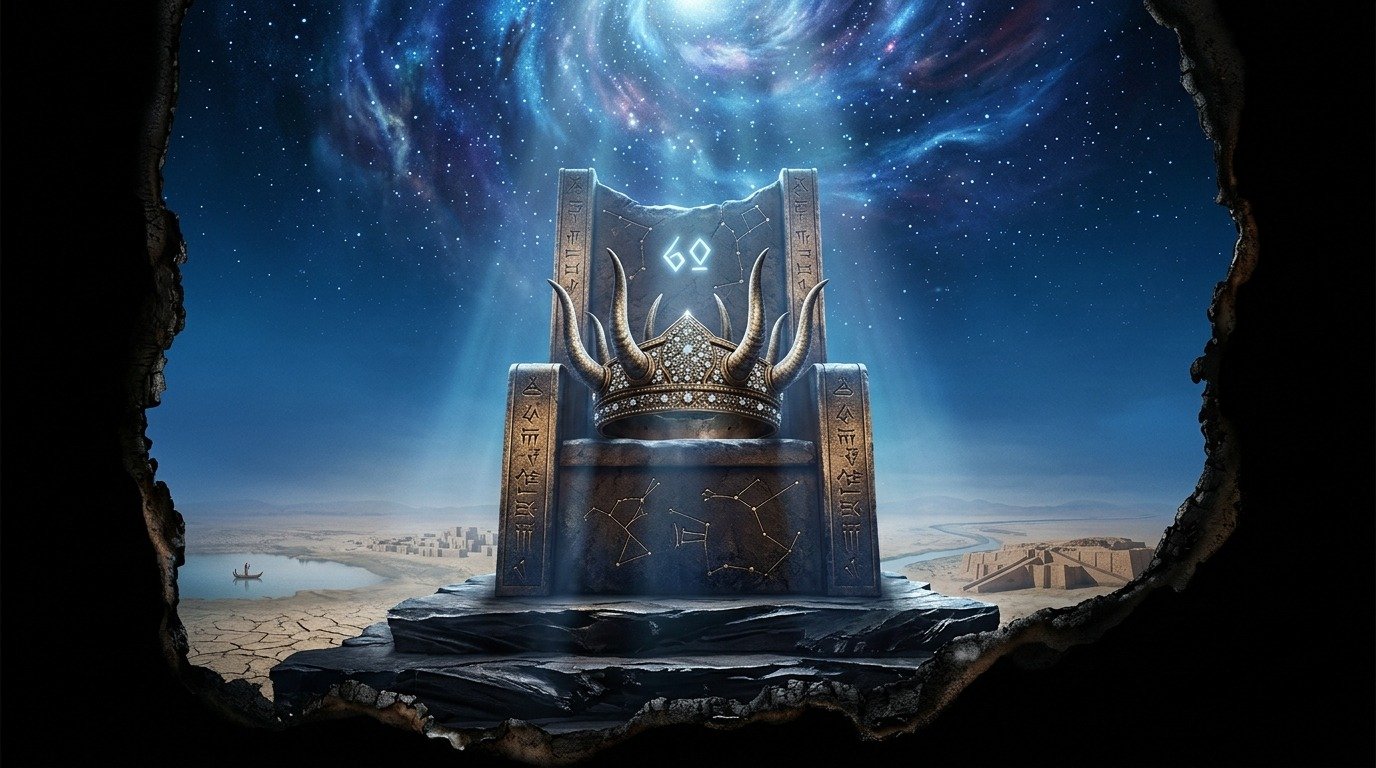
Anu: The Silent Crown of the Firmament
The Birth of the Absolute Blue
Before time had a course and the clay cities rose on the riverbanks, there existed only the primordial ocean, an abyss of silent and shoreless waters. From that dark immensity emerged the first duality: the earth, dense and heavy, and the sky, a mantle of cold and pure light. From the union of these two forces was born Anu, the very personification of the celestial vault, the infinite blue that contemplates the world without ever touching it.
His origin is the origin of order. By rising above all things, Anu separated the cosmos from the initial chaos, claiming the realm of the heights as his absolute territory. In the great hall of the firmament, where the stars are his eyes and the constellations his messengers, he crowned himself as the first sovereign of creation. He was not born to till the earth nor to battle in the salt deserts; he was born to rule, to be the source from which all legitimate authority emanates, both for the gods who dwell below and for the mortals who dream of looking up.
The Tiara and the Silence
Anu's power does not manifest in the roar of the wind or the crash of lightning; his dominion is that of absolute silence and immutable law. His symbol is the horned tiara resting upon an empty throne, an image that inspires a reverent and distant respect. For the other inhabitants of the pantheon, Anu is the supreme ancestor, the judge who resides in the third heaven, a region of light so intense that it is blinding to the eyes of any lesser creature.
When Anu decides to intervene in the affairs of the world, he does not descend in person. His will is transmitted through his decrees, words that carry the weight of stars falling upon the earth. He is the possessor of the number sixty, the figure of mathematical perfection and the base upon which time and space are calculated. When lesser gods rebel or when plagues ravage the harvests, eyes turn toward the zenith. A single word from Anu can unleash the deluge or restore the dynasty of a dying king, for royalty itself is not an invention of men, but a sacred gift that descended directly from his celestial throne.
The Judge of the Firmament
Anu's majesty is defined by his distance. On one occasion, when the goddess of love and war demanded that the Bull of Heaven be unleashed to punish the pride of a mortal king, Anu hesitated from his heights. He knew the consequences: seven years of drought and misery for the land. However, faced with her insistence and the threat of shattering the gates of the underworld, Anu yielded, demonstrating that his justice, though severe, must sometimes weigh the balance between the passions of his own divine lineage and the destiny of men.
In another era, when the south wind blew with such fury that it capsized the boat of the sage Adapa, he cursed the wind and broke its wings. Anu, outraged by the audacity of a mortal who dared to break the order of nature, summoned him to appear before his celestial throne. Upon seeing the man's wisdom and humility, the god of the sky softened and offered him the bread and water of eternal life. But destiny is a complex web; Adapa, cunningly advised by another god, refused the feast, thinking it was poison. Anu remained silent, allowing the mortal to return to earth to die like all of his kind. That scene sums up his essence: a sovereign who offers immortality with one hand and contemplates with impassivity how it slips through humanity's fingers with the other.
Comments
Share information, an experience, or a source to help enrich this entry. They are automatically reviewed before being published.
Loading comments...