Marduk
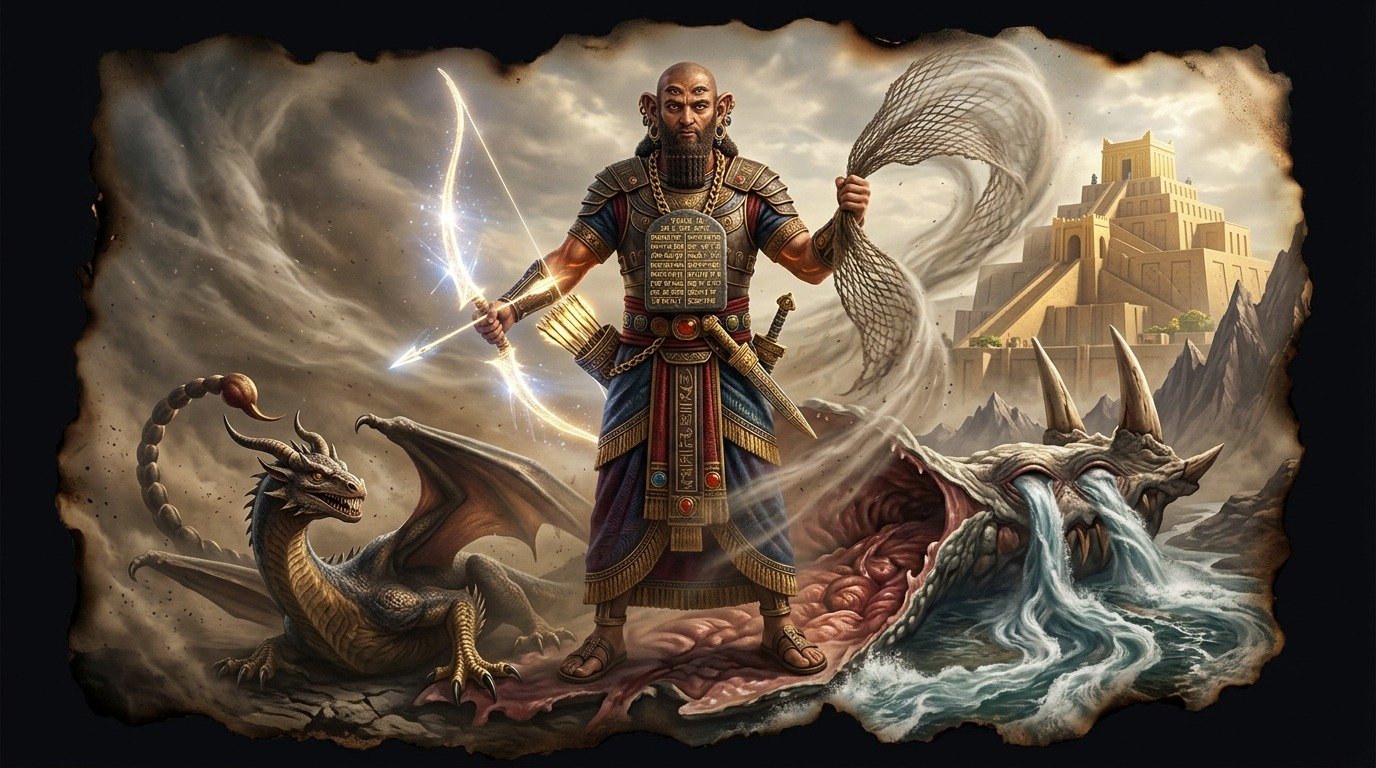
Marduk: the sovereign of the wind and the maker of empires
The heir of the sweet waters
In the most ancient times, Marduk was only a minor god of agriculture, a deity who watched over the sprouts of the fields around a small settlement on the banks of the Euphrates called Babylon. However, his destiny was tied to the rise of his own city. Son of Enki, Marduk inherited his father's wisdom but added to it an imposing physical stature, an indomitable inner fire, and a gaze that encompassed the four corners of the earth. It was said that he had four eyes to see everything and four ears to hear even the slightest whisper of the wind.
His opportunity to claim the throne of the cosmos came when the forces of primordial chaos rose once again. Tiamat, the abyssal mother of salt waters, enraged by the noise and insolence of the young gods, spawned an army of monsters, horned dragons, and scorpion-men to march against the established order. None of the ancient gods—neither Anu with his cold authority, nor Enlil with his storm—dared to face the great dragon of the primordial ocean. Amidst the terror of the immortals, the young Marduk stepped forward, demanding a single condition: if he defeated Tiamat, he would rule over them all forever.
The battle for cosmic order
The battle between Marduk and Tiamat is the ultimate clash between shapeless chaos and the organizing will. Armed with a net that held the four winds, a bow of light, and the storm as his chariot of war, Marduk advanced toward the abyss of salt water. Tiamat opened her monstrous jaws to devour him, but the god was faster: he cast the hurricane winds into her mouth, preventing the dragon from closing her jaws. The winds bloated her belly and, with a precise shot of his arrow, Marduk split her heart in two, extinguishing the life of primordial chaos.
With Tiamat's immense corpse, Marduk performed the great work of creation. He divided her body into two halves, like an oyster: with one half he formed the celestial vault to contain the waters above, and with the other he shaped the dry land. From her eyes flowed the Tigris and Euphrates rivers; from her fangs he carved the northern mountain ranges. Then, he snatched the Tablet of Destinies from the chest of Tiamat's lieutenant and hung it upon his own, consolidating his unquestionable right to rule the cosmos.
The lord of the tower and the dragon
To celebrate his triumph, Marduk ordered the gods to build a palace that would serve as the heart of the earthly universe: Babylon, the gate of the gods. At its center rose the Esagila, his golden temple, and the immense stepped tower that sought to touch the sky, connecting his father's Abzu with the firmament of Anu. As a symbol of his power over the beasts of chaos, he was accompanied by the Mušḫuššu, the dragon with eagle talons and a scorpion tail, now tamed beneath his sovereign foot.
Under the reign of Marduk, the creation of humanity acquired a new purpose. Using the blood of a rebel god executed after the war, he fashioned mankind to take over the maintenance of the world, allowing all the deities of the pantheon to rest and live off offerings. Marduk thus became the god of the empire, the protector of civil justice, the healer who drives away fevers, and the supreme judge of dynasties. Every year, at the spring festival, the king of Babylon had to kneel before his statue, strip himself of his insignia, and be slapped by the high priest until tears ran down his cheeks, proving before the great lord of the wind that he remained humble and worthy of holding the scepter that Marduk lent him.
Comments
Share information, an experience, or a source to help enrich this entry. They are automatically reviewed before being published.
Loading comments...