Ninlil
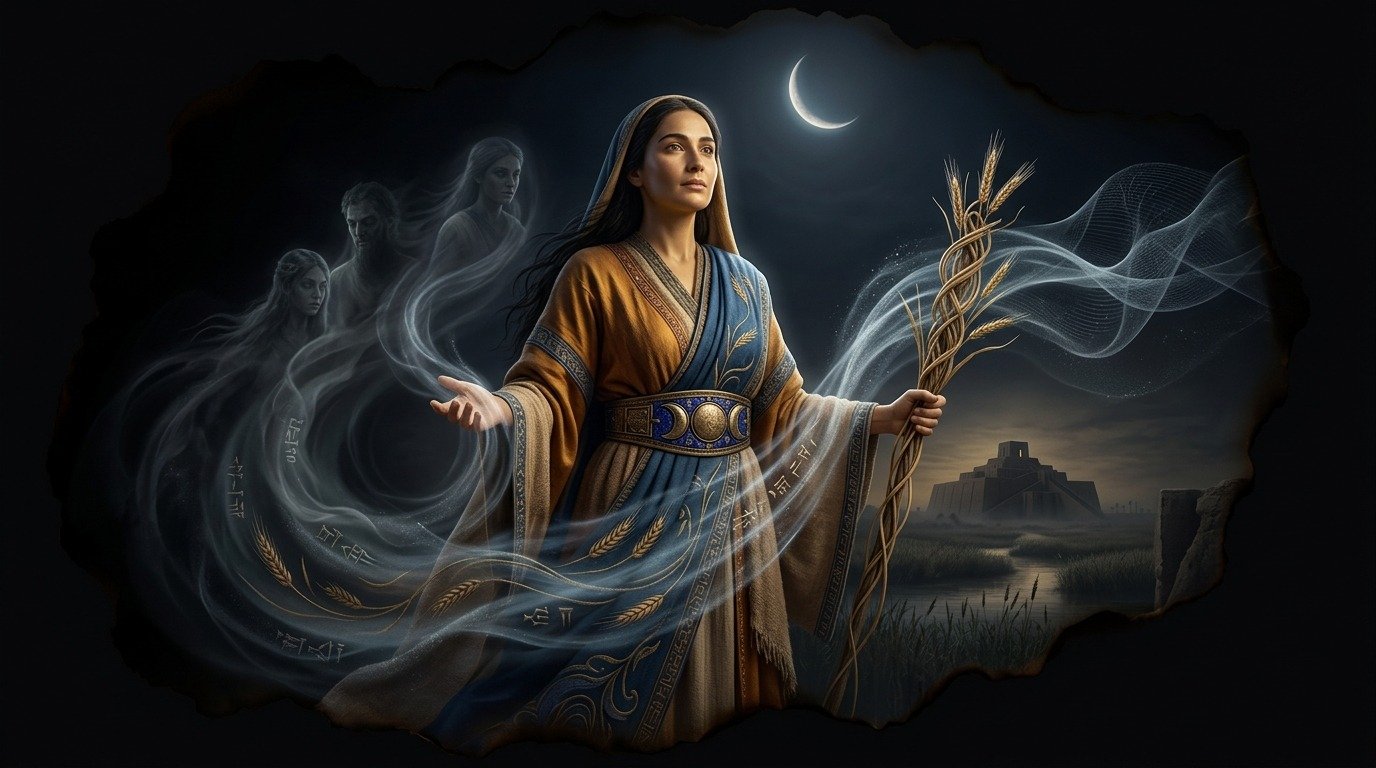
Ninlil: The Sovereign of the Wind and the Temperance of Destiny
The Maiden of the Silver Canal
Before she was the undisputed queen of the wind, before her name was whispered with fear and reverence in the mud-brick temples of Nippur, she was Sud. In those primordial days, she was a divinity of purity and golden ears of grain, a young maiden who dwelt on the shores of Shuruppak, where the reed beds rustled under the sun and the fresh water kissed the fertile earth. Her mother, the wise Nunbarsegunu, knew the dangers of the desire of the great lords of the cosmos and warned her not to go near the currents of the Nunbirdu, the sacred canal. She warned her that the wild wind, embodied in the mighty Enlil, prowled those waters with hungry eyes.
But the destiny of the gods is not governed by the prudence of mortals. Sud went down into the waters of the canal, letting the current caress her skin. Enlil, the lord of the storm, saw her from the heights. His love was a whirlwind, a brutal force of nature that knew no waiting or delicate courtship. He took her right there, among the reeds and the primordial mud, infusing her with the seed that would give rise to the moon god.
That act of possession unleashed the wrath of the pantheon. The fifty great gods, scandalized by the transgression of order, banished Enlil to the Kur, the underworld of dust and shadows. But Sud was no longer the defenseless maiden of Shuruppak. By uniting with the wind, she had become Ninlil, the Lady of the Wind. With her womb heavy with light, she decided that no abyss would hold the father of her child, and she descended of her own free will into the depths of the dead earth.
The Pact of Shadows and Light
Ninlil's descent into the Kur is one of the strangest and most moving feats of creation. She carried within her Nanna, the moon, a creature of pure light who could not be born in the realm of eternal shadows, for the law of the underworld demanded that everything that entered there must remain forever.
Enlil, wandering in the darkness and knowing that his wife was searching for him, adopted three successive disguises to protect her and circumvent the laws of the abyss. He became first the gatekeeper of the underworld, then the man of the river of death, and finally the ferryman who crossed the waters of pain. In each of these encounters, Ninlil recognized the essence of her beloved beneath the rough shell of the disguise. At each of those stops on the subterranean journey, she gave herself to him, conceiving three chthonic deities: Nergal, the lord of war and plagues; Ninazu, the healer of the underworld; and Enbilulu, the lord of underground canals.
This sacred exchange saved the balance of the cosmos. By giving birth to three shadow gods to take the place of light in the Kur, Ninlil bought her firstborn's freedom. Nanna was thus able to ascend to the firmament to illuminate the night of men, free from the chains of dust, while she returned to the surface of the earth, crowned not only as the goddess of the cool wind, but as the great weaver of destinies who had bent the laws of death.
The Breeze That Appeases the Storm
Back in the world of the living, Ninlil took her rightful place in the Ekur, the Mountain House, the most sacred sanctuary of Nippur. There, seated beside Enlil, she ruled over the destiny of humanity. While Enlil represented the north wind, the violent gale that tore down walls and overflowed rivers with blind fury, Ninlil was the south wind and the eastern breeze. She was the gentle air that carried pollen, the whisper that ripened barley, and the coolness that relieved the burning Mesopotamian midday.
Her power lay in mediation. While Enlil was a god of destructive and irrevocable decrees, Ninlil possessed a compassionate heart that listened to the cries of mortals. In the myths of great floods and droughts, when the lord of storms decided to punish men for their noisy clamor, it was Ninlil who interceded, whispering words of temperance into her husband's ear, reminding him of the value of the life they themselves had helped to flourish.
On clay tablets, she is described carrying the tablet of destinies, sharing with Enlil the supreme right to decree the future of kings and nations. Her gaze was not that of an implacable judge, but that of a cosmic mother who knew the weight of suffering and darkness.
The Eternal Whisper in the Clay Temples
Throughout the centuries, the cult of Ninlil spread beyond the borders of Nippur, assimilating with other great mothers and queens of heaven in Babylonia and Assyria. Kings sought her blessing before battles, not to obtain the destructive fury that Enlil bestowed, but to achieve the wisdom, stability, and legitimacy of a prosperous reign. They called her "the great mother," "she who gives life," and "the lady who decides destinies with a breath."
Her image survived in temple reliefs as a serene figure, often accompanied by lions or nocturnal birds of prey, symbols of her dual dominion over the fertility of the earth and the mysteries of the underworld. Ninlil never forgot her journey through the shadows; her power always maintained that twilight quality, the certainty that even in the deepest night of the Kur, light can always break through if one has the cunning and courage to negotiate with the abyss.
Comments
Share information, an experience, or a source to help enrich this entry. They are automatically reviewed before being published.
Loading comments...