Lich
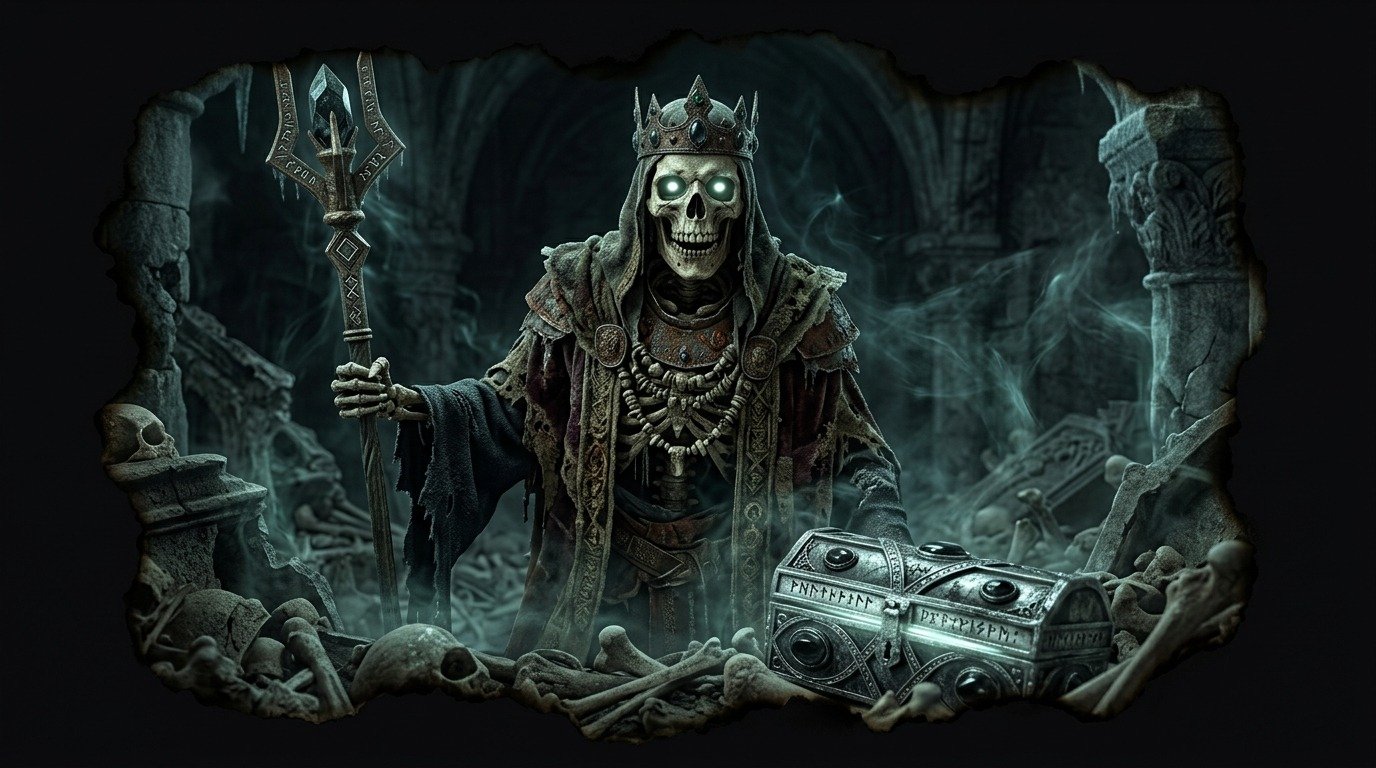
Lich: The Monarch of the Charnel House and the Transmutation of the Withered Soul
Origin and Legend
The term *Lich* has deep linguistic roots in West Germanic languages, deriving from Middle English *lich* and Old High German *lih*, words that simply denoted a physical body, living or dead (surviving in modern terms like *lichgate*, the roofed gate of English churchyards). However, the transmutation of this linguistic term into the figure of the immortal, cadaverous sorcerer is a phenomenon that merges Slavic folklore with 20th-century fantasy literature.
The primary inspiration for the Lich is found in figures such as *Koschei the Deathless* from Russian folklore, a powerful sorcerer who hid his soul outside his body inside a needle, which in turn was inside an egg, inside a duck, inside a hare, kept in an iron chest buried under a mystical oak tree. This notion of the externalized soul is the core of modern Lich mythology.
Historical and Regional Evolution
The literary transition of the Lich began to take shape with authors of Gothic and fantasy literature such as Ambrose Bierce and Clark Ashton Smith. In his short story "The Empire of the Necromancers" (1932), Smith describes wizards who preserve their withered bodies beyond natural death to continue ruling their barren lands. However, the definitive codification of the entity as we know it today—a skeletal archmage who achieves immortality through a profane pact and the creation of a receptacle for their soul—was established in the 1970s by Gary Gygax during the development of the first fantasy role-playing game manuals. Since then, the Lich has ceased to be a generic term for a corpse and has become the undisputed monarch of necromancy in global popular culture.
Esoteric or Symbolic Meaning
From an esoteric perspective, the Lich represents the antithesis of the process of the alchemical Great Work. While the alchemist seeks spiritual immortality through the purification of their being and alignment with the Divine Logos, the Lich seeks a purely egoic and material immortality through stagnation and the desecration of natural laws. It is pure intellect divorced from compassion and the cosmic soul; the human will rebelling against the necessary cycle of death and rebirth. The Lich prefers to exist as an eternal corpse, devoid of sensory pleasures and plunged into a constant agony of spiritual dryness, rather than surrender its individuality and knowledge to the abyss of cosmic transmutation. It is the representation of the hypertrophied ego devouring itself within its own mental fortress.
Manifestation, Testimonials, or Practice
The process of transforming into a Lich—referred to in arcane texts as the *Dark Ascension* or the *Ritual of Unlife*—requires absolute mastery of necromancy, sacred geometry, and soul transmutation. The manifestation of this physical entity is that of a skeleton or mummified corpse of regal appearance, whose eyes have been replaced by two points of cold light (usually green or icy) glowing in the empty sockets of its skull. Its presence saturates the surrounding environment with an aura of paralyzing dread, capable of freezing the will of any living beings that approach.
To counteract or destroy a Lich, the operative grimoire establishes an inescapable protocol structured around its soul receptacle: the *Phylactery*:
* **The location of the Phylactery:** The Lich cannot be destroyed by physical damage inflicted upon its material body. If its corporeal form is reduced to ashes, its consciousness and soul, sheltered within the phylactery (which is usually an object of great material or mystical value, such as a jeweled chest, a runic ring, or a scroll of human skin), will weave a new physical body from the residual energy of the environment within a matter of days. * **The destruction of the receptacle:** The phylactery must be located and destroyed through specific and extremely violent methods: immersion in alchemical fire (green fire or sulfur fire), dissolution in mystical acids, or the strike of a weapon consecrated in the name of a deity of natural death and cosmic balance. * **The collapse of the vital cord:** Once the phylactery is destroyed, the soul of the Lich is instantly dragged toward the realms of spiritual judgment, causing its physical body to immediately collapse into inert dust, unable to sustain the illusion of life without its metaphysical anchor.
Comments
Share information, an experience, or a source to help enrich this entry. They are automatically reviewed before being published.
Loading comments...