Ghoul
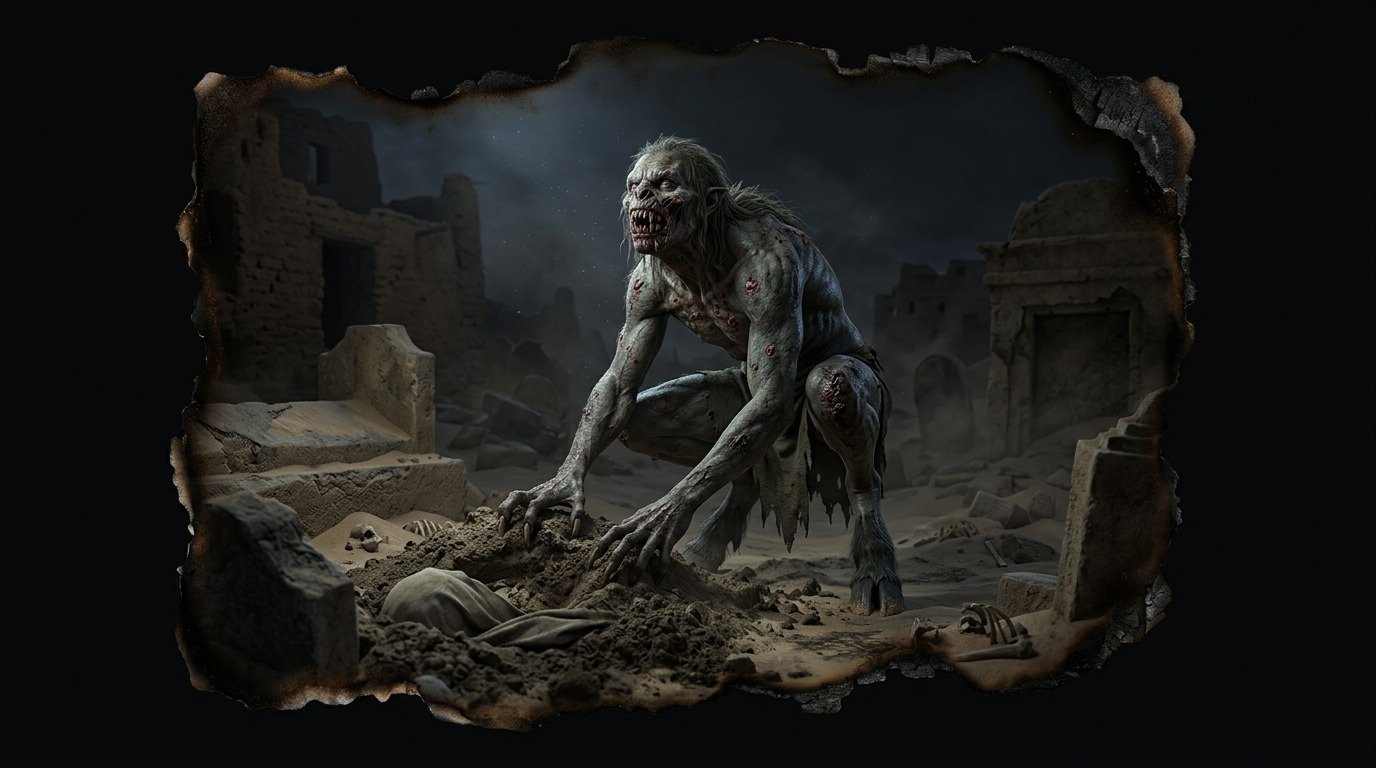
The Ghūl: The Abomination of the Deserts and Devourer of Tombs
Etymology and Pre-Islamic Origin
The *ghūl* (from the Arabic غول, plural *ghīlān*), from which the Spanish term "necrófago" or the English "ghoul" derives, has its roots in the mythology and folklore of the pre-Islamic Arabian Peninsula. Its etymology is linked to the verb *ghāla*, which means "to seize," "to destroy," or "to ambush." In the Bedouin poetry of the desert (*Jahiliyyah*), the *ghūl* was not a simple physical monster, but a demonic manifestation of the hostile desert, a class of rebellious *jinn* (genie) of an eminently evil nature that inhabited unexplored dunes, forgotten ruins, and dry riverbeds (*wadis*).
In the primal Bedouin imagination, the desert was a liminal territory inhabited by invisible forces. The *ghūl* embodied the horror of disorientation, extreme hunger, and survival cannibalism. It was described as a stalking predator that possessed the ability to shapeshift to lure solitary travelers away from safe caravan routes, leading them to their deaths in the vastness of the sand to then devour their fresh flesh.
Theological and Historical Evolution
With the advent of Islam in the seventh century, the figure of the *ghūl* was assimilated into Quranic demonology and the treatises of Muslim scholars such as Al-Jahiz (in his *Kitab al-Hayawan* or "Book of the Animals") and Ibn Qutaybah. They were formally classified as an inferior subclass of terrestrial *jinn*, associated with the material plane and influenced by *Iblis* (the devil).
As Middle Eastern cities grew and monumental cemeteries were established on their outskirts, the traditional habitat of the *ghūl* shifted from the open desert to the necropolises. It was during this period that the creature acquired its most famous and abject trait: necrophagy. Unable to hunt regularly in an increasingly traveled desert, the *ghūl* began to desecrate fresh graves, exhuming corpses to feed on their decaying flesh and the fluids of putrefaction.
The introduction of the creature to the West occurred through the French translation of *The Thousand and One Nights* by Antoine Galland in the 18th century. In these tales (especially in the story of *Sidi Nouman*), the *ghūl* became fixed in the European mind as a pale, semi-human creature that prowled cemeteries in groups, clawing at the earth with long, sharp nails. Later, authors like H.P. Lovecraft reformulated the myth, transforming them into a subterranean race of anthropomorphic beings with canine features that inhabit a network of tunnels beneath great human metropolises.
Anatomy, Capabilities, and Metamorphosis
The *ghūl* in its natural state is described as a repulsive, deformed creature with grayish or greenish skin, covered in mange and with a pungent odor of sulfur and carrion. It possesses extremely hard claws suitable for digging through packed earth and a dislocating jaw equipped with sharp teeth capable of crushing bones to extract the marrow.
However, its primary weapon is deception through metamorphosis. Its preferred transformation is that of a beautiful woman who pretends to be lost in the desert or weeping over a grave to draw the compassion of gentlemen and travelers. Nevertheless, Arabic legends warn that there is one physical trait that the *ghūl* can never alter, regardless of the form it takes: **its donkey or goat hooves** instead of human feet. The astute traveler always had to look at the ground to discover the deception before it was too late.
Defenses and Confrontation Protocols
In the Islamic tradition and the popular folklore of the Middle East, there are specific methods to repel or destroy these entities:
* **The Spiritual Apotropaic:** The recitation of the *Ayat al-Kursi* (the Throne Verse) or the aloud pronunciation of the *Adhan* (the call to prayer) disorients and weakens the *ghīlān*, forcing them to reveal their true form or flee into the depths of the earth. * **The Rule of the Single Blow:** This is the most crucial and widespread physical defense in Arabic folklore. If a warrior faces a *ghūl* and manages to strike it with a sword blow, they must do so with such force that it is immediately fatal. If the dying *ghūl* begs the attacker to strike a second blow to end its suffering, the warrior **must flatly refuse**. A second blow of steel acts as a magical balm on the creature's body, instantly healing all its wounds and granting it renewed strength that will destroy the combatant.
---
Comments
Share information, an experience, or a source to help enrich this entry. They are automatically reviewed before being published.
Loading comments...