Draugr
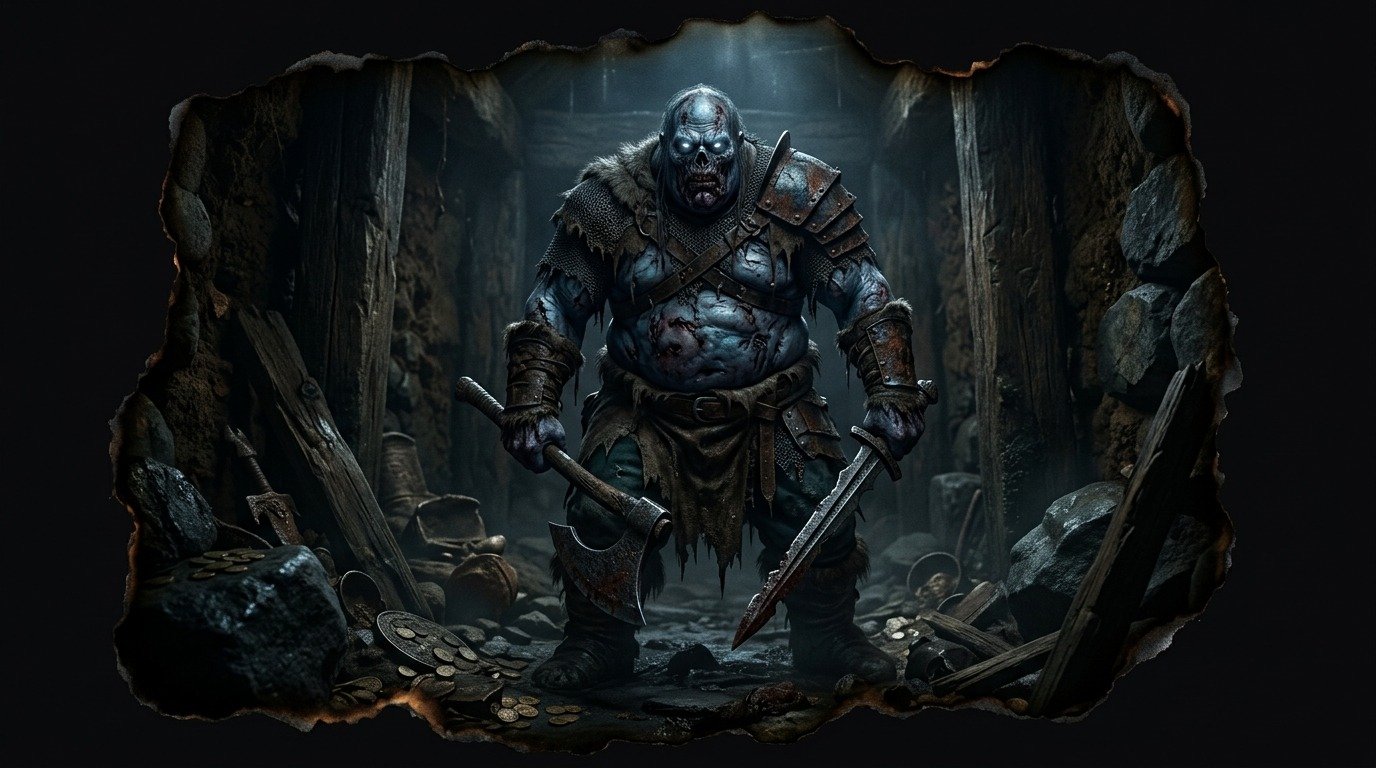
The Draugr: the barrow-dweller and guardian of the Norse shadows
Mythology and Sources
In Old Norse tradition, the *draugr* (plural *draugar*), also called *aptrganga* ("the one who walks again"), represents one of the most physical and ominous manifestations of the return of the dead. Far from the conception of the ethereal or incorporeal specters of Southern Europe, the *draugr* is a reanimated corpse that retains its physical density, its memories, its malice, and a colossal, Herculean strength. The most detailed records of these creatures are found in the Icelandic sagas of the medieval period (Sagas of the Icelanders), which codify the folklore of the Viking Age. In the *Grettir's Saga*, the hero's combat against the draugr Glámr precisely describes the relentless and physical nature of this being. Likewise, the *Laxdæla Saga* and the *Eyrbyggja Saga* recount plagues of *draugar* ravaging entire settlements, showing that the return of a single impious dead person can act as a focus of spiritual infection that raises others from their graves.
Physiology, Abilities, and the "Gaze" of the Dead
The physical appearance of the *draugr* is the corrupt reflection of its grave. Sources describe them under two main appearances: the *hel-blár* (death-blue, or a bluish-black tone denoting putrefaction and lack of blood) and the *nár-folr* (pale as a corpse). Its body is bloated, increasing in size and weight in a supernatural way; a *draugr* can become so heavy that not even a team of oxen can move its coffin or its inert body. Among its faculties is not only a devastating physical strength capable of crushing human bones with bare hands, but also a repertoire of magical arts linked to *seiðr* (Norse sorcery): * **Draugsháttur (The gaze of the draugr):** Its eyes emit a dying light or possess an unbearable fixity. Anyone who holds the gaze of a *draugr* can be cursed for life, lose their sanity, or suffer a tragic fate, as happens to Grettir after defeating Glámr, whose gaze instilled in him a permanent fear of the darkness that precipitated his downfall. * **Lycanthropy and Metamorphosis:** They have the ability to shape-shift, transforming into flayed seals, black bulls, giant cats, or horses without ears or tails. * **Climatic and Geographical Control:** They can summon dense mists and storms to lead sailors or hunters astray, and they have the ability to merge with the earth of the barrow to travel underground.
Origin of the Return and Esoteric Function
The *draugr* does not rise by accident. Its origin is usually linked to greed, bitterness, resentment accumulated in life, or a violent and unresolved death. Those men who were selfish and jealous of their material riches in life usually return to guard their *haugr* (the burial mound) and the hoard of gold and weapons with which they were buried. The barrow is not just a grave, but a liminal space where time stands still; the *draugr* is the warden of that threshold between the world of the living (*Miðgarðr*) and the realm of the dead (*Helheim*). Esoterically, the combat against the *draugr* represents a test of initiation and sovereignty for the Norse hero. Penetrating the darkness of the barrow, physically subduing the rotting beast, and snatching its clan sword or its treasure is not just an act of looting, but a rite of passage where the warrior defeats death itself and claims the power of the ancestors.
Protocols of Containment and Extermination
Norse folklore and the sagas stipulate highly rigorous measures to prevent the rising of a potential *draugr* or to destroy it if it already walks: 1. **The Door of the Dead (*Líkdyr*):** When removing the corpse from a house, it was not carried through the main door, as it was believed that the spirit would remember the way back in. Instead, a hole was broken in the back wall through which the body was extracted headfirst, and the hole was immediately blocked to cut off its return route. 2. **The Needle of the Feet:** Iron scissors were placed on the chest of the deceased, and needles or thorns were driven into the soles of their feet to prevent them from being able to walk again. 3. **Ritual Extermination:** If the *draugr* was already wreaking havoc, the only solution was to dig it up. The hero had to engage in hand-to-hand combat, bring it down, decapitate it with a sword that had not been forged by human hands (or use the monster's own weight), and place the severed head upon the buttocks or the thigh of the corpse. Subsequently, the body had to be completely cremated on a pyre and its ashes had to be thrown into the sea or buried in an inaccessible place so that the wind would disperse them.
The Appetite of the Draugr
Primary sources such as the *Eyrbyggja Saga*, the *Grettis Saga Ásmundarsonar*, and the *Laxdæla Saga* describe the Draugr not only as a strangler of colossal strength, but as a creature possessing an insatiable appetite for the flesh and blood of the living. Unlike the later Slavic vampire, the hematophagous intake of the Draugr responds to a telluric dynamization of the cadaveric flesh. The anatomical descriptions of the *Eyrbyggja Saga* (chapters 34 to 63, referring to the sinister Thorolf Lame-foot) specify that the bodies of those destined to become Draugar undergo a hyperbolic alteration: the body mass swells to monstrous proportions, acquiring an enormous density and a necrotic blue or coal-black pigmentation (*blár sem hel*, "blue as Death"). The Draugr leaves its barrow (*haugr*) during stormy nights to devour livestock, break the spines of horses, and pounce on travelers, whom it dismembers or whose blood it drinks directly from open wounds before dragging them into the earth.
Body, Soul, and Christianization
The genesis of the Draugr lies in the Germanic conception of the body and the soul. Norse cosmology did not practice Cartesian dualism; the individual was composed of the *lík* (physical body), the *hugr* (mind/will), the *hamr* (external form), and the *fylgja* (guardian spirit). If a man died harboring a pathological greed (*fé-girni*), an unresolved resentment, or without having received proper burial rites, the perverted *hugr* reanimated the *lík*, retaining the *hamr* to terrorize his former settlement. With the Christianization of Scandinavia and Iceland (around 1000 AD), the phenomenon underwent a theological reinterpretation. Missionaries and religious compilers transformed the Draugr from a manifestation of family/community discord into a direct demonic entity: the corpse no was longer moved by its own bitterness, but was a desecrated vehicle possessed by demons to punish the settlers' lack of faith. In the later oral traditions of Norwegian and Swedish folklore, the myth evolved into the sea *Draug*, a drowned sailor without church burial who sails in half a broken boat, whose screams foretell shipwreck and who demands the sacrifice of vital fluids from sailors.
The Binding to Matter
In the runic esoteric tradition and the analysis of the Germanic underworld, the Draugr represents the absolute binding to matter (*Malkuth/Midgard*). It is the antithesis of the warrior who ascends to Valhalla or Folkvangr; the Draugr is the consciousness that has failed in the purification following physical death due to an obsessive fixation on earthly goods, family property, or personal revenge. It is the ego imprisoned in its own decaying container. The link of the Draugr with the consumption of blood and flesh lies in its need for vital substance to counteract rigor mortis and the atrophy of the barrow. Blood, the vehicle of the soul force (*önd*), provides it with a temporary vivification. Likewise, it possesses magical faculties associated with necrotic *Seiðr*: the ability to alter the weather, predict the future, pass through solid surfaces by plunging into the earth as if it were water, and the fixing gaze (*sjónhverfing*), capable of driving anyone who holds its eye contact insane.
The Trial of the Corpse
* **The Trial of the Corpse (*Stofn-dómr*):** In the *Eyrbyggja Saga*, when the ghosts of Kiðjaberg terrorize the district, the inhabitants organize a formal trial at the door of the house. Charges are cited against each undead for trespassing and murder. Upon the passing of the sentence, the Draugar are legally forced to leave the premises. * **The Head Next to the Buttocks:** If the legal route failed, brute force executed by a hero of superior ability was used. The warrior had to subdue the undead, cut off its head with its own barrow sword, and place the severed head directly against the buttocks or the thigh of the corpse (*láta höfuðið við rass*).
Comments
Share information, an experience, or a source to help enrich this entry. They are automatically reviewed before being published.
Loading comments...