El Coco
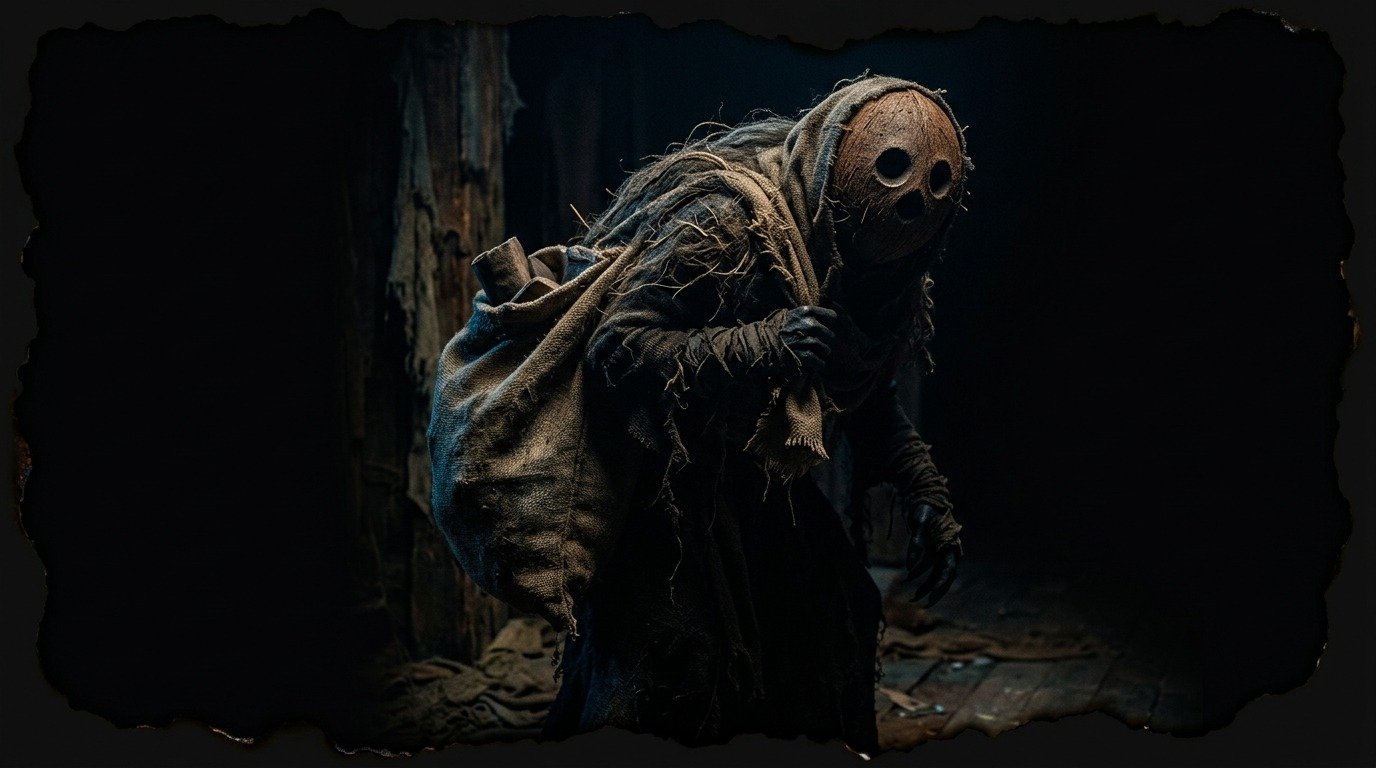
El Coco: The Devourer of Childhood and the Faceless Shadow of Primal Fear
Genealogy and Philological Evolution
El Coco (or Cuco) is perhaps the oldest, most widespread, and most persistent spectral entity in the Spanish- and Portuguese-speaking cultural sphere. Its origins date back to pre-Roman Iberia, linked to the Celtic term *gog* or *gogor*, meaning "heaviness" or "mask". The first documented written mention appears in the *Auto de la Sibila Casandra* (1513) by Gil Vicente, where it is described as a terrifying figure used to scare infants. During the Age of Discovery, Portuguese sailors under Vasco da Gama, upon reaching India in 1498, called the fruit of the coconut tree *"coco"* because its brown shell, with its three characteristic holes, resembled a grimacing head or skull, a classic representation of this being. El Coco is not a monster with a defined zoological form; it is the very personification of darkness and anthropomorphic emptiness.
Manifestation and Psychology of the Shadow
Unlike other creatures that possess claws, fangs, or wings, El Coco's strength lies in its physical indeterminacy. It is a dense shadow, a presence that slips into the corners of children's bedrooms, under beds, or inside ajar closets. It feeds directly on the elemental fear of the dark (*nyctophobia*) and the vulnerability of childhood. In traditional Spanish and Hispanic-American lullabies (such as the famous *"Go to sleep, child, go to sleep now, for El Coco is coming and will eat you"*), an anthropological paradox becomes evident: parents themselves invoke the entity to impose moral and behavioral order through psychological terror. El Coco is the executor of discipline operating on the threshold of sleep, the moment when the barrier of conscious control dissolves.
Regional Variants and Syncretism
The myth of El Coco branched out and adapted to every corner of the Spanish Empire, acquiring local nuances of terrifying specificity: - **El Hombre del Saco / El Ropavejero:** In Spain and the Southern Cone, El Coco is humanized in the form of a wandering, dirty, wild-eyed old man who carries a burlap sack where he puts disobedient children to melt them down for fat or take them to unknown places. - **El Cucuy:** In northern Mexico and the American Southwest, it is conceived as a creature with glowing red eyes and sharp claws, associated with dry riverbeds and dark alleys. - **El Cuco Caribeño:** In the West Indies, it is often described as a hairy, shapeless being that hides on rooftops, waiting for a child's cry to descend and snatch them away.
Esoteric Treatment and Traditional Defenses
In defensive home esotericism, El Coco is classified as a low-ranking astral parasite or a *larva* that feeds on the cortisol and auric energy of frightened children. To purge a space of this vibration, tradition advises: 1. **Breaking the Decree:** Immediately cease the use of threatening lullabies. Verbal invocation, even of a playful or corrective nature, opens channels of manifestation for these parasitic energies. 2. **Salt and Vinegar:** Place a container with water, coarse salt, and white vinegar under the infant's bed to absorb the miasmas of nighttime fear. 3. **The Seal of Light:** Draw a protective pentagram or a runic scarecrow with consecrated oil on the inside of closet doors and under the mattress. 4. **Creative Confrontation:** Teach the child to name the shadow and give it a ridiculous shape. By stripping El Coco of its shapeless mystery through laughter or comical artistic representation, the entity immediately loses its source of energetic sustenance and dissipates.
Comments
Share information, an experience, or a source to help enrich this entry. They are automatically reviewed before being published.
Loading comments...