El Silbón
El Silbón: The Herald of the Infinite Plain
The Foundational Parricide
In the vastness of Los Llanos, a Colombian-Venezuelan region characterized by infinite horizons, river floods, and inclement droughts, wanders El Silbón. Unlike other spirits whose origins are lost in the mists of pre-Hispanic times, El Silbón has a markedly tragic genesis, linked to the transgression of the most sacred taboo of the family structure: parricide.
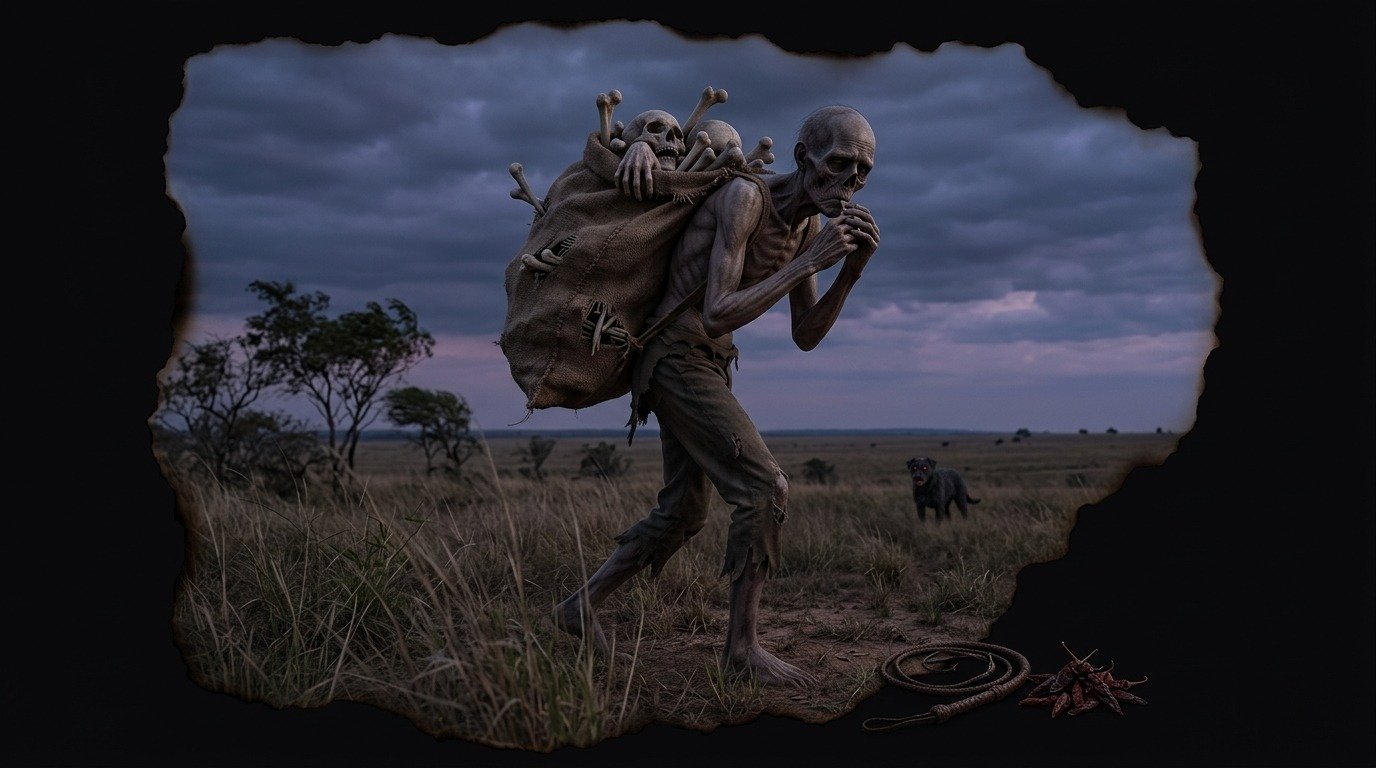
Oral chronicle places the origin of the entity in a spoiled and hot-tempered young man from the plains. Upon demanding that his father hunt a deer to satisfy his cravings for organ meats, and with the latter returning empty-handed, the son, in a fit of satanic rage, murdered his progenitor and extracted his organs for his mother to cook. Upon discovering the origin of the meat, the family imposed a punishment of cosmic proportions. The grandfather ordered the young man to be tied to a post, whipped with a leather lash, his wounds rubbed with hot chili pepper, and finally, untied so that he would be eternally pursued by *Tureco*, a rabid and ghostly dog. Following the family curse, the young man transformed into a lost soul of disproportionate dimensions (a skeletal figure more than six meters (19.6 feet) tall) who carries on his back a canvas sack with the clean bones of his father and of those victims he encounters in his wandering.
The Acoustic Paradox and the Omen of Death
The main manifestation of El Silbón is his whistle, a tonal sequence that emulates the musical scale (*do, re, mi, fa, sol, la, si*), executed in a slow and mournful manner. The physics of this entity defies human sensory logic through a fatal acoustic inversion:
* If the whistle is heard **near**, there is no imminent danger; El Silbón is far away and his attention is scattered. * If the whistle is heard **far away**, the entity is just a few centimeters (a few inches) from the observer, stalking in the immediate gloom.
Hearing the distant whistle is an almost mathematical death sentence. El Silbón primarily seeks out two types of men: drunkards, whose belly buttons he sucks to extract the alcohol they consumed, and womanizers, whom he dismembers to add their bones to the canvas sack he carries on his back.
Esoteric Symbology of the Plain
El Silbón represents unredeemed guilt and the dead weight of the family past. The sack of bones is an inverted alchemical symbol: instead of the transmutation of matter, it is the stagnation of physical death, the impossibility of the earth absorbing the waste of parricide. The entity's gigantism reflects the overwhelming vastness of the plains; in a landscape devoid of mountains or visual boundaries, terror takes the form of a monstrous verticality that walks over the treetops of the pasito and creek trees.
Protocols of Defense and Preservation
Popular memory has preserved the exact elements that stop El Silbón, all of them linked to the traumas of his original punishment. If the presence of the entity is suspected in the vicinity of a home (he frequently sits on the porch to count the bones in his sack; if no one hears him, a member of the household dies at dawn), the following resources must be employed:
1. **The Dog:** The presence of a dog, especially one with dark fur or a mutt, immediately scares away El Silbón, who relives the panic of being pursued by the canine of the family curse. 2. **The Whip or Mandador:** The crack of a leather whip recalls the grandfather's lashings. 3. **The Hot Chili Pepper:** Having ground chili or chili pepper plants near the threshold of the door prevents the entity from crossing, as he fears the mystical burning of his open wounds.
Comments
Share information, an experience, or a source to help enrich this entry. They are automatically reviewed before being published.
Loading comments...