El Familiar
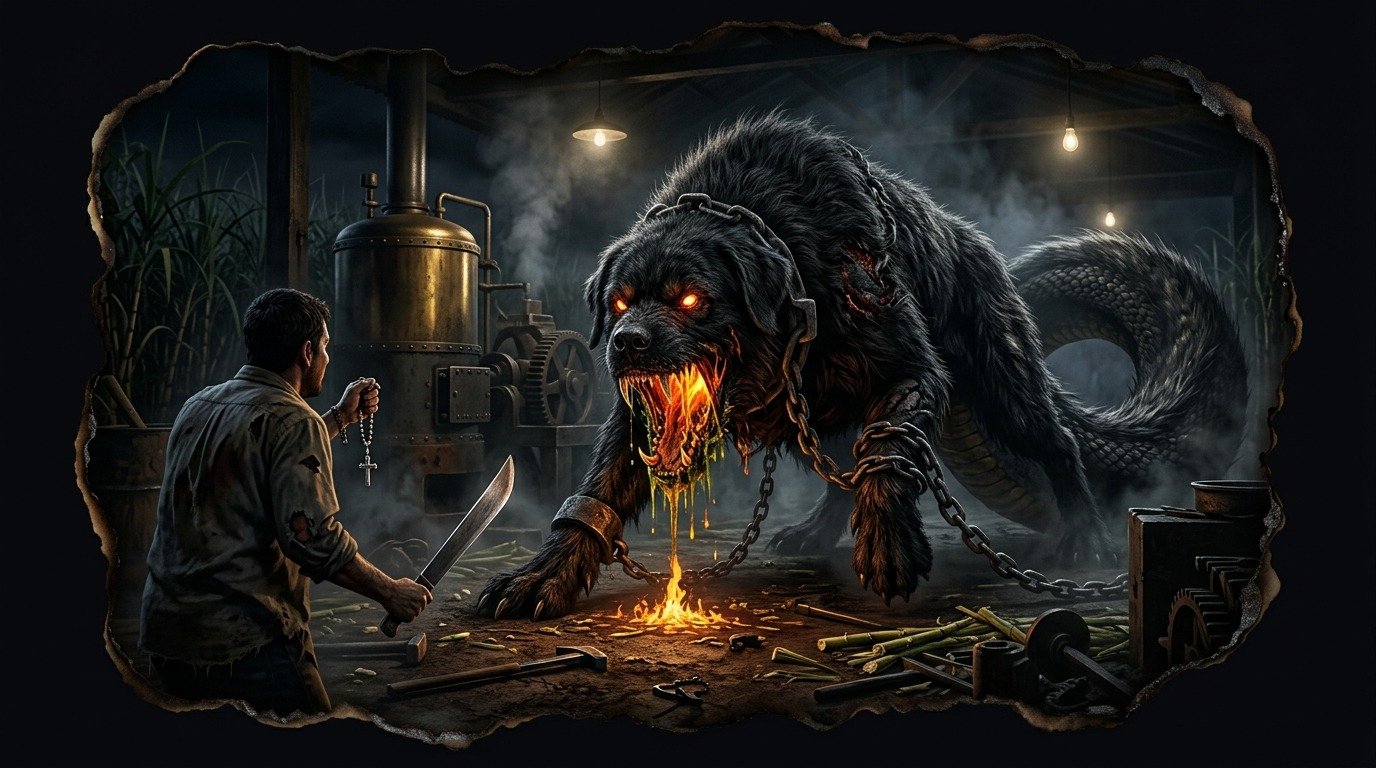
El Familiar: The Blood Pact of the Sugar Mills
The Historical and Industrial Context of the Argentine Northwest
Unlike the specters that inhabit untouched nature, El Familiar is a monster born from industrial modernization, labor exploitation, and agrarian capitalism of the late 19th and early 20th centuries in the Argentine Northwest (provinces of Tucumán, Salta, and Jujuy). Its primary setting is the *sugar mills*, immense sugarcane processing factories that operated under a regime of semi-slavery over indigenous populations (Tobas, Wichís) and impoverished criollos. The myth documents a brutal historical reality: the owners of the sugar mills (the *patrones*) made an explicit pact with the Devil—who in this region takes the name of "El Familiar"—to guarantee the prosperity of the sugarcane harvest, prevent strikes, and ensure that the machinery did not break down. In exchange for this excessive wealth, the devil demanded an annual blood quota: the life of one or more mill workers.
Anatomy and Behavior of the Beast
El Familiar manifests in various forms, adapting to the industrial geography of the sugar mill: * **El Perro Familiar:** The most common manifestation. A black dog of colossal size, with thick fur and eyes like burning coals, dragging a heavy iron chain whose dull clanking echoes through the cane fields at night. It has no head, or if it does, its jaws drip acidic drool and fire. * **El Viborón:** A colossal hairy snake that dwells in the factory's boilers or in the basements of the patron's mansion. This variant devours the workers who are sent to perform "cleanings" or maintenance tasks in isolated areas from which they never return. The *patrones* set aside special rooms in their mansions or in the heart of the factory to feed El Familiar with human flesh. "Rebellious" workers—those who attempted to unionize, demanded better wages, or were simply inconvenient for the administration—were assigned to solitary night shifts in the tool sheds or boiler rooms, thus facilitating their disappearance and subsequent consumption by the entity.
Political, Esoteric, and Social Significance
El Familiar is one of the most perfect mythological representations of alienation and bloody surplus value. It represents the dehumanization of the worker, whose physical life is literally devoured by the gears of capital. The *patrón* is no longer just an economic exploiter, but an esoteric intermediary of evil who uses dark forces to discipline the working class. The forced disappearance of people finds a mythical explanation in El Familiar which, far from being a simple fantasy, covertly denounces the crimes of the Argentine landowning oligarchy.
Survival Protocols in the Cane Field
For the cane peons, night work required rigorous spiritual preparation to avoid falling prey to the black dog. Traditional protective amulets included: 1. **The Cross of Saint Anthony or Caravaca:** Hung around the neck or fastened to the belt. 2. **The wooden Rosary:** Wrapped around the dominant hand to strike the beast. 3. **The Silver Dagger:** The only physical weapon capable of wounding El Familiar. If the worker managed to slash the beast with a blessed or pure silver weapon, El Familiar would retreat, as the pact forbade the Devil from taking the lives of those who were actively protected by the ecclesiastical sacraments. However, wounding El Familiar sealed the worker's fate on the physical plane: they were usually fired the next day or died in strange work accidents orchestrated by the foremen.
Comments
Share information, an experience, or a source to help enrich this entry. They are automatically reviewed before being published.
Loading comments...