El Trauco
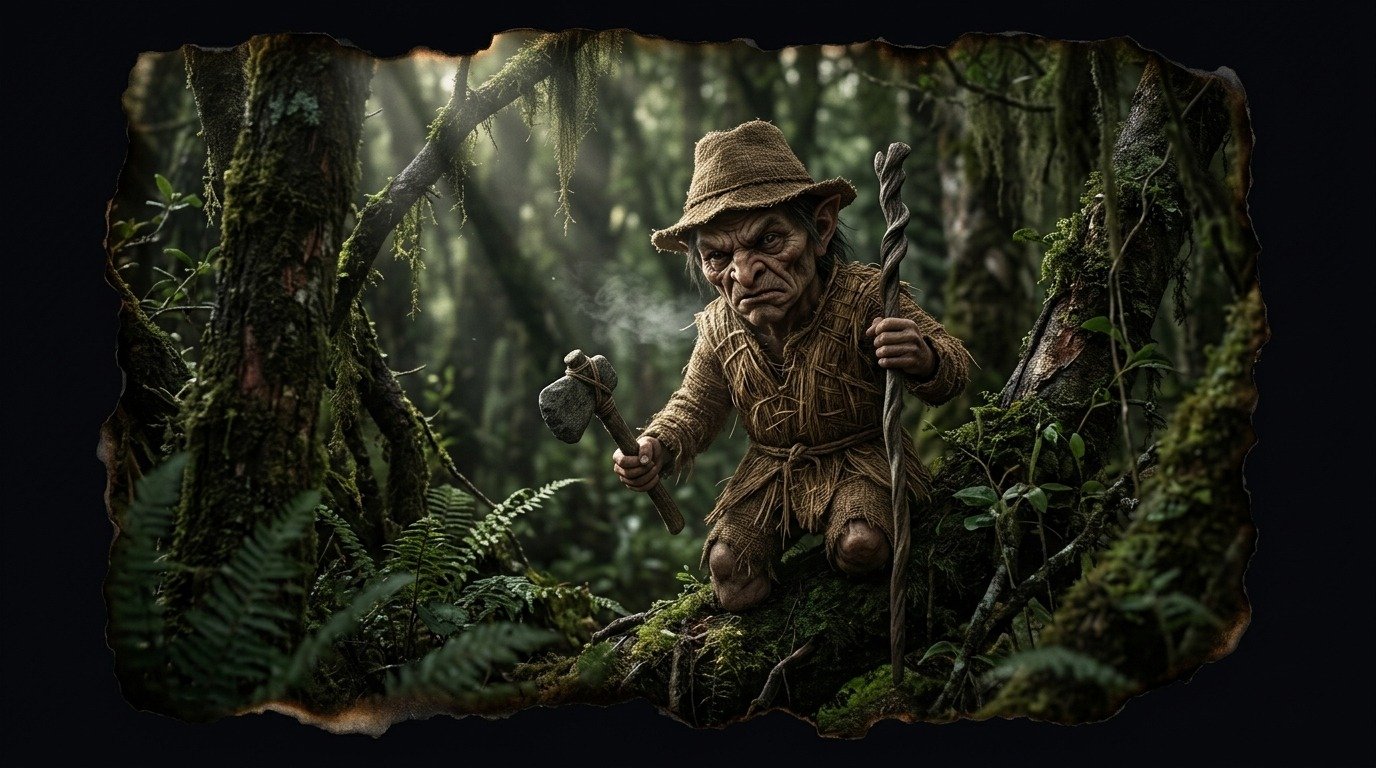
El Trauco: Wild Lust and the Breath of the Thicket
Origin and Identity on the Edge of the Cold Rainforest
In the humid depths of the Chiloé Archipelago, in southern Chile, dwells one of the most complex and feared entities of southern folklore: the Trauco. Far from being a simple goblin of comparative mythology, this creature is a chthonic numen, a spirit of the temperate rainforest (the Valdivian forest) whose roots lie deep in the syncretism between Huilliche beliefs and the superstitious tradition of the Spanish colonizers. The Trauco is described as a being of short stature—not exceeding eighty or ninety centimeters (31 or 35 inches)—with contorted, angular features and a terrifying ugliness. He lacks feet; instead, his lower limbs end in shapeless stumps, giving him a faltering but strangely rapid gait. He wears a rustic suit woven from *quilineja* (a strong, fibrous local climbing plant) and a hat made of the same material known as a *pahueldún*. In his hands, he carries a stone axe (*pahuel*) with which he fells trees with a single blow to demonstrate his immense telluric strength, or a twisted staff (*coligüe*) that he uses to support himself and project his influence.
Dynamics of Being Targeted and Shadow Magnetism
The power of the Trauco does not lie in direct physical violence, but in an implacable and magnetic sovereignty over the will. He is an archetypal sexual predator. He dwells in the foliage, watching young women who venture into the forest from the treetops (*coigües* and *tineos*). Oral tradition warns that his gaze possesses a devastating hypnotic power: if the Trauco sets his eyes upon a woman before she perceives him, the victim falls into a mystical slumber, a state of absolute vulnerability where her will is neutralized. The Trauco's breath is another of his weapons; a subtle breath that travels with the forest wind, capable of inducing erotic dreams and an obsessive, irresistible attraction toward his lanky figure. The encounter inexorably culminates in carnal consummation on a plane of trance. Those who have been touched by his influence return home plunged into a deep melancholy, unable to remember the details of the encounter, but carrying the seed of the forest in their wombs.
Sociological Function and Psychological Exegesis
From an anthropological and sociological perspective, the myth of the Trauco has historically operated as a mechanism of social control and rationalization in the closed and ultra-conservative colonial and nineteenth-century communities of Chiloé. The "pregnancy by the Trauco" functioned as an acceptable and institutionalized explanation to conceal the stigma of incest, intra-familial sexual abuse, or premarital relations in a rigidly Catholic society. By attributing the conception to an inevitable and supernatural force of the forest, the honor of the young woman and her family was partially safeguarded, shifting the moral blame to the territory of the untamed. On the level of depth psychology, the Trauco personifies the shadow of wild nature: the intrusion of uncontrolled libido and the most primitive reproductive impulses that threaten the civilized and structured order of the Chilote home.
Comments
Share information, an experience, or a source to help enrich this entry. They are automatically reviewed before being published.
Loading comments...