La Ciguapa
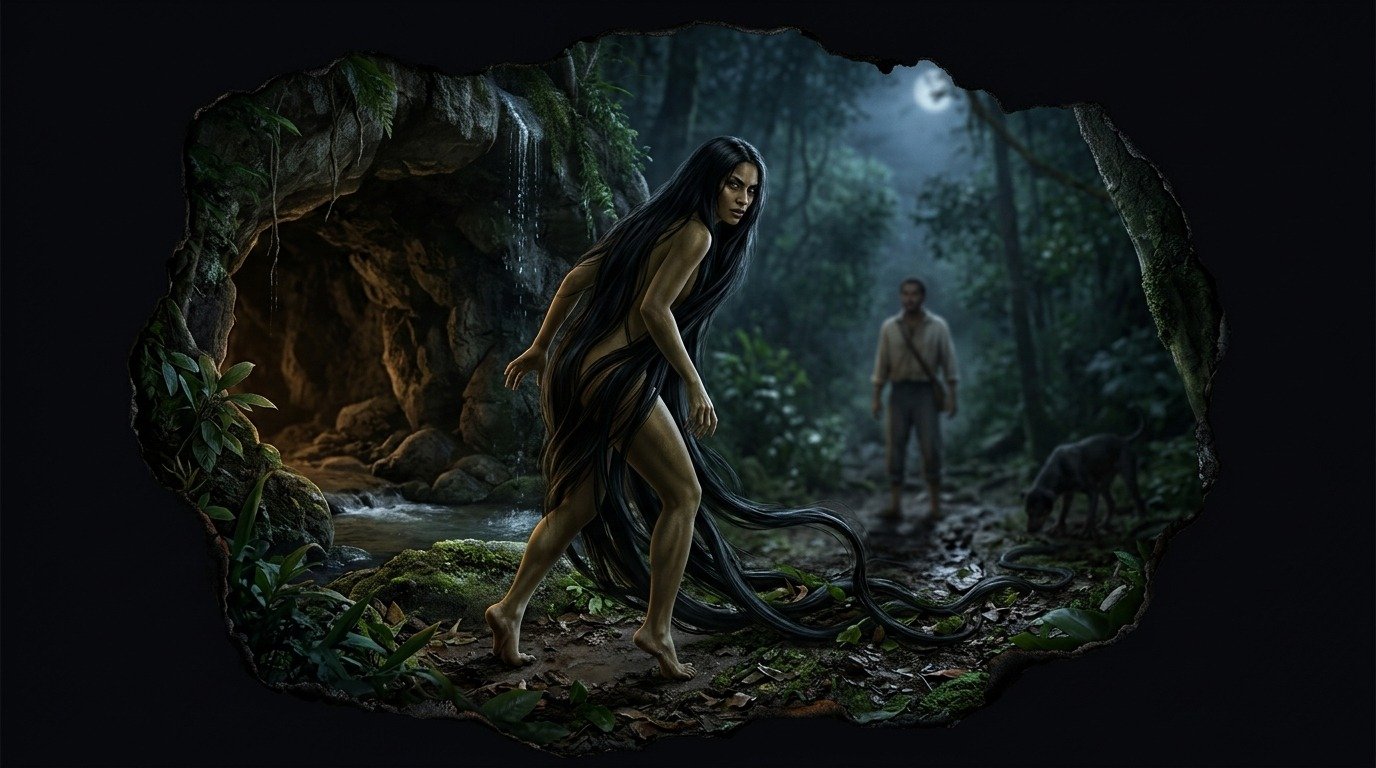
La Ciguapa: The Shadow of the Inverted Feet of Hispaniola
Origin and Mythological Roots
In the geographical heart of the island of Hispaniola, especially in the mountainous areas of the Cordillera Central of the Dominican Republic, dwells the myth of La Ciguapa. Although the term "ciguapa" lacks a clear etymology in the documented Taíno lexicon, various anthropologists and historians, such as Bernardo Vega, suggest that the creature is a complex syncretism. It combines the aboriginal cosmogony of forest spirits (such as the *operitos*, the navelless dead who wandered at night) with African legends of the *asamanukpai* (West African forest spirits with inverted feet) and European myths of mermaids and undines. La Ciguapa is described as an entity of humanoid and female appearance, characterized by sallow or coppery skin, a lustrous black mane of hair so long that it serves as her only clothing, and the most disturbing anatomical peculiarity: her feet are oriented backward, with the heels pointing forward.
Esotericism of the Inverted Footprint
The anatomical inversion of the lower limbs is not a random occurrence in universal folklore; it manifests in entities such as the Amazonian Curupira, the Andean Chullachaqui, and the Patasola. From an esoteric and depth psychology perspective, the inverted footprint represents the dissolution of the natural order, absolute deception, and the distortion of space-time. Anyone who attempts to follow the trail of a Ciguapa irremediably moves away from her, while anyone who flees from her footprints walks directly toward her lair. Symbolically, she embodies the wild and untamed nature that rejects colonial domestication and the linear logic of the conqueror. She is the guardian of the pre-Columbian, a telluric force that dwells in caves and freshwater streams, places that in Taíno mythology functioned as portals to *Coaybay*, the underworld of the deceased.
Physiology, Behavior, and Seduction
La Ciguapa does not possess articulate language. She communicates through a mournful, high-pitched, and unsettling wail known locally as a "hipido," similar to the screech of a nocturnal bird or the cry of a newborn. They are beings of strictly nocturnal habits who avoid contact with civilization, descending from the peaks only to forage for food (wild fruits, birds, or fish) or to seduce solitary men. The magnetism of La Ciguapa is hypnotic in nature. Those men who venture into the deep forests and lock eyes with her fall into a state of stupor and fascination that strips them of their will. They are led into the depths of caves or rivers where, after consummating the carnal act, the men die of starvation, madness, or drowning, trapped in the loop of mystical obsession.
Warnings and Containment Protocols
Dominican peasant tradition warns that the only way to track, capture, or ward off a Ciguapa is through the use of a "binga" or "cinco garras" (five-clawed) dog (a canine suffering from polydactyly, presenting a sixth toe on its hind paws). Only these animals, free from the entity's visual spell, possess the sharp sense necessary to decipher the paradox of her footprints. Attempting to domesticate a captured Ciguapa is strongly discouraged; oral folklore records unanimously assert that the creature, when deprived of the freedom of the forest and the flow of free waters, dies of a deep melancholy within a matter of days, leaving behind a body that rapidly decays into the smell of decomposing vegetation.
Comments
Share information, an experience, or a source to help enrich this entry. They are automatically reviewed before being published.
Loading comments...