Beleth
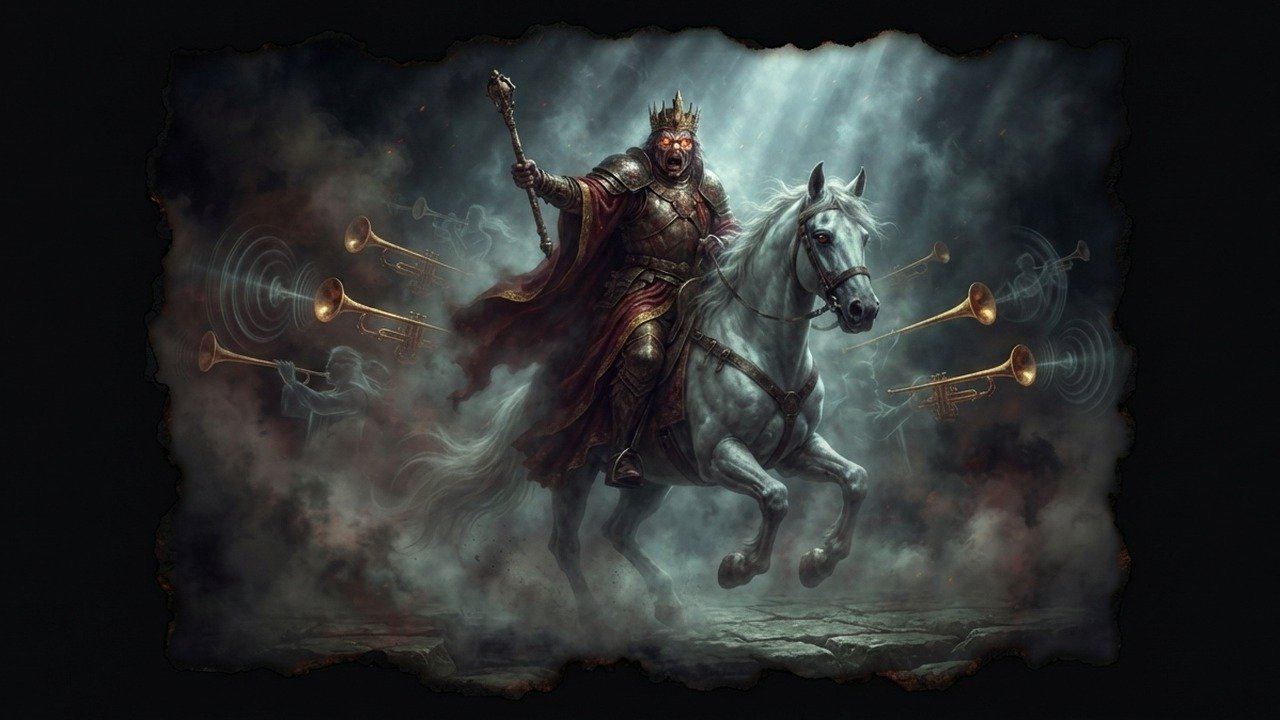
The Legacy of Beleth: The King of the Dread Flame and the Geometry of Command
The Shadow of the Great Monarch: His True Origins To trace the true origins of Beleth, it is necessary to strip the myth of the chains of inquisitorial fear and travel to the cradle of the Mesopotamian and Levantine kingdoms, where imperial power was not separated from the cosmic order. Beleth was not born as a monster of the medieval abyss; his essence comes from the ancient genii and archetypal deities of absolute command, terrible majesty, and the fire of the throne.
In the Sumerian, Akkadian, and Canaanite worldviews, royal sovereignty was not a simple civil administration, but an intimidating theurgic force. Kings did not only rule by divine mandate, but they embodied the fearsome radiation of power—what in Akkadian was known as Melammu, an awe-inspiring aura or glow that instilled reverence, paralysis, and instant submission in enemies. Beleth is the spiritual personification of that royal glow: the force that instills fascination, unwavering respect, and passionate submission in those who enter his radius of influence.
With the hegemony of Abrahamic monotheism, the figures of sacred pagan royalty and the genii who granted dominion over the will of others were rewritten. The majesty that subdued the masses was classified as demonic tyranny, and the power to instill love or terror by royal decree was chained within the hierarchies of hell as a furious and terrifying king.
The Protocol of the Crown: Beleth in the Ars Goetia The passage of centuries consolidated Beleth as one of the most imposing and complex entities of classical grimoiric tradition. In the Lemegeton: Clavicula Salomonis and in Johann Weyer's Pseudomonarchia Daemonum, Beleth occupies the thirteenth place, holding the rank of Great King and commanding eighty legions of lesser spirits.
Esoteric literature is emphatic about the way this King presents himself to the operator: he arrives riding a pale horse, preceded by the dull thunder of cornets, trumpets, and all kinds of martial music. His arrival is neither silent nor discreet; it is a triumphant entry designed to test the mettle, courage, and temperance of the magician.
Ancient grimoires sternly warn that Beleth appears furious and wrathful at first, demanding recognition of his royal status. Medieval manuals prescribed that the practitioner hold a hazel wand in their hand, draw protective circles, and use silver rings on the middle finger to shield their breath from his scorching breath. However, behind the threat and the military apparatus, the texts reveal his primary attribute: Beleth has the power to grant all the love and devotion that the magician desires, from both men and women, until the operator's will is completely satisfied.
Esoteric Significance: The Psychology of Domination and the Fire of Majesty
In High Magic and contemporary esoteric analysis, Beleth represents much more than a spirit to bend the affections of others. He is the embodiment of the Earthly Solar Fire and the archetype of Psychological Sovereignty.
In the system of the Dark Kabbalah, Beleth has a strong resonance with the Qliphothic sphere of Golachab (The Burners), the counterpart of Geburah (Strength and Judgment). While Geburah represents righteous severity, Golachab is the relentless fire, the willpower devoid of hesitation that imposes itself over chaos. Beleth governs the transmutation of weakness into authority, the art of commanding without hesitation, and the ability to project a magnetic presence before which weak wills bend.
From the perspective of depth psychology, Beleth symbolizes the Archetype of the Inner King/Tyrant and mastery over the fear of confrontation. The vision of the furious King entering with trumpets is nothing more than the test of the guardian of the threshold: the mind of the individual must be capable of holding the gaze of absolute power without cowering or falling into tyranny. Beleth's ability to awaken love and submission lies in the law of attraction of royal authority: the human psyche instinctively tends to surrender to and love that which it perceives as unwavering, focused, and sovereign.
Practice and Manifestation: The Force of Presence in Reality
Beleth's energy is not the convulsive or chaotic passion of lesser demons; his signature in reality is heavy, regal, fiery, and rigorously structured. When his current manifests in the individual or in a space, the environment becomes dense and tense, like the atmosphere preceding a trial or a great battle.
In everyday reality, the force of Beleth acts by transforming the body posture, tone of voice, and magnetic field of the individual. Under his influence, doubt disappears and is replaced by a cold, regal certainty. People around perceive a natural authority that requires neither shouting nor violence; it is the weight of presence that generates respect, fascination, and the alignment of others' wills with that of the practitioner.
Physiologically, his manifestation is felt as a pressure in the center of the chest (the Anahata chakra in its fire aspect or the solar plexus), an expansion of the spine, and a sensation of constant heat arising from the core of the will.
Protection, Sovereignty, and the Protocol of Respect Approaching Beleth from a place of supplication, cowardice, or childish arrogance is a recipe for mental disaster. Beleth is a King and only responds to the true royalty of the spirit. Whoever kneels before him in fear is trampled by his mount; whoever treats him with disrespect is consumed by his fury.
The practitioner who seeks to integrate Beleth's energy must operate under the principle of Mutual Sovereignty:
First, the operator must have previously conquered dominion over their own inner kingdom (their emotions, their vices, and their fears). One cannot invoke the strength of the King if one is a slave to one's own impulses.
Second, the approach to Beleth demands ceremonial, composure, and a firm sense of dignity. The traditional "protection"—represented in ancient texts by the wand or the ring—is in reality the firmness of one's own will (Thelema). The true safeguard against Beleth's fury is not to blink, not to doubt one's own authority, and to receive him as a legitimate monarch receives another allied King.
If the energy of this entity becomes overwhelming, manifesting as excessive pride, megalomania, or control paranoia, correction requires cultivating conscious humility and the fluidity of the Water element. The instructed magician does not seek to tyrannize the world with the fire of Beleth, but to use the majesty of this great King to govern their own destiny with justice, poise, and invincible majesty.
Comments
Share information, an experience, or a source to help enrich this entry. They are automatically reviewed before being published.
Loading comments...