Popobawa
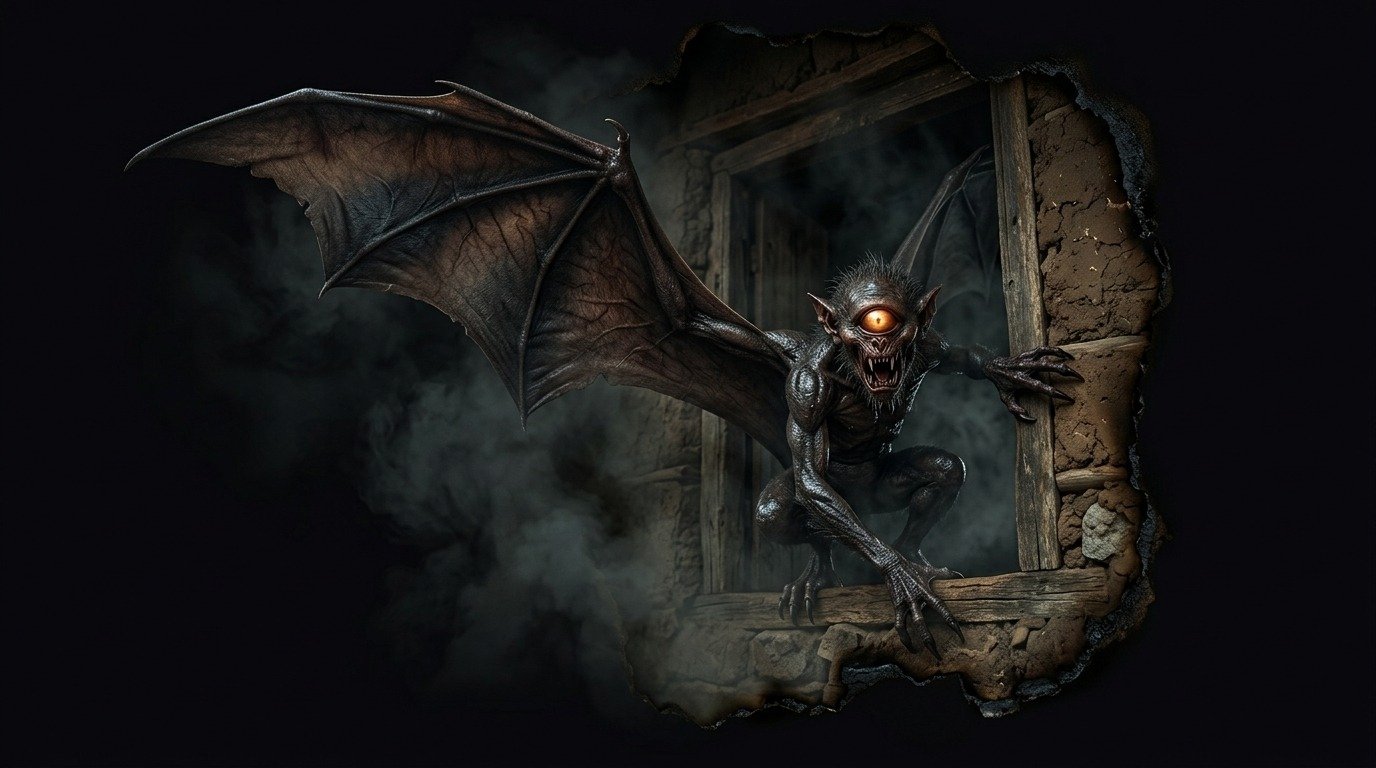
Popobawa: The Winged Shadow and the Terror of Pemba
Origin and Genesis of the Swahili Terror
The Popobawa is one of the most insidious and documented demonic entities of the modern era in the Zanzibar archipelago, particularly on the island of Pemba (Tanzania). Its name, which in Swahili literally translates to "bat wing," designates an evil spirit of a shifting nature (*shetani*) that transcends traditional animist folklore to intertwine with the political and social history of the region. Although the roots of the *shetani* date back to beliefs prior to the Islamization of the East African coast, the specific manifestation of the Popobawa was systematically recorded for the first time in 1964, coinciding with the violent Zanzibar revolution. Since then, its presence has resurfaced cyclically in waves of collective panic, notably in 1995, 2000, and 2007, periods marked by acute political tension and turbulent electoral processes.
Physiology and Metamorphosis of the Shadow
The entity is described as a being of grotesque and chimeric physiognomy. In its astral or primary form, it manifests as a dwarf, one-eyed creature (a trait that evokes the cyclopes of classical tradition), equipped with membranous wings similar to those of a giant bat, sharp claws, and a disproportionate virile member. However, the Popobawa is an exquisite shapeshifter. It can adopt the appearance of ordinary human beings or domestic animals (cats, dogs, or goats) whose only anomaly is a dense and fetid smell of sulfur that permeates the air before its attack. Its transition from physical to vaporous form allows it to pass through walls, ceilings, and ventilation slits, invalidating any physical barrier that its victims attempt to interpose.
The Dynamics of Silence and Collective Hysteria
Unlike other parasitic entities of the night, the Popobawa does not solely seek the extraction of vital energy or blood, but rather the psychic and intimate degradation of its victims. Its attacks are perpetrated in the darkness of homes, directed against men, women, and children alike. The entity immobilizes its prey through forced paralysis, exerting suffocating pressure on the chest (a phenomenon identical to that of classical *incubation* or sleep paralysis) to then subject them to brutal sexual assaults. The signature of this entity lies in its sociological imperative: the Popobawa explicitly demands that its victims publicly recount the assault. If the victim remains silent out of shame or skepticism, the demon returns night after night with increased violence. This mechanism turns the myth into a viral transmission vector of panic, where public testimony acts as a personal exorcism but propagates collective hysteria throughout the community.
Defense Protocols and Community Cohesion
Modern anthropology and forensic psychiatry classify the waves of the Popobawa as episodes of mass hysteria linked to collective post-traumatic stress and political repression. However, for the inhabitants of Pemba, the threat requires immediate pragmatic and spiritual measures. During peak sightings, the family structure is completely altered: men and entire families abandon the interior of their homes to spend the night in the open air, grouped around large community bonfires, since the entity prefers to attack isolated individuals in the privacy of their bedrooms. On the esoteric level, defense is articulated through traditional Islamic and Swahili medicine. Protection prayers (*ruqyah*), the constant recitation of verses from the Quran (particularly the *Ayat al-Kursi*), and the burning of purifying resins are used to dissipate the sulfuric stench that heralds the approach of the winged shadow.
Other Chronicles of the Zanzibar Terror
Other records place its first documented appearance in 1965, on the island of Pemba, coinciding with a period of extreme political tension, social violence, and collective trauma following the socialist revolution of Zanzibar. There, the entity is described as a short humanoid, with dark or olive skin, equipped with a single, huge eye socket in the center of its face, sharp claws, and membranous wings similar to those of a giant bat; a shapeshifter (*mabadiliko*) capable of assuming the appearance of ordinary people, domestic animals, or dense vapors that seep through the cracks of homes during the night. The *Popobawa* operates under a behavioral pattern that directly links it to the incubi of European demonological tradition, although with cultural nuances specific to East Africa. The same chronicles record outbreaks of collective hysteria medically documented in 1970, 1995, and 2007, periods during which a large part of the population of Stone Town and outlying villages chose to spend the night outdoors, grouping around community bonfires to avoid being surprised in the solitude of their bedrooms.
Psychosocial Reading and Esotericism of Fear
From an anthropological and psychiatric approach, the *Popobawa* is a paradigmatic case of the materialization of political and social trauma through the folklore of the *jinn* (spirits of the Islamic tradition, dominant on the Swahili coast). State repression, post-revolution physical abuse, and the helplessness of the civil population found a symbolic channeler in this figure. The requirement to "speak publicly about the abuse" is a raw metaphor for the need for catharsis and denunciation in the face of systematic violence that civil society was forced to keep silent. On the esoteric level, the *Popobawa* represents the collective shadow in its facet as a violator of intimacy. It is the transgression of the boundaries of the home, the sacred space where the human being is most vulnerable. Its single central eye evokes the watchful eye of the oppressor, a panoptic gaze that strips the individual of their secrets and dignity, reminding us that fear, when it is not named or shared, consumes the soul from within.
Comments
Share information, an experience, or a source to help enrich this entry. They are automatically reviewed before being published.
Loading comments...