Ghul of the Arabian Desert
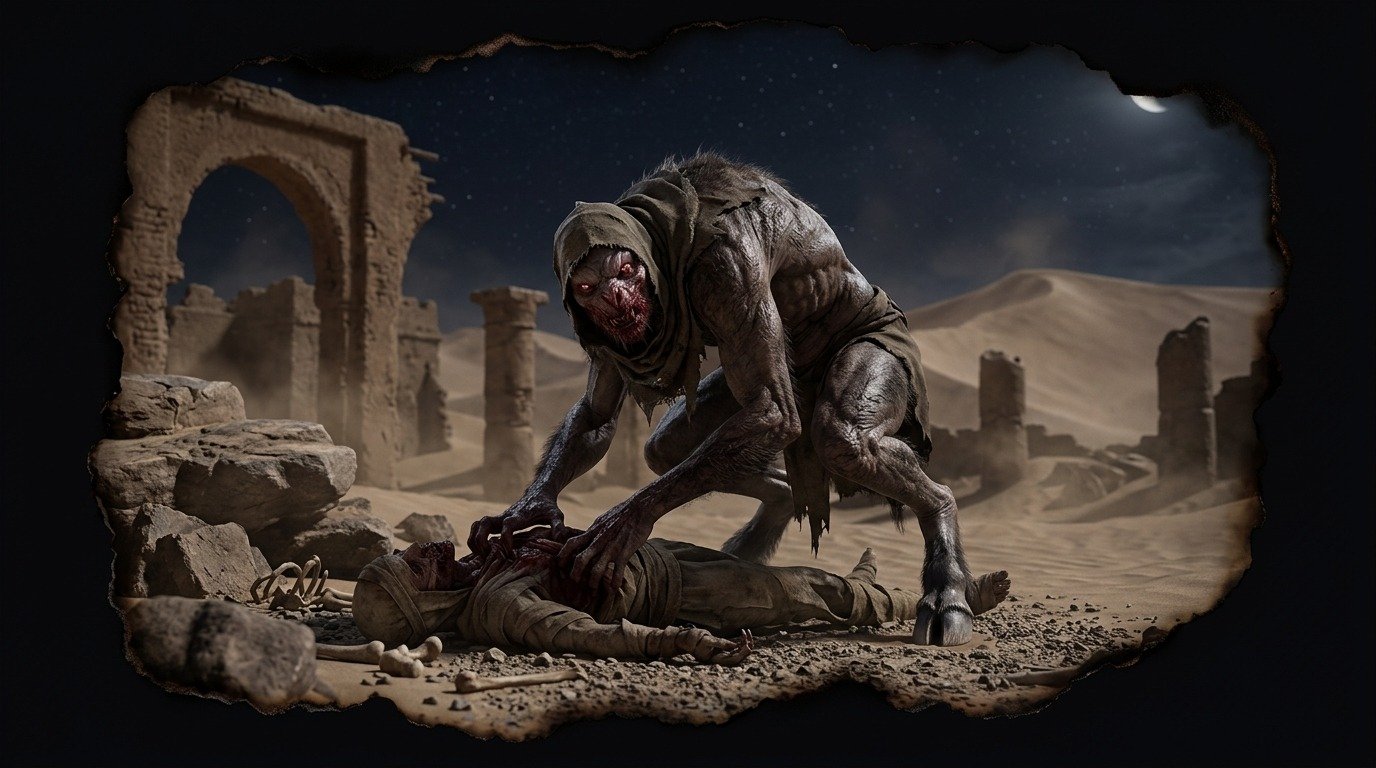
Ghul: The Carrion Devourer of the Wastelands
Pre-Islamic Origins and Roots
Long before the term "ghoul" was assimilated and diluted by European Gothic folklore and contemporary fiction (reducing it to a mere necrophagous zombie), the *Ghul* (plural *Ghilán*) was one of the most feared and respected entities of pre-Islamic Arabia. Its origin is deeply rooted in the oral tradition of the Bedouin tribes of the desert (*Badiyat ash-Sham* and the *Rub al-Khali*), where the desert was not just a geographical space, but a spiritual abyss populated by hostile and hungry forces. Etymologically, the word derives from the Arabic root *ghala* (غَال), which means "to seize," "to destroy," or "to ravage with violence." In the cosmology of the ancient Arabs, the ghilán were considered a monstrous subclass of the *djinn*, born of smokeless fire but fallen to a purely physical and degraded existence. The oldest written record of these creatures is found in pre-Islamic poetry (*Jahiliyyah*), where poets like Ta'abbata Sharran described physical encounters with these beasts in the darkest canyons of the desert, depicting them as personifications of sudden death and disastrous straying.
Nature, Physiology, and Transformation
Unlike incorporeal spirits, the Ghul possesses a dense, though highly mutable, corporality. Its primary habitat consists of abandoned cemeteries, the ruins of destroyed caravans, recent battlefields, and the depths of desert caves. They feed on exhumed human corpses, but their preference is the fresh flesh of the living, especially solitary travelers, lost children, and lagging pilgrims. The Ghul's most dangerous ability is the transmutation of its form (*tashakkul*). It frequently adopts the appearance of a helpless traveler, a defenseless woman of melancholy beauty, or even a domestic animal to lead explorers away from the safe caravan routes and guide them into the depths of the dunes, where disorientation and thirst facilitate their capture. However, as with other entities of its lineage, its transformation is always imperfect: the creature is unable to hide its feet, which retain the shape of cloven donkey hooves, or its eyes, which glow with a reddish, feline luminescence in total darkness. Bedouin tradition preserves a precise physical protocol for confronting a Ghul. It is believed that these beasts can be killed through physical force, but under an unbreakable hermetic condition: they must be dealt a single, mortal blow. If the Ghul falls mortally wounded and begs for mercy or for a second blow to end its agony, the warrior must never grant it; a second impact reactivates the creature's vital energy, healing it instantly and granting it twice the physical strength to devour its attacker.
Historical Evolution and Demonization
With the arrival of Islam in the 7th century, the Ghul was formally integrated into Quranic theology and demonology. They were definitively classified as emissaries or allies of *Iblis* (Satan), operating under the status of earthly *Shayatin* (demons). Prophet Muhammad himself refers to them in various *hadiths*, instructing his followers on how to protect themselves from their deceptions during night travels by reciting the *Adhan* (the call to prayer) and reading protective verses such as the *Ayat al-Kursi* (the Throne Verse), which disperse the optical illusion (*al-ghul*) created by the creature. In medieval literature, especially starting with the compilation of *The One Thousand and One Nights*, the figure of the Ghul was codified in a more narrative manner. Both male and female (*ghulah*) specimens were described, the latter often depicted as atrocious succubi who lured young men to their tombs under the promise of pleasure, only to devour their viscera on the eve of dawn.
Esotericism of the Ghul
On the plane of inner alchemy and Islamic esotericism (*Tasawwuf*), the Ghul is not just a physical threat of the outer desert, but a pathology of the "inner desert" of the human being. It represents the *Nafs al-Ammara* (the soul that incites evil) in its most abject and uncontrolled state: the blind appetite that devours what is already dead and rotten (past attachments, spiritual vices, selfishness). It is the personification of moral entropy, the force that disintegrates consciousness and reduces the divine temple of the human body to a pile of bones and carrion ready to be consumed by base passions.
From the Arabian Ghul to the European Ghoul
The most radical transformation of the myth occurred outside the borders of the Middle East. In the 18th century, the French orientalist Antoine Galland translated the compilation of tales from *The One Thousand and One Nights* into French, introducing the Ghul into the European vocabulary as "ghoul." In the process, the creature lost part of its mystical and incorporeal nature to become a strictly physical monster: a pale, deformed grave robber that devours corpses in European cemeteries. However, in its original context, the Arabian Ghul possesses fearsome variants such as the *Si'lat*, a female variant endowed with superhuman cunning, capable of perfectly mimicking the voice and appearance of a helpless woman to guide stray travelers into the heart of the desert, where she finally devours their bodies and assimilates their memories.
The Guardian of Nothingness
From an esoteric and psychological perspective, the Ghul is the personification of the devouring desert, the void that consumes individuality. On the plane of spiritual alchemy, it represents the phase of *putrefactio* without the promise of resurrection; it is pure decomposition, the destructive force that prevents the soul from ascending by keeping it trapped in the lowest appetites of the flesh. It also represents the atavistic fear of being forgotten, of having our physical body, the temple of the spirit, stripped of its mortuary dignity and reduced to mere sustenance for chthonic forces. The Ghul is the guardian of nothingness, the reminder that matter devoid of divine breath quickly returns to the formless chaos of the earth.
Other Forms and Defenses
The Ghul manifests primarily in places of transition: abandoned ruins, forgotten cemeteries, dry wadis, and desert crossroads. Bedouin chronicles state that these entities often present themselves as hyenas, black dogs, or solitary travelers. Protection against the Ghul involves the recitation of sacred verses of preservation (such as the *Ayat al-Kursi*), the use of wrought iron, and sacred fire, which drives away the shadows where these entities weave their visual illusions.
Comments
Share information, an experience, or a source to help enrich this entry. They are automatically reviewed before being published.
Loading comments...