Eastern State Penitentiary
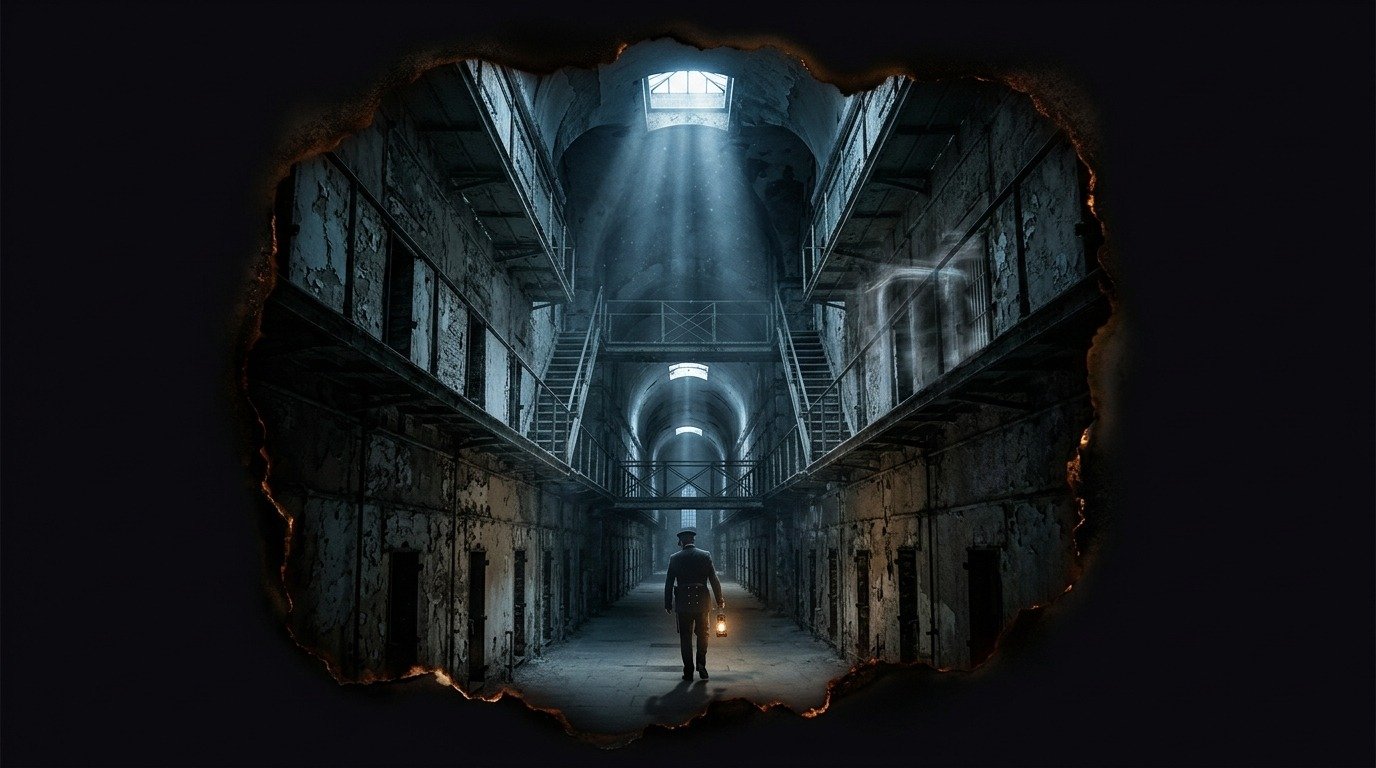
Eastern State Penitentiary: The Experiment of Absolute Silence
The Weight of the Hood
On October 25, 1829, a man named Charles Williams crossed the stone portal of Eastern State Penitentiary in Philadelphia. His head was covered by a heavy black canvas hood with two small holes at eye level that did not allow him to see beyond his own feet. Two guards escorted him in silence down a vaulted corridor to his cell. When the oak and iron door closed behind him, Williams found himself in a stone room with a single skylight in the high ceiling, designed so that he could only see the sky. He would not hear a human voice, see a face, or touch another person for the next two years. The experiment of total isolation had begun.
The Temple of Repentance
Eastern State was not designed to punish the body, but to reform the soul through psychological terror. The radial design of the prison, created by architect John Haviland, featured a central watchtower from which seven wings of individual cells radiated. The system became known as the "Pennsylvania System."
The premise was simple: absolute isolation would force the prisoner to face their own conscience and God. Inmates ate, worked on handlooms, and slept in their cells without any contact with the outside world. If they had to leave the room, the black hood was placed over their heads to prevent them from learning the layout of the building or communicating with others. The silence was so strict that guards wore felt socks over their boots to avoid making noise while patrolling. The system did not generate repentance; it triggered outbreaks of collective madness, suicides, and severe mental breakdowns that forced the abandonment of the isolation method in 1913.
The Laughter of Cellblock 12
The history of the prison tells that the concentrated suffering within its cells left an indelible mark on the stone. The most active hotspot of the legend is Cellblock 12. Guards who worked there during the final decades of the prison's operation, before its closure in 1971, swore that a hysterical, metallic laughter could be heard bouncing off the concrete walls in the middle of the night.
Another persistent legend involves the mobster Al Capone, who spent eight months in the prison in 1929. Inmates in adjacent cells claimed to hear him screaming in the dark, begging a specter named "Jimmy" to leave him alone. Historical records indicate that James Clark was one of the victims of the St. Valentine's Day Massacre, ordered by Capone months before entering prison.
Shadows in the Central Tower
Today, the penitentiary is a shell of preserved ruin. Visitors walking through the peeling corridors describe a dense, heavy atmosphere and a sudden cold that takes their breath away in the middle of summer. In Cellblock 4, tourists frequently report the appearance of a dark figure watching from the upper cells, vanishing when a flashlight is turned on.
Paranormal investigation teams have recorded disembodied voices whispering words of lament in the corners of the oldest cellblocks, and rhythmic thuds mimicking the tapping code that prisoners used on the pipes to communicate despite the punishment.
The Condemnation of History
The effectiveness and cruelty of Eastern State are widely documented. The British writer Charles Dickens visited the prison in 1842 and captured his horror in his travelogues, describing the system of isolation as a mental punishment immensely worse than any physical torture. Reports of madness among the prisoners accumulated for decades and ultimately brought down the Pennsylvania system.
The Marks on the Concrete
The gray cellblocks of Eastern State remain as a monument to the failure of the utopia of silence. On the walls of the empty cells, where sunlight enters through the overhead skylight, one can still see the scratches that prisoners made in the limestone in an attempt to keep track of time.
Comments
Share information, an experience, or a source to help enrich this entry. They are automatically reviewed before being published.
Loading comments...