Green Children of Woolpit
The Green Children of Woolpit: Visitors from an Underground World
What Happened
The Green Children of Woolpit is the name given to two siblings, a boy and a girl, who inexplicably appeared in an English village during the 12th century. Their physical characteristics did not correspond to any known ethnicity: their skin was a bright green color, they wore clothes made of a strange material, and they spoke a language unintelligible to the local inhabitants.
The Protagonists and the Place
The event occurred in the village of Woolpit, in the county of Suffolk, England, during the reign of King Stephen (1135–1154) or Henry II. The protagonists were two young children found by local peasants, and Sir Richard de Calne, the landowner who took them into his home to integrate them into the community.
The Events
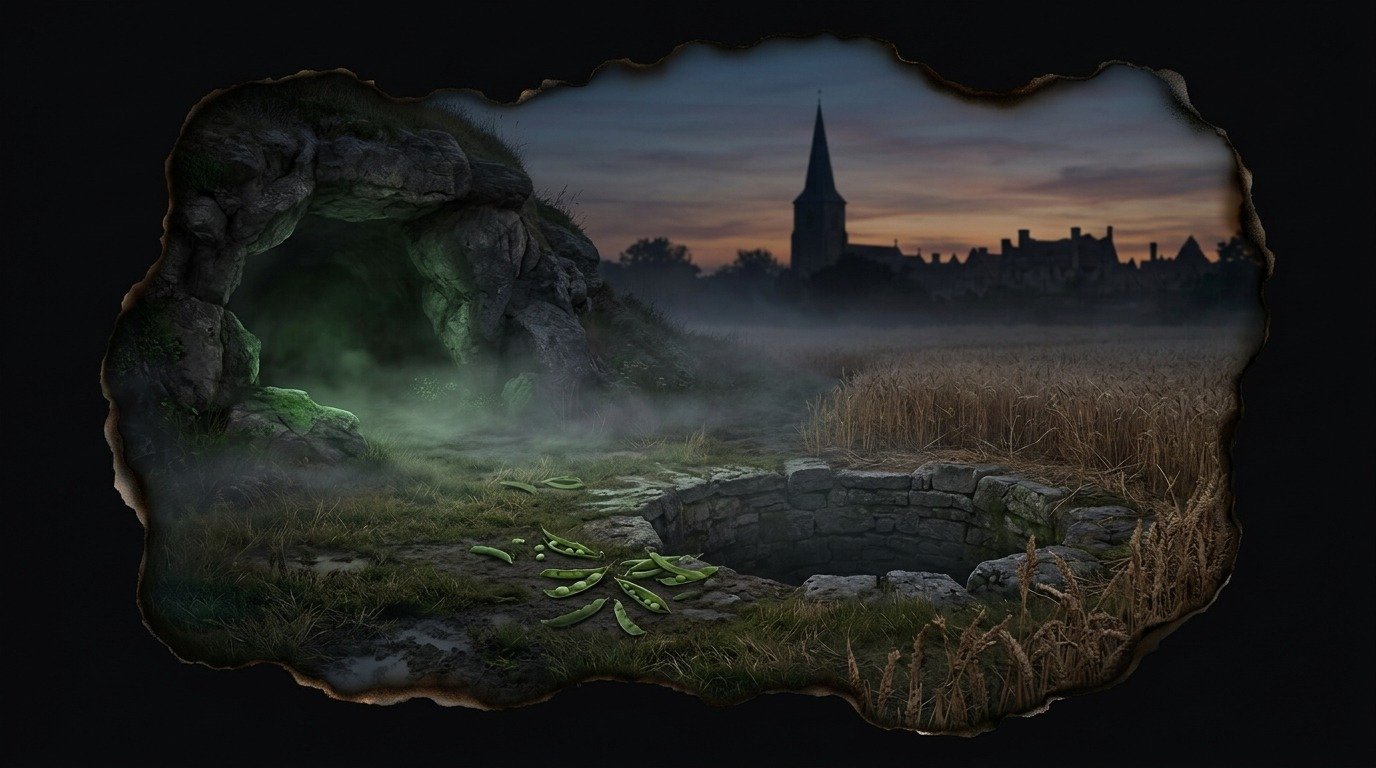
During harvest time, the villagers of Woolpit discovered the two children crying next to one of the deep pits dug to catch wolves (from which the town takes its name, *Wulf-pytt*). Their skin was completely green, their clothes were of strange textures, and their language was incomprehensible.
They were taken to the residence of Sir Richard de Calne. There, the children refused to eat any kind of food offered to them, showing signs of severe malnutrition. The situation changed when the servants brought freshly cut green beans to the dining room; the children rushed toward them and consumed them greedily. For months, this was their only sustenance.
The boy, who was younger than his sister, fell ill with melancholy and died shortly after their arrival. The girl survived, adapted to the local diet, and gradually lost the green pigmentation of her skin. She learned the English language and was baptized, later working as a servant in Sir de Calne's house, where she gained a reputation for rebellious behavior.
When she was able to communicate fluently, she explained that she and her brother came from a region called "St. Martin's Land." She described their home as an underground territory where there was no direct sunlight, but rather a constant twilight, and where all the inhabitants had green skin. She claimed that while herding their father's cattle, they entered a cavern following the sound of the bells of Woolpit church. Upon emerging from the cave, the blinding sunlight and heat disoriented them, preventing them from finding their way back.
The Investigation
The case was recorded by two contemporary chroniclers of high historical credibility: Abbot Ralph of Coggeshall in his *Chronicon Anglicanum* (c. 1220) and the historian William of Newburgh in his work *Historia rerum Anglicarum* (c. 1189). Both collected the account independently; Ralph of Coggeshall claims to have heard it from Richard de Calne himself.
The most solid historical and scientific explanation suggests that the children were orphans of Flemish immigrants who had settled in the region and who were persecuted and massacred during the Battle of Fornham in 1173. The children would have fled to the surrounding forests and the abandoned flint mines of the area.
Their incomprehensible language was Flemish, which was not spoken by the Suffolk peasants. Their green coloration is explained by chlorosis, also called "green sickness," a type of severe anemia caused by extreme malnutrition and lack of sunlight, which disappears upon recovering a balanced diet of iron and proteins.
The Legacy
This event is a cornerstone of British folklore and fantasy literature. It is considered one of the first documented records of alleged intraterrestrial or interdimensional travelers. It is linked to the Hollow Earth theory, dimensional portals, and Celtic mythological myths about the hill people.
Comments
Share information, an experience, or a source to help enrich this entry. They are automatically reviewed before being published.
Loading comments...