Time slips
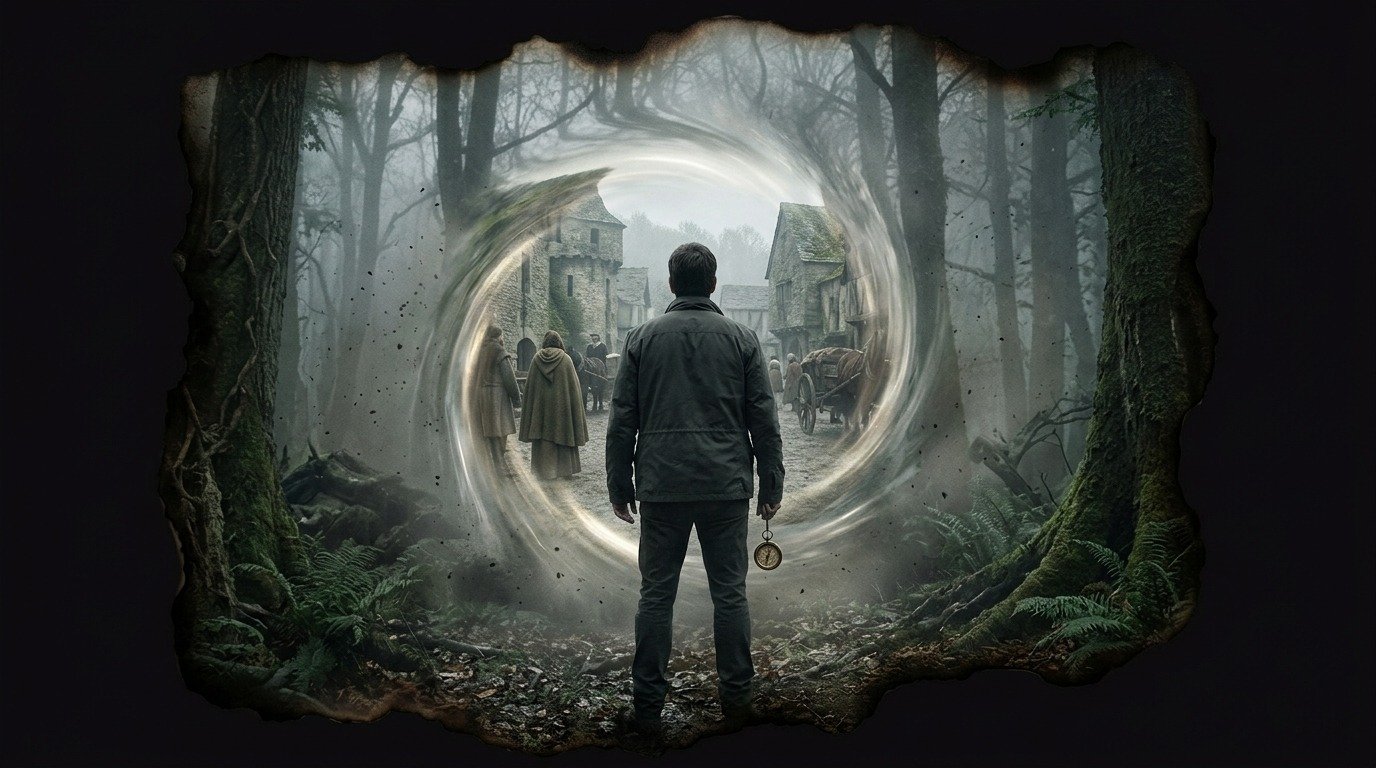
Time slips: cracks in the flow of time
What they are
A time slip is a physical and perceptual alteration by which an individual or a group of people is displaced, involuntarily and momentarily, to an era different from their own. It is not a vision or a hallucination: the subject physically interacts with the environment of the past or the future, breathes its air, walks on its ground, and, on occasion, speaks with its inhabitants before abruptly returning to their original present.
How they manifest
The phenomenon always begins with an abrupt atmospheric and sensory change. The witness experiences an absolute and unnatural silence; the sound of the wind, animals, or traffic disappears completely. The air becomes dense, heavy, and difficult to breathe. Sunlight changes tone, acquiring a grayish or flat hue, without defined shadows. Next, the physical environment is transformed. Paths, buildings, or elements of nature appear that do not belong to the present. Witnesses see and touch people dressed in clothing from other eras performing daily tasks of that time. During the slip, the observer experiences a deep sense of melancholy, extreme fatigue, or an inexplicable sadness. The return to the present occurs suddenly, with ambient noise instantly recovering.
History and traditions
The belief in the malleability of time exists in all cultures. Celtic tradition describes the passage to the *Otherworld* through fairy mounds, where time passes differently and a mortal can spend a day inside and return a century later. Modern esoteric theory explains these slips through the existence of "residual places." Certain historical events of great emotional charge remain engraved in the ether of physical space. Under specific climatic or electromagnetic conditions, this recording plays back and absorbs those who are in the location, merging two different timelines into a single geographical point.
Famous cases
The most documented case occurred on August 10, 1901, in the gardens of the Petit Trianon in Versailles. Two English academics, Charlotte Anne Moberly and Eleanor Jourdain, were walking through the area when the environment became silent and oppressive. They saw men dressed in official eighteenth-century attire and a woman they identified as Marie Antoinette sketching on the lawn. After publishing their experience in the book *An Adventure* (1911), it was verified that the architectural and clothing details they described belonged exactly to the Versailles of 1789, elements that no longer existed in 1901. Another significant event is the Kersey, Suffolk slip in 1957. Three British naval cadets entered this English village and found a medieval scene devoid of utility poles, antennas, or paving. The houses were made of adobe and the windows had no glass. Upon fleeing the place due to the distress caused by the silence of the environment, the village immediately regained its modern appearance.
What explains it
For esotericism, time is not a straight line, but a map of overlapping layers. Slips occur due to flaws in the density of the physical plane, which generates a gravitational or electromagnetic attraction that drags the observer toward an adjacent layer of the past. Science explains these experiences through neuropsychological factors. Clinical psychology attributes it to episodes of depersonalization, caused by extreme fatigue or stress, where the brain loses track of the real environment and vividly projects memories or prior historical knowledge. Neurology also points to temporal lobe epilepsy as a cause of complex hallucinations that alter the perception of time and space.
Connections
This phenomenon is closely linked to dimensional portals, bilocation, residual ghost apparitions, and premonitions.
Comments
Share information, an experience, or a source to help enrich this entry. They are automatically reviewed before being published.
Loading comments...