The Tower of London
The Tower of London: The Stone Scaffold of the British Crown
A Thousand Years of Stone, Blood, and Power
On the north bank of the River Thames rises the imposing silhouette of the Tower of London, officially Her Majesty's Royal Palace and Fortress. Founded by William the Conqueror in 1078, this massive fortification has been not only a royal residence and a repository for the Crown Jewels, but also England's most feared state prison. For nearly a millennium, its Caen stone walls witnessed courtly intrigue, dungeon torture, and summary executions. Overthrown kings, disgraced queens, and traitors to the crown entered through Traitors' Gate (the Traitors' Gate) knowing their chances of coming out alive were zero. This centuries-long accumulation of suffering has turned the Tower of London into the epicenter of paranormal activity in the United Kingdom.
The Ghosts of the Tudor Dynasty and the Lost Princes
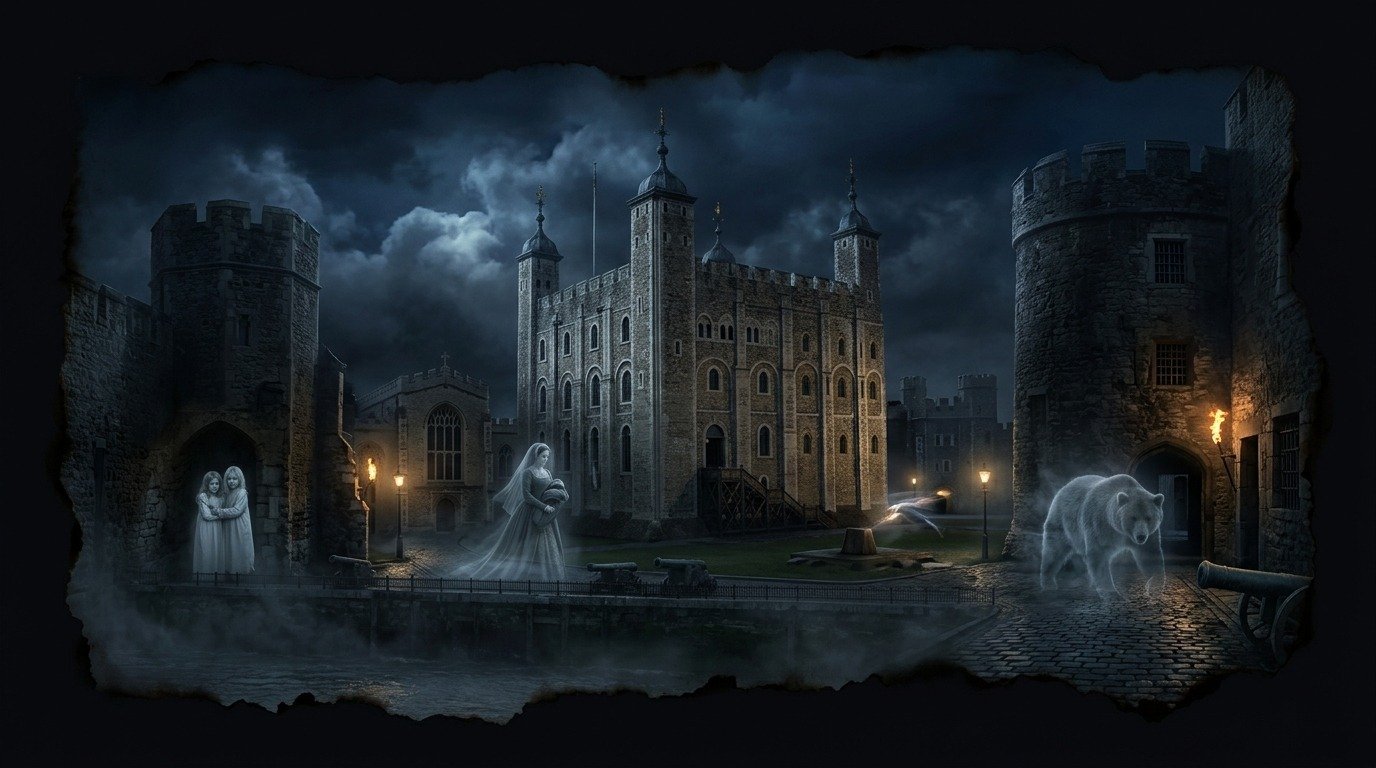
The most famous specter that supposedly walks the rooms of the Tower is that of Anne Boleyn, the second wife of Henry VIII. Beheaded on Tower Green in 1536 under false accusations of adultery and treason, her spirit has been reported on numerous occasions, particularly near the Chapel Royal of St. Peter ad Vincula, where her remains rest. The testimonies of the tower guards—the Yeomen Warders or "Beefeaters"—describe a period-dressed female figure walking the corridors of the White Tower carrying her own head under her arm, or floating gently over the lawn where the scaffold was erected.
Another of the fortress's darkest episodes is the mystery of the "Princes in the Tower." In 1483, twelve-year-old King Edward V and his nine-year-old brother Richard were confined to the Bloody Tower (the Bloody Tower) by their uncle, the future Richard III. The children disappeared without a trace. Nearly two centuries later, in 1674, workmen discovered the skeletons of two children buried beneath the stairs of the White Tower. Since then, sentries from different eras have claimed to see the silhouettes of two children dressed in white nightgowns clinging to each other in the darkest corners of the building, vanishing into thin air when addressed.
The brutality of the executions also left its mark. It is said that Margaret Pole, Countess of Salisbury, executed at age 67 by order of Henry VIII in 1541, refused to lay her head on the execution block, maintaining her innocence. The executioner, an inexperienced novice, chased her around the scaffold, hacking at her shoulders and neck until she finally died. Witnesses claim that on every anniversary of her death, the echo of her screams of terror and the spectral chase can be heard in the inner courtyard.
The Bear of the Tower and Military Testimonies
Unlike other historic sites where ghost stories belong solely to popular folklore, at the Tower of London, phenomena have been reported by active-duty military personnel and imperial guards. One of the strangest and best-documented incidents occurred in January 1816, when a night sentry in front of the Jewel House (where the jewels were kept) witnessed the appearance of a spectral bear emerging from beneath the room's door. The terrified soldier lunged at the figure with his bayonet, only to find the weapon passing through empty air before striking the wooden door. The guard was found unconscious and died a few days later in the military hospital, presumably from shock. At that time, the Tower housed the Royal Menagerie, which lends a strange historical coherence to the story.
Skeptics point out that the Tower of London is a labyrinthine, cold, and damp structure, prone to extreme drafts and noises from the thermal expansion of stone and old wood. The psychological weight of guarding a place with such a heavy historical and tragic burden predisposes night guards to auditory and visual hallucinations caused by fatigue. However, the persistence of the same sightings over the centuries by witnesses who were unaware of the prior legends continues to defy rational explanations.
The National Monument Today
Today, the Tower of London is one of the most visited monuments in the world, a living museum managed by the organization Historic Royal Palaces. The Yeomen Warders still live inside the fortress with their families and, at nightfall, perform the solemn "Ceremony of the Keys," a closing ritual that has been repeated without interruption for over seven hundred years. When the tourists leave and the gates close, the fortress once again belongs to the silence of its stones and to the shadows that, according to those who patrol under the moon, have never left it.
Comments
Share information, an experience, or a source to help enrich this entry. They are automatically reviewed before being published.
Loading comments...