The RMS Queen Mary
The RMS Queen Mary: The Gray Giant Stranded in Its Own Ghosts
The Queen of the Seas and the "Gray Ghost"
The RMS Queen Mary is a steel colossus from the golden age of transatlantic travel. Launched in 1936 by the Cunard White Star Line shipping company, this 310-meter (1,017-foot) long ocean liner was the personification of luxury, speed, and Art Deco design. During World War II, however, its opulent interior of fine woods and crystal chandeliers was dismantled. Painted entirely in a dull naval gray, it became known as the "Gray Ghost" due to its ability to evade German submarines thanks to its incredible speed, transporting more than eight hundred thousand soldiers to the fronts of Europe. After the end of hostilities, the ship regained its civilian splendor until it was retired from active service in 1967. Since then, it has rested permanently moored in the port of Long Beach, California, converted into a floating hotel and tourist attraction. Beneath its teak wood decks lies a history of maritime tragedies, industrial accidents, and violent deaths that have labeled it as one of the most haunted places on the planet.
The Depths of the Engine Room and the Cursed Cabin
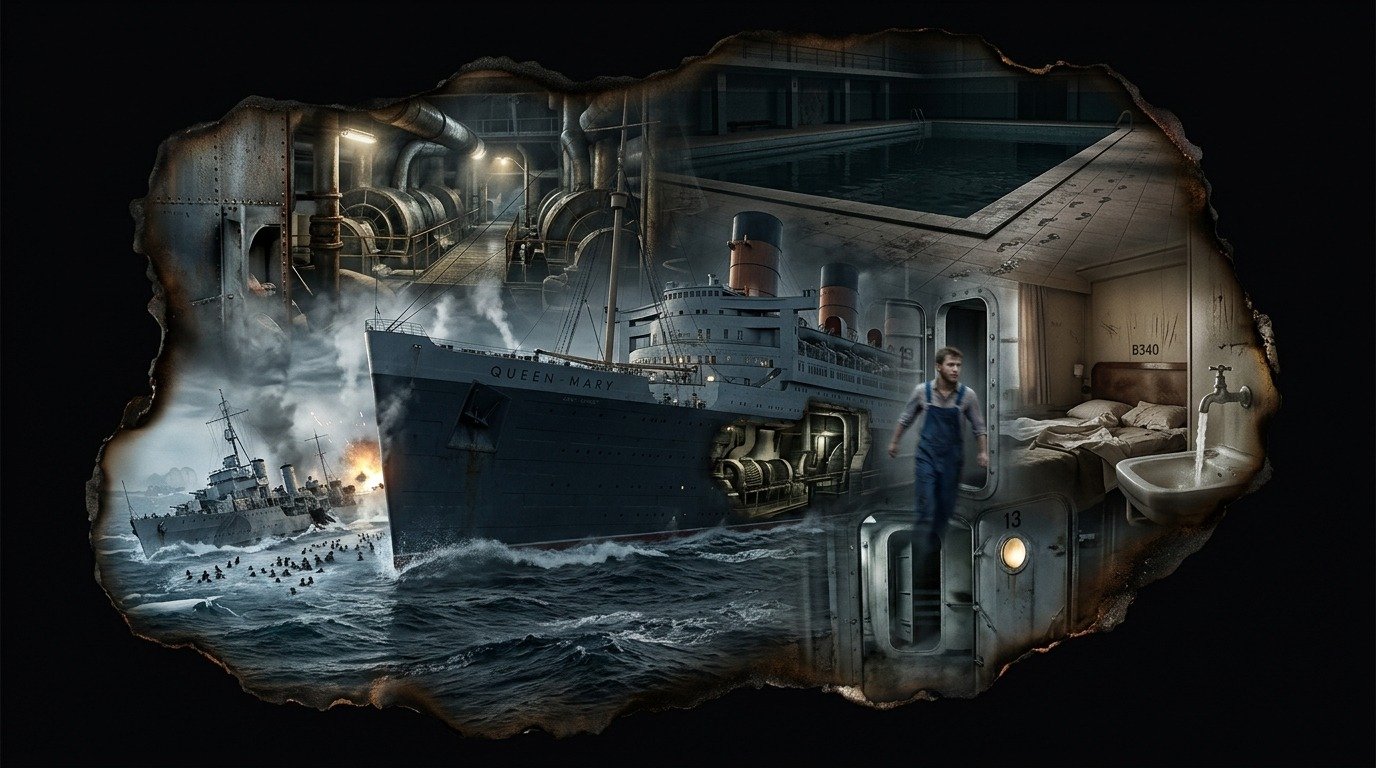
The geography of pain inside the Queen Mary is perfectly mapped by the tragedies that occurred on board during its thirty years of navigation. One of the darkest spots is the Engine Room, specifically the famous Watertight Door Number 13. During an emergency drill on July 10, 1966, an eighteen-year-old crew member named John Pedder was crushed by this safety door while attempting to cross it. His ghost, described as a young man in blue overalls and a thin beard, is frequently seen walking down the hallway leading to the metal door, disappearing just before touching it.
In the heart of the passenger area lies cabin B340. This room was removed from rental service for decades due to the virulence of the poltergeist phenomena that occurred there. Guests reported that sheets were ripped off the beds during the night, that faucets turned on by themselves pouring scalding water, and that violent knocks on the walls were heard from the hallway when the room was empty. Although the hotel reopened the cabin to paranormal enthusiasts at a high price, testimonies of sleepless nights and terror persist.
Another area of intense activity is the first-class swimming pool, currently out of service due to safety regulations. Visitors report hearing children's laughter, splashes in non-existent water, and seeing the wet footprints of small feet appearing on the dusty tile. Researchers associate these manifestations with Jacqueline Torin, a young girl who drowned in the pool during a crossing in the 1950s.
The Tragic Collision of the HMS Curacoa
During its military service, the Queen Mary was involved in one of the deadliest accidents in the history of the Royal Navy. On October 2, 1942, while sailing in a zigzag pattern to avoid enemy submarine attacks, the Queen Mary accidentally collided with its escort ship, the light cruiser HMS Curacoa. Due to its immense mass and speed, the ocean liner literally cut the Curacoa in half. Under strict orders not to stop under any circumstances to avoid becoming an easy target, the Queen Mary continued on its course, leaving behind hundreds of British sailors who drowned in the icy waters of the North Atlantic. More than three hundred men lost their lives. It is said that in the bow section of the Queen Mary, the sounds of twisting metal, cries for help, and the sound of rushing water can still be heard on the coldest nights in the port of Long Beach.
The Debate Between Mystery and Business
The reputation of the Queen Mary has been the subject of intense debate between parapsychologists and skeptical researchers. Notable researchers have pointed out that the ship has systematically exploited its fame commercially through night tours, Halloween events, and promotional material, raising doubts about the authenticity of some modern testimonies. Many of the reported incidents, such as the deaths of children in the pool, lack clear records in the ocean liner's official logbooks, suggesting that part of the myth was created by public relations to keep the ship financially afloat during its worst hotel occupancy crises. However, independent researchers who have spent nights on board point out that the electromagnetic fields detected in certain areas of the ship, such as the bow and the engine room, present physical anomalies that science has not yet been able to explain conclusively.
The Steel Sentinel in Long Beach
The RMS Queen Mary remains today an irreplaceable historical icon of Long Beach. Despite the financial and structural maintenance challenges that threaten its iron survival, the gray giant continues to attract thousands of visitors a year. The ship is a floating labyrinth where the past and the present blur under the amber light of its silent corridors, an Art Deco palace that guards the echoes of the souls that once crossed the ocean aboard its majestic structure.
Comments
Share information, an experience, or a source to help enrich this entry. They are automatically reviewed before being published.
Loading comments...