The Headless Horseman (Dullahan)
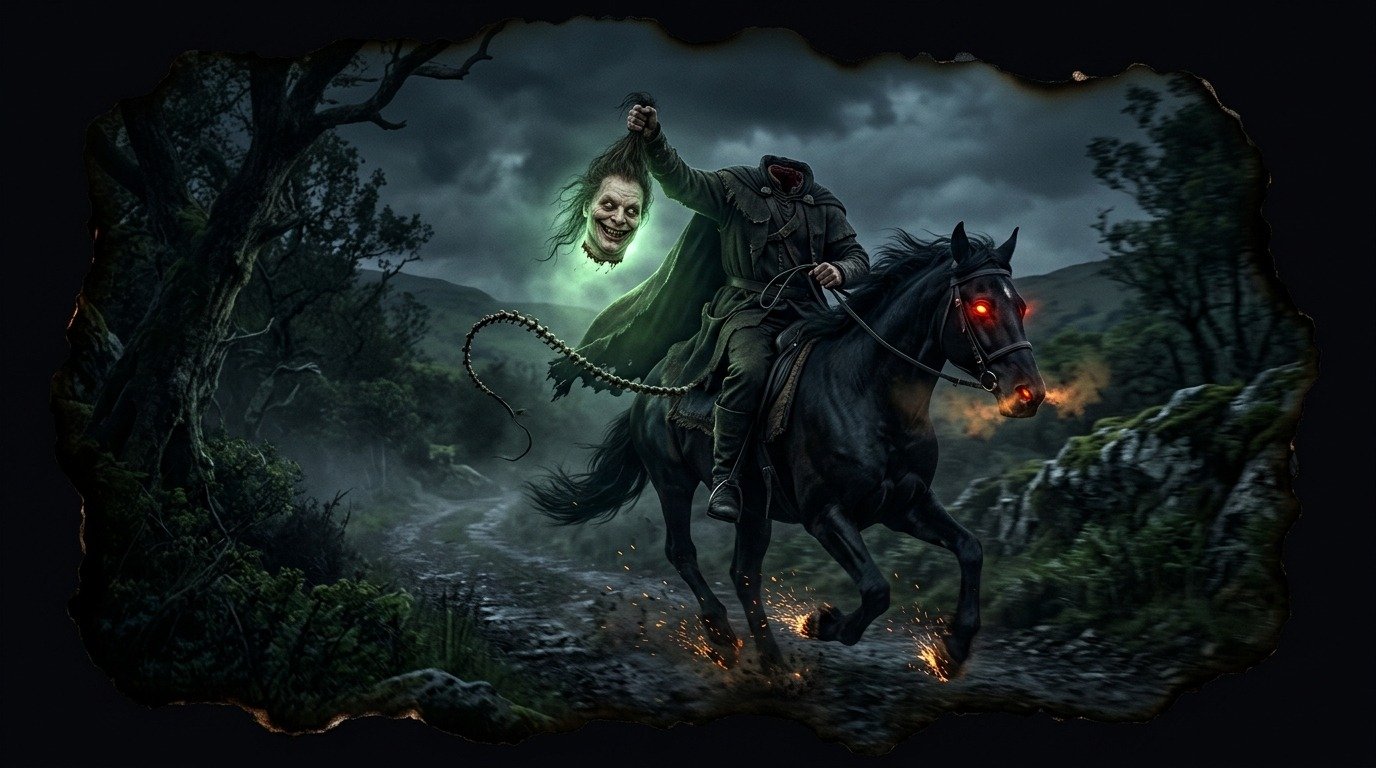
The Headless Horseman (Dullahan): The Herald of Death on Dark Roads
The Origin of the Myth: From Pagan Deities to Night Riders
In the fields of Ireland, long before asphalt shortened distances, the night belonged to the shadows. The myth of the Headless Horseman has its deepest roots in the Dullahan, a creature of Celtic folklore that embodies the inevitability of death. Chroniclers of the past suggest that this being is the transposition of Crom Dubh, an ancient fertility god who demanded human sacrifices, preferably by decapitation. When the worship of this deity died out with the arrival of Christianity, the figure did not disappear; it simply transformed into a wandering demon, a rider claiming souls that heaven or hell have not yet registered.
Unlike the literary horseman popularized by Washington Irving in the woods of Sleepy Hollow, the original Dullahan does not search for his lost head to put it back on. He knows perfectly well where it is: he carries it in his right hand, holding it by the hair like a macabre lantern to light his way along the darkest mountain paths.
The March of Terror: The Whip and the Head of Fire
Those who claim to have crossed paths with this entity describe an atmosphere that freezes instantly. The Dullahan does not travel in silence. He announces himself with the beating hooves of a coal-black stallion, whose eyes flash sparks and whose breath exhales the sulfurous smell of the grave. The rider wears dark garments, but the absolute horror is concentrated in his hands. With one of them, he holds the horse's reins, or a sinister whip crafted from a human spine. With the other, he holds aloft his own decapitated head.
This head is not a dry skull; it retains a doughy, pale flesh, similar to rancid cheese. A deformed grin, stretching from ear to ear, splits the face, and the eyes—small, black, and quick as flies—flicker constantly, granting the entity a panoramic vision that allows him to scan the horizon in search of his prey. The head glows with the phosphorescence of decaying organic matter, using itself to guide the gallop.
The Dullahan possesses a single weakness: gold. The slightest glint of this precious metal is capable of frightening him away, causing him to vanish into a greenish mist. But without that protection, the encounter is fatal. The rider halts his progress only when he reaches the home of a dying person. In that instant, the head utters a single name. Upon hearing its call, the named person drops dead immediately, feeling their soul being ripped from their physical body.
Crossing Borders: From the Irish Hills to Sleepy Hollow
With the migratory waves of the 19th century, the legend crossed the Atlantic Ocean and settled in the New World, adapting to North American soil. There, stripped of his divine Celtic roots, the horseman became the ghost of a Hessian mercenary from the Revolutionary War, decapitated by a cannonball in a nameless battle.
The archetype transformed into a reminder of the traumas of war, a specter trapped in an eternal quest for vengeance and physical restitution. Nonetheless, whether in the form of the Irish Dullahan whispering names in the darkness of Munster, or as the German rider stalking the Black Forest demanding passage from travelers, the pattern remains invariable: a blind, relentless force, devoid of face and empathy, traversing the boundary between the world of the living and the dead, reminding us that no one can escape their own appointed hour.
Comments
Share information, an experience, or a source to help enrich this entry. They are automatically reviewed before being published.
Loading comments...