Near-Death Experience
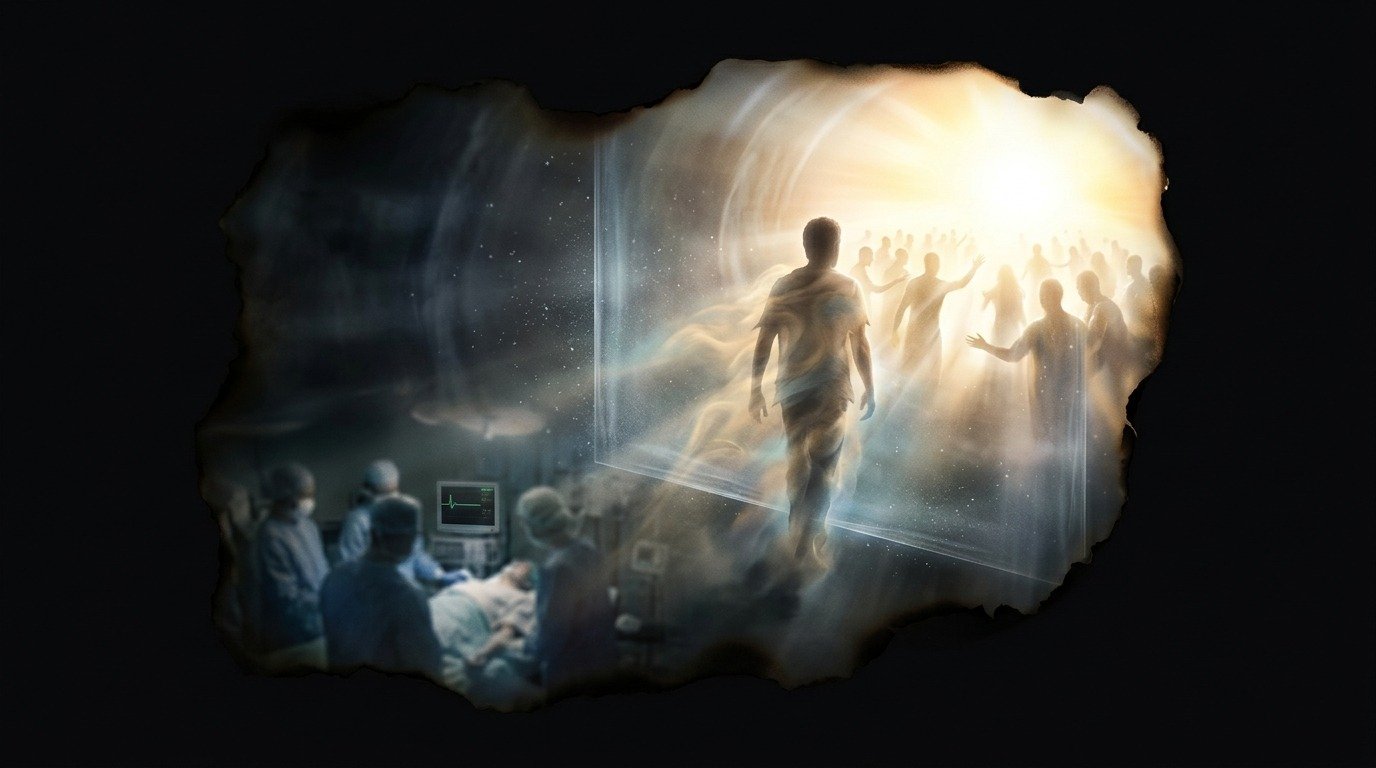
Near-Death Experience: The Passage to the Threshold
What It Is
The near-death experience (NDE) is a state of heightened consciousness that occurs when a person is clinically dead or in imminent danger of death due to severe trauma, cardiac arrest, or deep coma. During this period of brain inactivity and cessation of vital functions, the individual experiences a series of structured spiritual and sensory occurrences that defy the loss of consciousness.
How It Manifests
NDEs follow a sequential and universal pattern consisting of the following stages: 1. **Bodily detachment:** The individual experiences absolute peace and the disappearance of physical pain. They observe themselves and the emergency environment from the ceiling or an elevated point (autoscopy). 2. **The transit:** Consciousness is drawn toward a dark space or a tunnel at high speed. 3. **The light:** At the end of the darkness, a bright, warm light appears, of an intensity that does not damage the eyesight. 4. **The encounter:** The person is reunited with deceased relatives or with a being of light emanating unconditional love. 5. **The life review:** A three-dimensional panoramic view of the individual's existence is projected, where they experience the impact of their actions both from their own perspective and from that of others. 6. **The boundary:** A border is reached (a river, a fence, or an invisible line) representing the point of no return. 7. **The return:** The person instantly returns to the physical body, often with pain and reluctance, experiencing a radical change in their scale of values and completely losing the fear of death.
History and Traditions
Descriptions of these passages are found in ancient texts such as the *Tibetan Book of the Dead* (Bardo Thodol) and in the Myth of Er, which closes Plato's *The Republic*, where the experience of a soldier who awakens on his funeral pyre after spending twelve days in the afterlife is narrated. Modern research began in 1975 with the publication of the book *Life After Life* by psychiatrist and philosopher Raymond Moody. Moody coined the term "near-death experience" and classified the common elements after studying more than one hundred cases of patients who had survived cardiac arrest.
Famous Cases
The case of Pam Reynolds, an American singer who underwent complex brain surgery in 1991, is one of the scientific milestones of the phenomenon. For the operation, her body was cooled to 15 degrees (59°F), her heart was stopped, and her brain recorded no electrical activity on the electroencephalogram. Upon waking, Reynolds accurately described the surgical tools used, the doctors' conversations, and the specific details of the craniotomy that occurred while she was clinically dead. Eben Alexander, a Harvard-trained neurosurgeon, suffered a deep coma in 2008 due to severe bacterial meningitis that temporarily destroyed his active cerebral cortex. During his seven-day coma, he experienced a detailed NDE that he later described in his book *Proof of Heaven*, analyzing the phenomenon from his perspective as a specialist in the human brain.
What Explains It
The esoteric and spiritual explanation maintains that consciousness is independent of the physical brain. The brain acts solely as a transmitter or tuner of consciousness on the material plane. When the physical body stops, consciousness is liberated from biological limitation and returns to its original state of existence on the spiritual plane, where time and space do not exist. The scientific explanation postulates that NDEs are the result of anoxia (lack of oxygen) and hypercapnia (excess carbon dioxide) in the dying brain. This triggers a neurochemical storm that includes the massive release of endorphins, ketamine, and dynorphins, which generates visual hallucinations (the tunnel and the light due to the loss of peripheral vision) and an intense sensation of peace as a cerebral defense mechanism against the final trauma.
Connections
The near-death experience is related to astral projection, disembodied consciousness, bilocation, deathbed visions, and mediumship.
Comments
Share information, an experience, or a source to help enrich this entry. They are automatically reviewed before being published.
Loading comments...