Saulė
Saulė: The Charioteer of Fire and Amber Tears
The Lady of the Copper Chariot
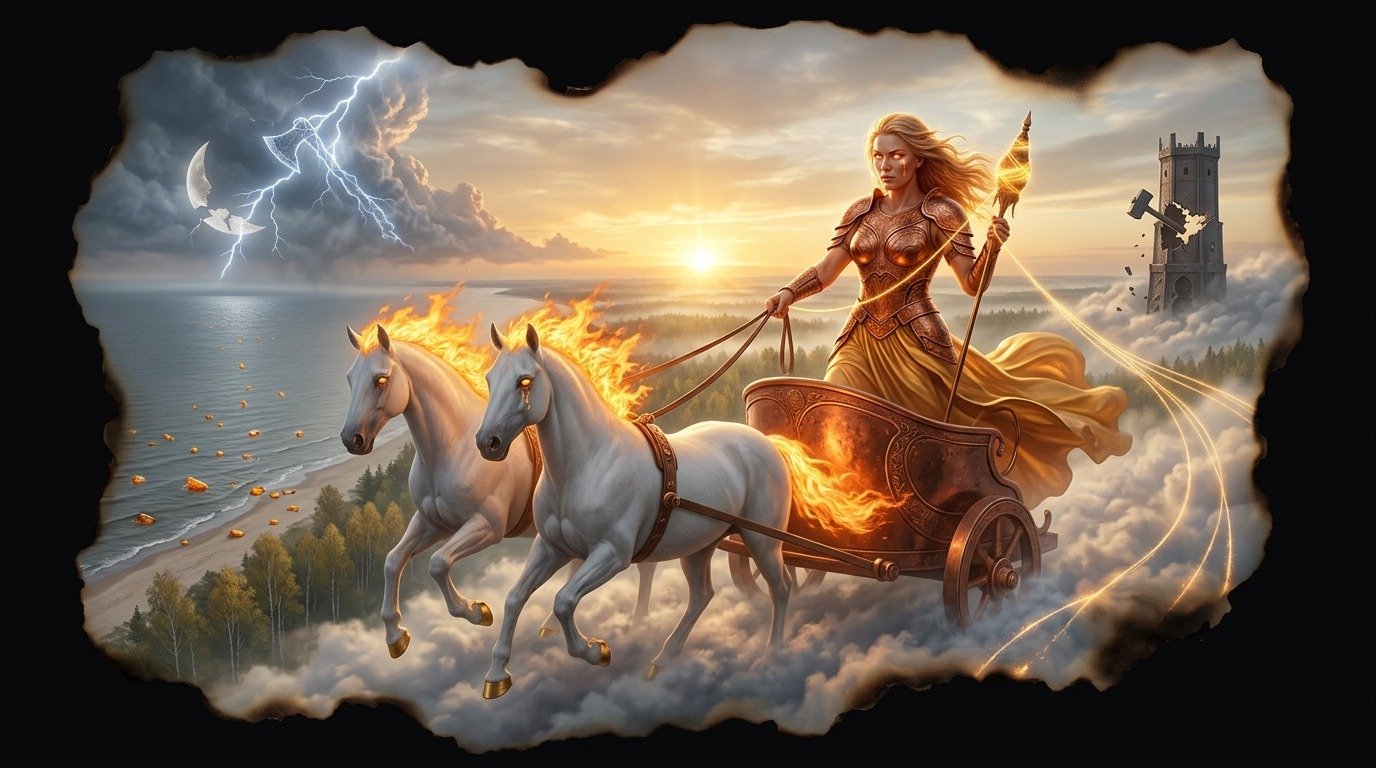
When the mist rises over the birch forests and the Baltic Sea still holds the chill of the night, a golden spark crowns the horizon. It is not a simple sunrise; it is the awakening of Saulė. She does not observe the world from a static throne, but rather claims it every morning by taking the reins of her heavy copper chariot. Her horses, of an immaculate white and with manes that breathe fire, never know fatigue thanks to their horseshoes of pure gold, capable of running over the backs of the clouds or the surface of the ocean without ever sinking. Saulė is the very pulse of the day, a deity of benevolent warmth but of an intensity that can blind mortals who dare to look at her head-on. During her daily journey, she spins the threads of light with a golden distaff, weaving the life that sprouts in the fields and warming the livestock. As evening falls, her journey takes her westward, where the waters of the sea await her. There, in the marine depths, she washes her fatigued horses in a bath of gold and retires to rest in her palace behind the waters, only to resume her march when the Morning Star lights the first torch in the sky.
The Betrayal of the Moon and the Axe-Blow of Thunder
Saulė's beauty is so radiant that it awakens passions that disrupt the cosmic order. At the dawn of time, she was wedded to Mēness, the god of the Moon. They were the perfect couple, the light of day and the light of night sharing dominion over the sky. However, the coldness of the night made Mēness fickle. As dawn broke, the Moon god set his eyes upon young Aušrinė, the Morning Star, Saulė's own daughter, and seduced her in the shadows. The discovery of the betrayal unleashed a cosmic storm. Saulė's wrath was so scorching that it withered the leaves of the forests, but the true punishment came at the hands of Perkūnas, the relentless god of thunder. Seeing the sacred order of marriage broken, Perkūnas descended with his axe of lightning and chopped Mēness into pieces. It is because of this divine punishment that the unfaithful husband could never again show himself whole permanently in the sky; he wanders condemned to wane, to disappear into the darkness, and to painfully rebuild himself month after month, always fleeing from the burning gaze of the wife he betrayed.
The Weaver of the Seasons and the Tears of the Sea
Saulė's power is not uniform; it expands and contracts to the rhythm of the seasons, an annual struggle against the forces of shadow and cold. At the summer solstice, during the shortest night, the goddess reaches the peak of her strength. It is the moment when she descends to the hills to dance in silver shoes, filling plants with healing properties and blessing the harvests. Men light bonfires on the summits to mimic her fire, helping her maintain her dominion over the darkness. But winter is inevitable. As the days shorten, Saulė is weakened by the deities of frost and darkness, who lock her in an iron tower at the ends of the world. During this captivity, the world plunges into lethargy and apparent death. Only the efforts of mythical heroes or the arrival of the celestial blacksmith, who strikes the tower with his giant hammer to free the captive, allows Saulė to return. When she rises again, victorious but exhausted after the long winter night, her tears of relief fall upon the waves of the Baltic, solidifying instantly and turning into the fragments of amber that the tides wash onto the sandy beaches as proof of her eternal return.
Comments
Share information, an experience, or a source to help enrich this entry. They are automatically reviewed before being published.
Loading comments...