Rusalka
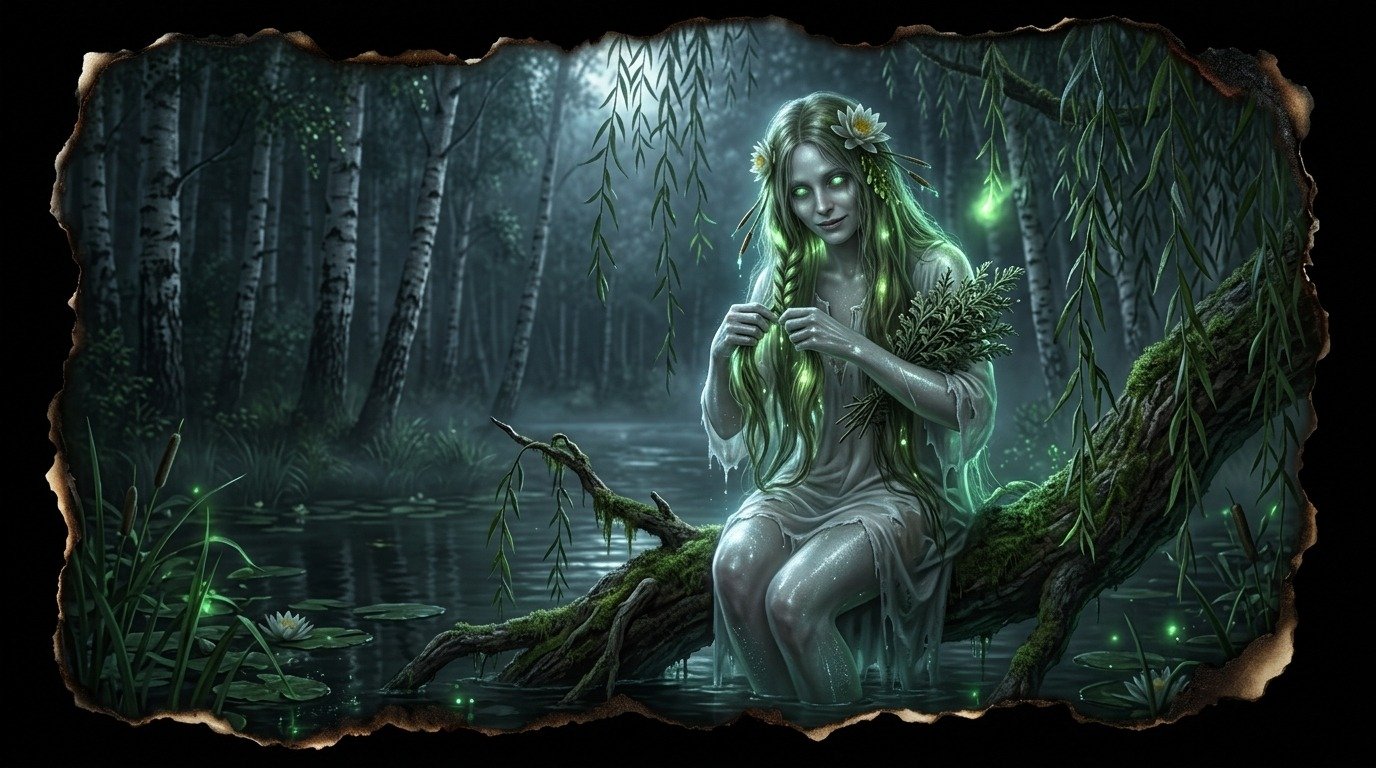
Rusalka: The Lament of Stagnant Waters
Origin and Pagan Roots
In the cosmogony and folklore of the Slavic peoples (Russia, Ukraine, Belarus, and the Balkans), the *Rusalka* (plural: *Rusalki*) is one of the most complex and feared spiritual entities. Originally, in pre-Christian Slavic paganism, the Rusalki were viewed as benevolent deities or fertility spirits linked to the vital moisture of spring, responsible for bringing nourishing dew to the crop fields to ensure the harvest. However, with the advent of Christianity and the subsequent process of demonization of the pagan pantheon, the nature of the Rusalka was transformed into a tragic and hostile manifestation of *Nav* (the Slavic underworld). They came to be classified as the wandering spirits of young women who died by drowning, whether by suicide due to a betrayed love, by infanticide, or by being thrown into the water by violent forces, as well as children who died without having received the sacrament of baptism.
Spectral Anatomy and Geography of Terror
The Rusalka is not a being of flesh and blood, but a spectrum of wet nature whose appearance reflects her tragic end: * **Physiognomy:** They are described as young women with translucent skin, pale as moonlight, with long hair of an algae-green or ashen-blonde hue that must never dry out. If a Rusalka's hair dries completely, her magical power vanishes and she perishes immediately. Their eyes lack defined pupils, glowing with a greenish will-o'-the-wisp in the darkness of the birch forests. * **Seasonal Behavior:** During the winter, the Rusalki dwell at the frozen bottom of rivers and lakes. However, during *Rusalnaya Nedelya* (the Rusalka Week or Green Week, which coincides with the feast of Trinity or Pentecost), they emerge from the water to climb onto the hanging branches of willows and birches at the water's edge. From there, they sing hypnotic melodies, braid their hair, and dance in circles under the moonlight in the damp meadows. * **Death by Laughter:** Any traveler who is seduced by their beauty or their song and approaches their dance circle is trapped. The Rusalki do not always drown their victims immediately; they often surround them, subject them to a state of hypnotic ecstasy, and tickle them hysterically until the victim dies of asphyxiation or cardiac arrest caused by involuntary laughter, only to then drag the corpse to the bottom of the mire.
Esoteric and Archetypal Meaning
The Rusalka represents the trauma of the soul trapped on the threshold between life and death, the lament of injustice, and the energy of vengeance of the violated feminine. It is a reminder that unprocessed emotions (the pain of abandonment, betrayal, and violent death) stagnate and become toxic. The Rusalka's water does not flow; it is the swampy water of chronic pain that imprisons the psyche. Esoterically, the Rusalki act as guardians of the threshold between the physical world (*Yav*) and the spiritual world (*Nav*). They embody the danger of obsessive nostalgia for the past; whoever looks back for too long or allows themselves to be seduced by the lament of ancient pains (the song of the Rusalka) ends up losing their vitality and being dragged to the bottom of the emotional abyss, where hysterical laughter masks absolute despair.
Methods of Protection and Apotropaics
Slavic folklore has developed an arsenal of extremely precise mystical defenses to survive encounters with these entities, especially during Green Week: 1. **The Power of Wormwood (*Chornobyl* / *Artemisia absinthium*):** Wormwood is the metaphysical counter-poison to the Rusalka. When entering damp forests during spring, one must always carry a bunch of wormwood on their chest. If a Rusalka intercepts a traveler, she will ask the ritual question: *"What do you bring in your hands, wormwood or parsley?"*. If the traveler answers *"Wormwood"*, the creature will scream *"May wormwood consume you!"* and flee in terror. If the traveler answers *"Parsley"*, the Rusalka will exclaim *"You are my sweet parsley!"* and proceed to tickle them to death. 2. **The Drawing of the Iron Circle and the Cross:** If cornered by a group of Rusalki, one must immediately draw a circle on the ground using an iron object or a knife with a blessed wooden handle, and remain inside it reciting prayers of protection against the spirits of the shadow. 3. **The Offering of Clothing:** To appease the Rusalki dwelling near a property, village women traditionally hung colored ribbons, scarves, and white linen garments on the branches of birch trees near the rivers. This act of symbolic compassion clothes the nakedness of the suffering soul, transforming its predatory wrath into a distant neutrality.
Comments
Share information, an experience, or a source to help enrich this entry. They are automatically reviewed before being published.
Loading comments...