Merrow
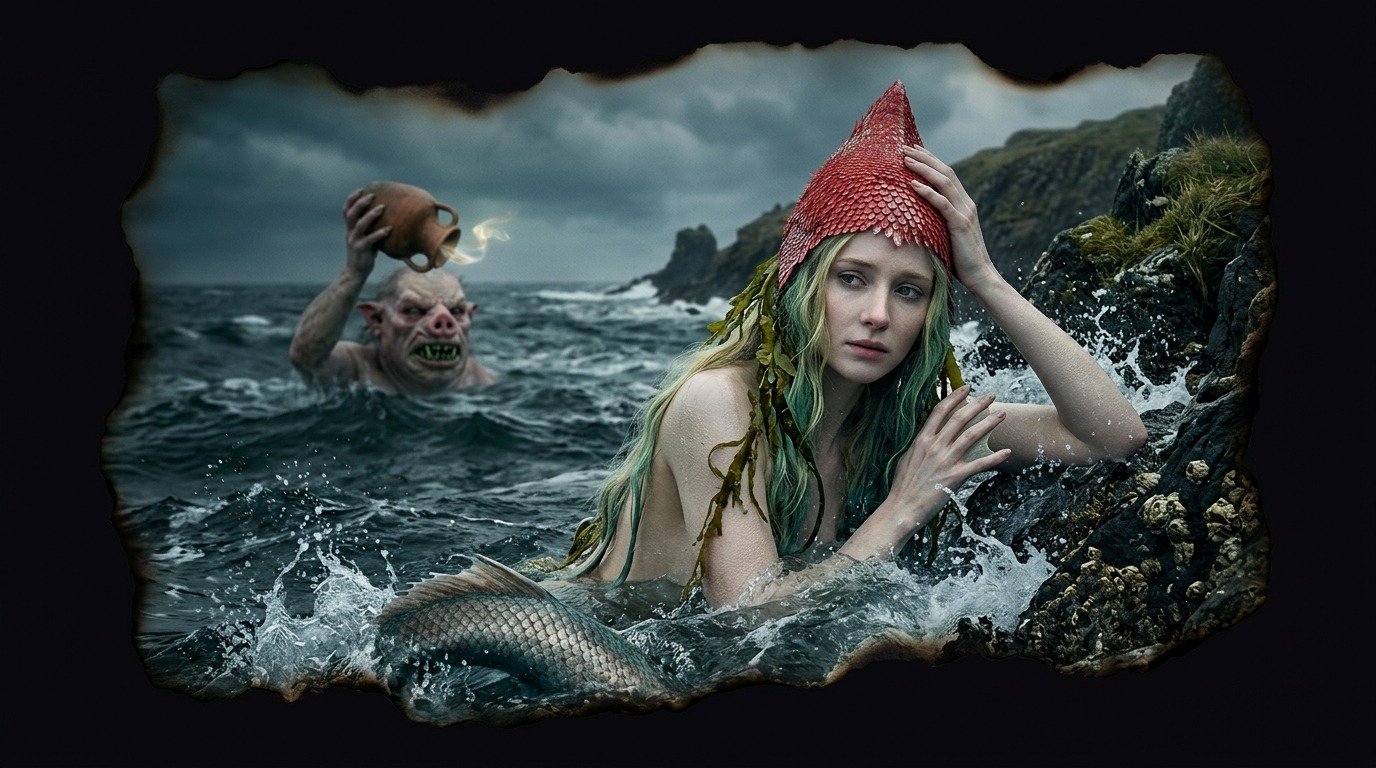
Merrow: The Abyssal Lineage of the Gaelic Coasts
Mythology of the Depths: Origin and Etymology
The word *Merrow* is an anglicization of the Irish Gaelic *Murúch* (formerly *Muir-óigh* or *Moruadh*), a term composed of *muir* (sea) and *oigh* (maid or young woman). This lineage of marine beings is deeply intertwined with Celtic mythology and the coastal folklore of the provinces of Munster and Connacht, where the Atlantic lashes the cliffs with relentless violence. Unlike the sirens of the Greco-Roman tradition, whose voices seduced sailors toward the reefs, the Merrows possess a nature closely linked to the *Tuatha Dé Danann*, the ancient divine lineage of Ireland. They are said to be fallen souls or a branch of the Danann themselves who chose the submerged realms of *Tír fo Thuinn* (the Land Under the Waves) following the invasion of the Milesians. Local legends do not present them merely as monsters or fleeting apparitions, but as a parallel society, endowed with its own laws, aristocracy, and existential melancholy.
The Cohuleen Druith: The Veil of Scales and Earthly Tragedy
The defining element of the Merrow's ontology is her *cohuleen druith* (also written *cochall*), a garment usually described as a cowl, a bright red conical hat, or the skin of a marine animal covered in feathers or fine scales. This artifact is not a simple ornament; it is the metaphysical nexus between her aquatic form and her ability to breathe and move in the depths of the ocean. If a Merrow loses or has her *cohuleen druith* taken from her when venturing onto fine sandy beaches, she is stripped of her primordial nature and forced to adopt a purely human existence. Many of the tales documented by folklorists such as T. Crofton Croker in the 19th century detail forced marriages between local fishermen and Merrows deprived of their cowls. These unions, though often blessed with wealth and offspring who inherited webbed fingers or a mystical affinity with the sea, were irremediably doomed to tragedy. The moment the sea woman discovered the hiding place of her sacred garment (usually hidden under the thatch of the roof or at the bottom of a wooden chest), she instantly abandoned her earthly husband and children, reclaimed by the irreversible call of the abyss.
The Dual Face: The Beauty of the Nereids and the Ugliness of the Abyss
There is a radical gender asymmetry in the morphology of the Merrow species, a detail that reveals the complexity of Irish folklore and its pagan roots: * **Female Merrows:** They possess a captivating beauty, though with subtle marks of their abyssal heritage: delicate hands with fine webbing between the fingers, hair that floats like golden or greenish seaweed, and a gaze of a blue as deep as the Porcupine Seabight. They are capable of feeling genuine affection, though always tinged with an incurable nostalgia for the submerged plains. * **Male Merrows:** Described in traditional tales as grotesque beings with a sullen temperament. Their faces present porcine features, sharp green teeth, reddened noses, and small, fiery eyes. Their ugliness is so extreme that the females of their species frequently seek the company of mortal men, which explains both their propensity to go ashore and the aggressiveness of the males of the lineage, who dedicate themselves to capturing the souls of drowned sailors in underwater prisons called *soul cages*, keeping them locked in upside-down clay pots.
Esoteric Symbology: The Threshold of Water and the Nostalgia of the Soul
From an esoteric perspective, the Merrow symbolizes the duality of the human psyche trapped between two realms: earth (the plane of reason, duty, and physical limitation) and water (the vast ocean of the unconscious, ancestral magic, and absolute freedom). The *cohuleen druith* represents the mask of power, the astral vehicle that allows transit between worlds. The tragedy of the Merrow on dry land is an allegory of the human soul exiled from its divine origin. Her return to the sea, even while leaving behind a life of human love, underscores that the essential nature of a being cannot be domesticated or repressed by affection or the law of men; sooner or later, the tide of origin reclaims what belongs to it.
Comments
Share information, an experience, or a source to help enrich this entry. They are automatically reviewed before being published.
Loading comments...