Jenny Greenteeth
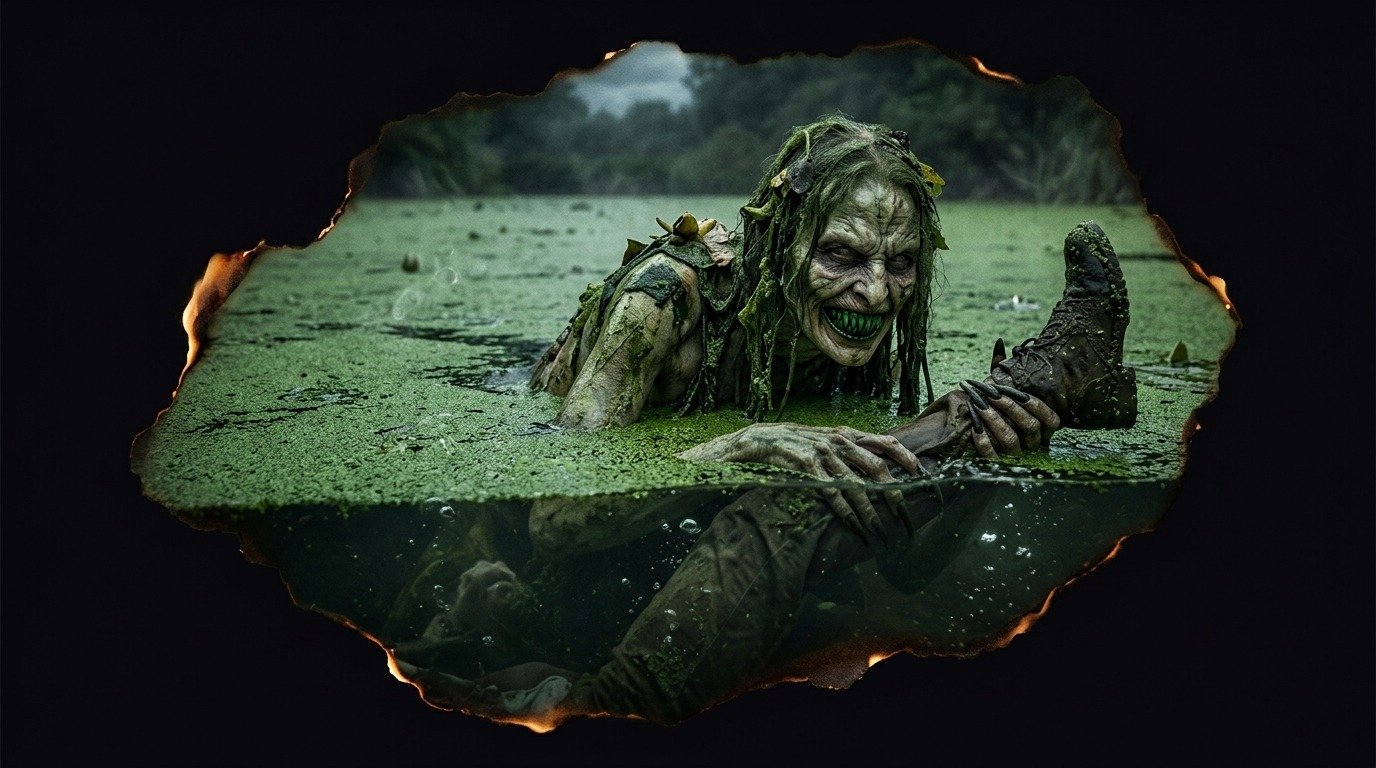
Jenny Greenteeth: The Green Embrace of the Stagnant Marsh
The Folklore of Dead Waters: Origin of the Myth in Northern England
*Jenny Greenteeth* (known in certain regions as *Ginny Greenteeth* or closely identified with figures such as *Peg Powler* in the River Tees or *Nelly Longarms* in the northwestern counties) is one of the most sinister incarnations of English river folklore. Originating from the industrial basins and wet moors of Lancashire, Cheshire, and Yorkshire, this entity inhabits still waters, agricultural ponds, navigation canals, and overgrown marshes. On a historical record level, the myth was consolidated during the Industrial Revolution, when artificial canals and flooded mine shafts multiplied across the British landscape, becoming death traps for unsupervised children at play. However, her roots are considerably older and connect with Celtic water deities who demanded blood tributes to ensure the fertility of marginal lands.
Morphology and Manifestation of the Canal Hag
Jenny is described as a spectral old woman or a water demon of emaciated appearance. Her skin is of a mossy or livid green hue, her fingers end in long, sharp claws of a horny consistency, and her most distinctive feature—from which her name derives—is a set of sharp, emerald-green teeth or teeth covered in decaying algae, capable of tearing flesh and crushing bones with the ease of an apex predator. Her hunting method is passive and lethal. Jenny stalks just beneath the water's surface, hidden under a dense layer of *Lemna minor* (commonly called duckweed, and known in the Lancashire dialect as "Jenny Greenteeth"). To the unwary observer, the pond's surface looks like a solid green meadow, a carpet of harmless vegetation. However, the moment a victim approaches too close to the edge, or attempts to walk on the false green solidity, Jenny's wet claws emerge from the mud, gripping the prey's ankles with supernatural strength to drag them down to the silty bottom, where she patiently suffocates them before devouring them.
Anthropological Analysis: The Nursery Bogey and the Bog Sacrifice
Modern anthropologists and folklorists classify Jenny Greenteeth under the category of *nursery bogie* (nursery bogeyman), a mythical figure used by parents to instill a healthy fear in children and keep them away from deep and dangerous waters. This utilitarian interpretation, while correct in the social context of the 18th and 19th centuries, barely scratches the surface of a deeper mythical structure. Comparative analysis connects Jenny with ancient bog sacrifice practices (*bog bodies*), common in Celtic and northern Islamic Europe. Marshes were considered portals to the Underworld, places where earth and water mix and the laws of ordinary space are suspended. Jenny Greenteeth is the anthropomorphic personification of the process of water decay: the green of life covering death by suffocation. She represents the biological warning that stagnant water is a breeding ground for pathogens, miasmas, and invisible dangers.
Stalking and Protection: Warnings for the Moorland Traveler
The Grimoire warns that approaching any body of stagnant water in the British Isles must be done with caution, observing the following danger signs: * **The Static Shroud:** If a pond is covered by a green carpet so dense that it does not allow the reflection of the sky to be seen, and no movement of fish or amphibians is perceived beneath it, the presence is active. * **The Marsh Gas Bubbles:** The constant rise of small bubbles that burst, releasing a foul odor of sulfur and decomposed organic matter, is the physical indication of Jenny's deep breathing from the muddy bed. * **The "Hair" in the Current:** In canals and stone locks, the presence of long strands of green algae moving against the gentle current is a sign that the entity is extending her limbs to feel the edge of the dock. Never attempt to retrieve fallen objects from these waters without using iron tools, a metal that the creature abhors due to its association with terrestrial fixity.
Comments
Share information, an experience, or a source to help enrich this entry. They are automatically reviewed before being published.
Loading comments...