Raum
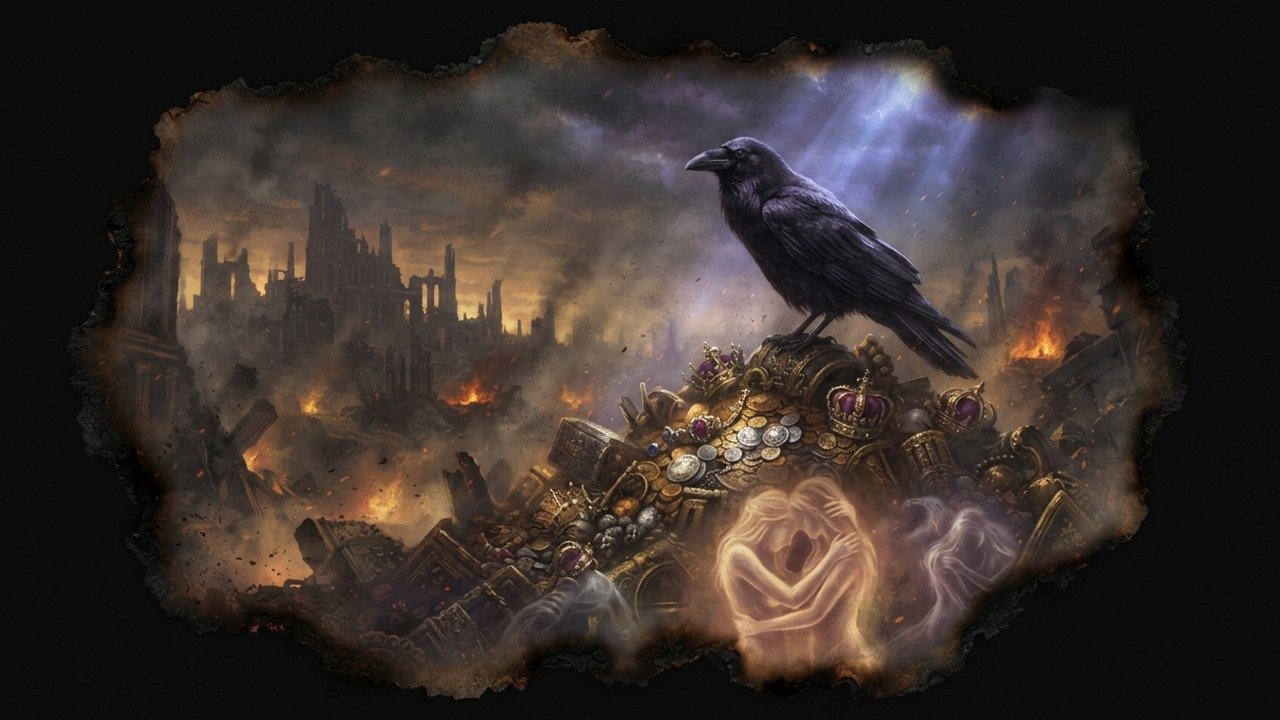
The Legacy of Raum: The Raven of Divestment and Cosmic Reconstruction
The Winds of Devastation: His True Origins To trace the essence of Raum, one must strip away late demonological categorizations and immerse oneself in the worldview of the Ancient Near East. Although his name appears in the lists of the Goetia as the fortieth spirit, his primal nature connects directly with the avian divinities and storm forces of Mesopotamia. In Akkadian and Babylonian mythology, entities like the Anzu bird represented the theft of destiny, the ability to snatch divine power from the gods themselves and imbue the cosmos with a restructuring chaos. Raum embodies this primordial principle: the impetuous force that strips away, the wind that tears the crowns from kings and dismantles structures that have lost their purpose. He is not born as a demon of gratuitous evil, but as the natural force that clears the ground through deprivation.
The Raven Earl: The Goetic Evolution With the arrival of medieval and Renaissance grimoiric tradition, notably documented in Johann Weyer's Pseudomonarchia Daemonum and the Lemegeton, Raum is classified as a Great Earl of Hell, under whose command march thirty legions of spirits. His first manifestation is invariably that of a raven, the scavenger bird par excellence, a symbol of transition, profane death, and the revelation of what lay hidden beneath the flesh. Demonological tradition assigned him paradoxical functions: his main task is to steal treasures from kings, destroy cities and dignities, but at the same time, he possesses the gift of reconciling enemies and discerning the past, present, and future. In the lists of the Inquisition, this duality was reinterpreted as the malice of a spirit that manipulates human greed to sow discord before offering a false truce.
The Alchemy of Divestment: Esoteric Meaning
In high magic, the Qliphothic Kabbalah, and depth psychology, Raum is not an entity that seeks mere material loss, but rather the archetype of the desacralization of illusions. In the web of the Qliphoth, he acts on the paths that connect the egotic mind with the forces of dissolution.
The Theft of the Treasure: It represents the extraction of energy and value accumulated in the false structures of the ego. The "king's treasure" is the petulance of the self that believes itself invulnerable; Raum steals it to return the individual to a state of spiritual nakedness.
The Raven and Transmutation: Like a phoenix in reverse, Raum's raven dissolves before it condenses. It is the pure alchemical Nigredo phase: the necessary blackening where matter must rot and be stripped of its apparent qualities to reveal the indestructible essence.
La Reconciliación de Enemigos: It is the integration of opposites on the psychic plane. By destroying the false pride that sustains conflict, Raum forces a truce based on raw shared reality.
Practice and Manifestation
The influence of Raum is perceived in the life of the individual when external structures—status, wealth, alliances based on self-interest—suddenly collapse, exposing the underlying truth.
How he acts: His manifestation in physical or internal reality is usually accompanied by a sense of sudden loss that reveals the fragility of human certainties. He is the force that exposes betrayal and clears stagnant environments.
Manifestation in the Individual: On a psychological level, Raum presents himself at the moment of violent disillusionment. He causes an abrupt awakening where social masks fall away.
Approach and Protection: Defending oneself against Raum through traditional exorcisms is useless if the magician maintains pride. True protection against his current is voluntary dispossession: not clinging to forms, titles, or riches. Approaching Raum requires a posture of absolute sobriety, invoking him not to ruin one's neighbor, but to cut the cords of one's own vanity and dismantle self-deceptions before reality does so destructively.
Comments
Share information, an experience, or a source to help enrich this entry. They are automatically reviewed before being published.
Loading comments...