Paimon
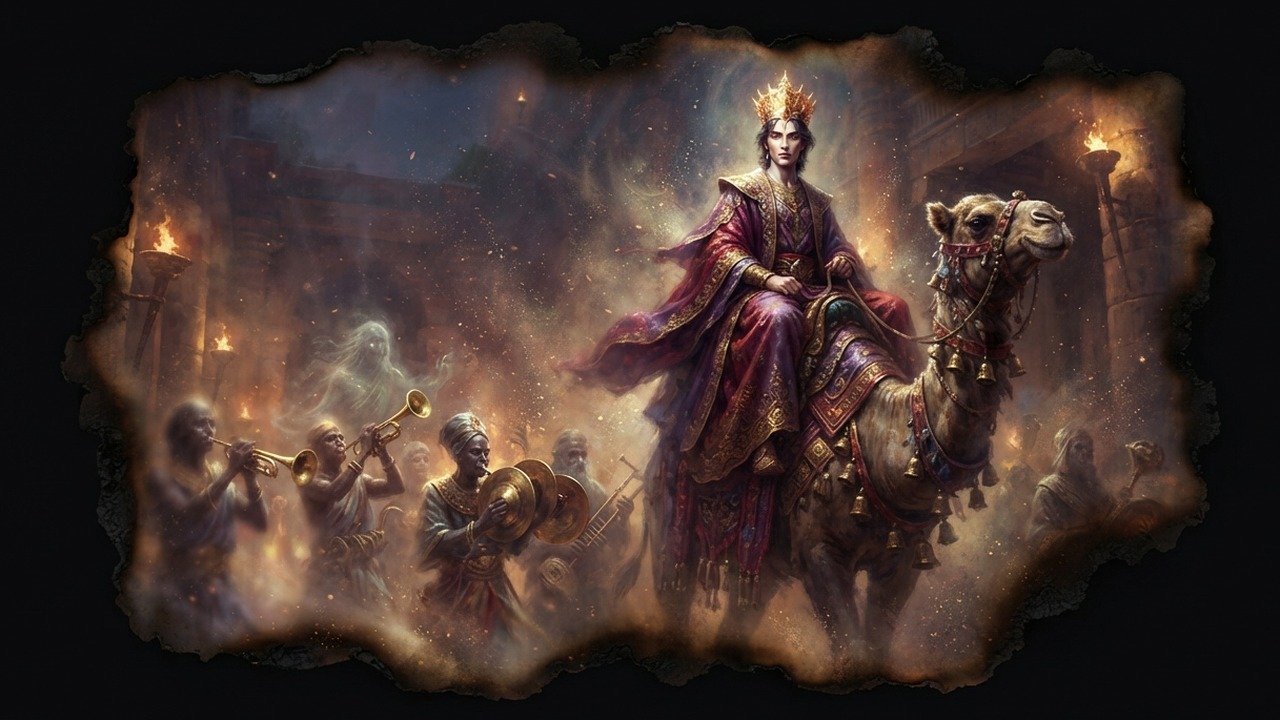
The Legacy of Paimon: The Sovereign King of the Intellect, the Illusion of the World, and the Light of Knowledge
Origin and Legend: The Crown of the East and the Radiant Sun
To trace the true essence of Paimon—recorded in medieval and Renaissance grimoires as Paymon or Paimonia—one must go back to the solar civilizations of the ancient Middle East, the Mesopotamian cults of the scorching air spirits, and the wisdom deities of the Semitic steppes. In the primordial pantheon, Paimon was not a creature from the sewers of the abyss, but a spirit of intellectual light, a power of the East wind and of the lands of the rising sun.
His name bears a close philological relationship to the Hebrew and Aramaic root referring to resonance, vibrating sound, or a bell (P'amon), alluding to the power of the spoken word, divine music, and vibratory command over matter. When the Solomonic tradition organized the Goetia in works such as the Lemegeton and the Liber Officiorum Spirituum, Paimon was crowned with the highest possible title within the catalog of spirits: one of the Great Kings of Hell, deeply loyal to Lucifer and commander of two hundred legions of celestial and infernal spirits. Magical literature always emphasized his distinguishing trait: absolute obedience to the Great Light and a majesty that demands the greatest honors before revealing his presence.
Historical Evolution: From the Deity of Knowledge to the King of the Demonic Veil
As the medieval church consolidated the demonization of non-canonical knowledge, Paimon was painted as the archetype of the intellectual seducer, the demon who promised scholars mastery of the liberal arts, understanding of the cosmos, and the ability to bend wills in exchange for their devotion. He was accused of being the king of false visions and the lord of the succubi and incubi who operated under his retinue.
However, for true students of High Magic and the Hermetic tradition—from Albertus Magnus to nineteenth-century occultists—King Paimon represented the pinnacle of Theurgy and the understanding of material illusion (Maya). Far from being a specter of physical destruction, Paimon was invoked by the aristocracy of magic for his unmatched ability to teach all sciences, philosophy, medicine, astronomy, and, foremost, the art of persuasion and mastery over the human mind without the need for violence.
Esoteric Meaning: The Archetype of the Sun King and Mastery of the Mind
In the architecture of the Qliphotic Kabbalah and the modern magic of the Left-Hand Path, Paimon operates in the sphere of Tiphereth in its dark reverse or within the path that connects the analytical mind with higher intuition.
The Archetype of the Intellectual Crown: Paimon embodies the total mastery of the psyche over dense-biological matter. He represents the light of the intellect that does not fear entering the darkness to classify, understand, and govern the principles of reality.
The Lord of Music and Arcane Harmony: Paimon is credited with mastery over all sound arts and the sciences of frequencies. It is the understanding that the entire universe is nothing more than a symphony of vibrations; whoever masters the right sound and rhythm masters the form and the mind of the listener.
The Master of Dignity and Command: He represents inner sovereignty. He does not teach chaotic rebellion or the brute force of the sword, but rather the serene authority of the sovereign who rules by the weight of his intellect, the elegance of his word, and the majesty of his presence.
Practice and Manifestation: The Presence, the Bond, and Sovereignty
Paimon's energy is immense, luminous, noisy in its retinue, but of a dazzling coldness and elegance at the moment of communion.
The Manifestation of His Energy: Ancient grimoires warn that his arrival is announced by the roar of transcendental music: the sounding of trumpets, cymbals, and a retinue of spirits singing harmonic songs. In spiritual vision, he manifests as a man with a beautiful and androgynous face, wearing a bright gold crown and riding a dromedary or camel of regal bearing. His voice is not a whisper; it is a powerful roar that resonates within the magician's cranial cavity until he is commanded to speak clearly.
Action on the Individual: When King Paimon acts upon the practitioner, he awakens an extraordinary intellectual brilliance. He grants the ability to absorb complex information in a matter of moments, master the arts of language, and develop an almost irresistible social or charismatic influence. He pulls back the veil of human secrets, revealing the thoughts and desires of those surrounding the operator.
Approach, Protection, and Respect: As a King of immense dignity, Paimon does not tolerate contempt, vulgarity, or a lack of preparation from the summoner. Approaching Paimon requires the practitioner to maintain the dignity of one monarch before another. Anyone who presents themselves before him with hesitation, doubt, or a lack of self-respect risks being overwhelmed by illusion, falling into megalomania, psychic delusion, or the loss of sanity under the weight of his retinue.
The Sovereignty of the Magician: True protection in the presence of King Paimon does not lie in threats or the coercion of rigid formulas, but in the poise of one's own center. The operator must stand firm in their own inner light, offering the ceremonial respect due to a Great King, but without ever kneeling. Upon being recognized as an equal on the spiritual plane, Paimon bestows his gifts with boundless generosity, teaching the secrets of creation to the mind that has learned to govern itself.
Comments
Share information, an experience, or a source to help enrich this entry. They are automatically reviewed before being published.
Loading comments...