Rangi and Papa
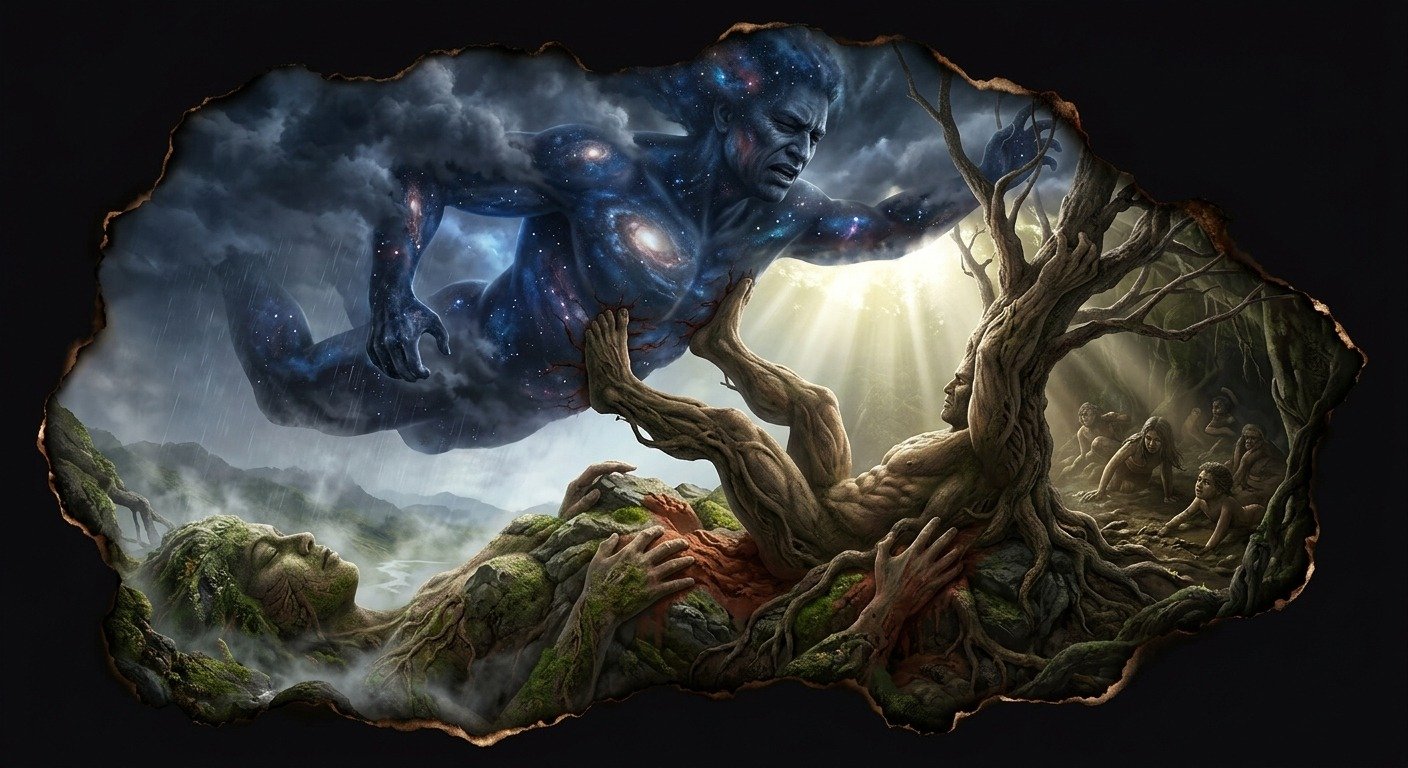
Rangi and Papa: The Eternal Embrace That Suffocated Creation
The Beginning in the Penumbra
Before days and nights existed, before the hills took shape and men walked upon the grass, only two beings existed: Ranginui, the Sky Father, and Papatūānuku, the Earth Mother. They were so deeply in love that they remained locked in an embrace so tight and suffocating that it left no room for anything else. In that damp, warm penumbra, between Papa's breast and Rangi's shoulders, their children, the great gods of nature, were born.
The children grew in the darkness, hunched over, crawling in the mud and stumbling over one another. They knew neither the light of the sun nor the freshness of the wind; only the constant whisper of their parents' love and the oppression of the sky crushing them against the ground. Over time, discontent began to grow among them. They met in secret within the folds of their mother's skin to discuss their fate. The debate was long and bitter. Tūmatauenga, the god of war, the fiercest of them all, proposed killing their parents to free themselves once and for all. But Tāne-mahuta, the god of forests and life, opposed this, suggesting a less bloody but equally definitive punishment: they must separate them, pushing Rangi to the heights to be a stranger above their heads, while Papa remained below to nurture and sustain them.
The Rebellion of the Children
One by one, the brothers attempted to break the primordial embrace. Rongo, the god of cultivated crops, leaned against his father and tried to push with all his might, but Rangi and Papa did not even budge. Tangaroa, the god of the sea, tried with the strength of his tides, but failed. Even Tūmatauenga used his stone axes to cut the tendons binding the couple, staining the earth with a red clay that can still be seen on the cliffs today, but the embrace remained impenetrable.
Finally, Tāne-mahuta stepped forward. He understood that he would not succeed in separating his parents by using the strength of his arms as his brothers had done. Instead, he lay on his mother's back, resting his head against the earth and placing his powerful legs against his father's chest. Tāne, who was the tree of life, began to stretch his trunk and branches toward the sky. His roots penetrated deep into Papa's soil, and his feet pushed Rangi's torso with the force of nature's growth.
The air filled with an immense, painful cracking sound. The parents cried out in agony and wonder as they felt their bodies being torn from each other. Rangi and Papa struggled to keep their fingers intertwined, but Tāne's strength was superior. For the first time, space opened up. Sunlight flooded into the world, blinding the children who had never seen it, and the wind blew free across the face of the newly uncovered earth.
The Eternal Weeping of Creation
Although the children achieved their freedom and the light to populate the world, the separation left an open wound in the heart of the cosmos that has never healed. Rangi was banished to the cold heights of space, while Papa remained below, exposed and lonely.
The pain of their separation manifests every day in weather phenomena. When the sky is covered with gray clouds and rain falls gently upon the forests and valleys, it is nothing but the weeping of Ranginui, who continues to mourn for the wife who was torn from him. And when the morning mist rises from the rivers, valleys, and swamps, floating lazily toward the sky, it is the sigh of Papatūānuku, sending her warmth and love toward the heights, seeking to reach the husband who remains forever out of her reach. Men walk in the space that was left between them, knowing that they live thanks to the sacrifice and pain of a divine love that was broken so that the world could be born.
Comments
Share information, an experience, or a source to help enrich this entry. They are automatically reviewed before being published.
Loading comments...