Pele
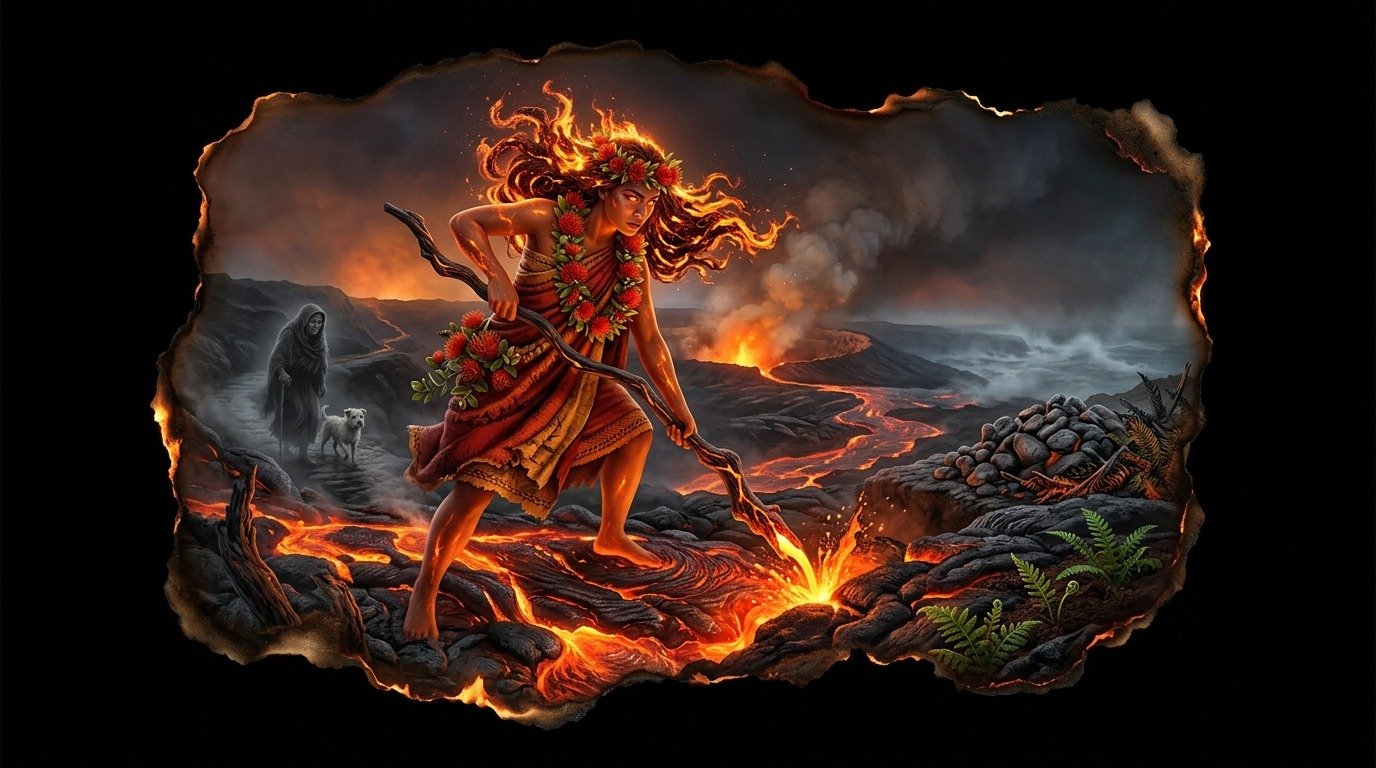
Pele: the fire that devours and begets the earth
The Flight Over the Waves
In the beginning, before her name was synonymous with the molten rock that roars in the depths of the earth, Pele was a traveler. Born in the distant and mythical land of Kahiki, her spirit was too fiery, too untamed for the peace of home. Her insatiable temperament soon pitted her against her older sister, Namakaokahai, the formidable goddess of the waters and ocean currents. The clash between Pele's fire and her sister's waves shook the oceans, forcing the flame-haired young woman to flee north in a great canoe, carrying her younger siblings and her precious secrets of creation with her.
Her journey was a desperate search for a sanctuary where she could plant her sacred staff, the *paoa*. Every time Pele struck the earth on an island of the archipelago, attempting to dig a home for her sacred fire, Namakaokahai caught up with her. The waves flooded her pits, extinguishing the embers with a fury of foam and salt. Thus was born the trail of extinct craters that adorns the Hawaiian islands today: scars of lost battles where water drowned fire. But Pele did not give up. She continued southeast until she reached the youngest island, the summit of Kilauea. There, in the pit of Halemaʻumaʻu, she dug so deep that her sister's water could not reach her. She found the beating heart of the earth and claimed it for herself.
The Dance of Destruction and Life
Pele is not a deity to be contemplated from a distance; she is a physical presence that moves along the slopes of the volcano. She manifests before mortals in three distinct ways, as a warning or a test of character. Sometimes she is a young woman of extraordinary beauty, with wavy black hair that smells of sulfur and *ʻōhiʻa* flowers, walking along lonely paths asking for a drink of gin or a place to shelter. Other times she is a decrepit old woman, hunched and wrapped in gray cloaks, accompanied by a white dog, begging travelers for food. Whoever treats her with respect and shares what they have receives her protection; whoever rejects her with disdain discovers too late that the lava does not respect the boundaries of the proud.
Her power in action is a slow, red tide that devours forests, roads, and entire villages. But in her destruction there is no malice, only an implacable cosmic necessity. Pele's lava destroys the old to build the new. Where today there is fire and gray ash, tomorrow there will be barren black rock, and later, fertilized by her own ash, a vibrant green rainforest that will reclaim the hillside. She is the only deity who still actively sculpts the world, gaining ground from her sister's ocean with every flow of molten rock that solidifies on the coast.
The Tragic Destiny of Lohiʻau
Pele's passion is as devastating as her fire. During a spiritual journey in which she left her body sleeping in the volcanic cave so her consciousness could wander the islands, she heard the drums of a celebration in Kauai. There she saw Lohiʻau, a handsome mortal chief, and fell in love with him. Unable to remain in the spirit world, Pele returned to her physical body and entrusted her younger sister, the sweet Hiʻiaka, goddess of the fern forests, with the task of bringing Lohiʻau to her home in Kilauea.
Pele, consumed by the impatience and jealousy that always stalked her, gave her sister a strict deadline. When Hiʻiaka was delayed due to the dangers of the road and the traps of evil spirits, Pele believed she had been betrayed. In a fit of blind fury, she laid waste to her sister's beloved fern groves and ordered Lohiʻau to be buried under a rain of hot stones and lava just as the two reached the summit. When Hiʻiaka, heartbroken with grief, unearthed her beloved's body and revived him with her chants, Pele understood the devastation her mistrust had caused. The fire of her wrath was extinguished in a lament that shook the walls of the crater, a reminder that even gods must submit to the ashes of their own mistakes.
The Strands of the Goddess
Pele's presence lives on in the very texture of the volcanic landscape. The strands of volcanic glass blown by the wind, so fine they look like golden hair, are called "Pele's hair" by the locals. The small droplets of black obsidian that dot the hillsides are her tears. Travelers who visit her domain know they must not take even a single fragment of volcanic rock as a souvenir; to do so is to steal a piece of the goddess's own body, unleashing a curse of misfortune that is only broken when the stone is returned to the slopes of Kilauea, the home where Pele still rests, watching over the abyss with eyes of burning embers.
Comments
Share information, an experience, or a source to help enrich this entry. They are automatically reviewed before being published.
Loading comments...