The Rainbow Serpent
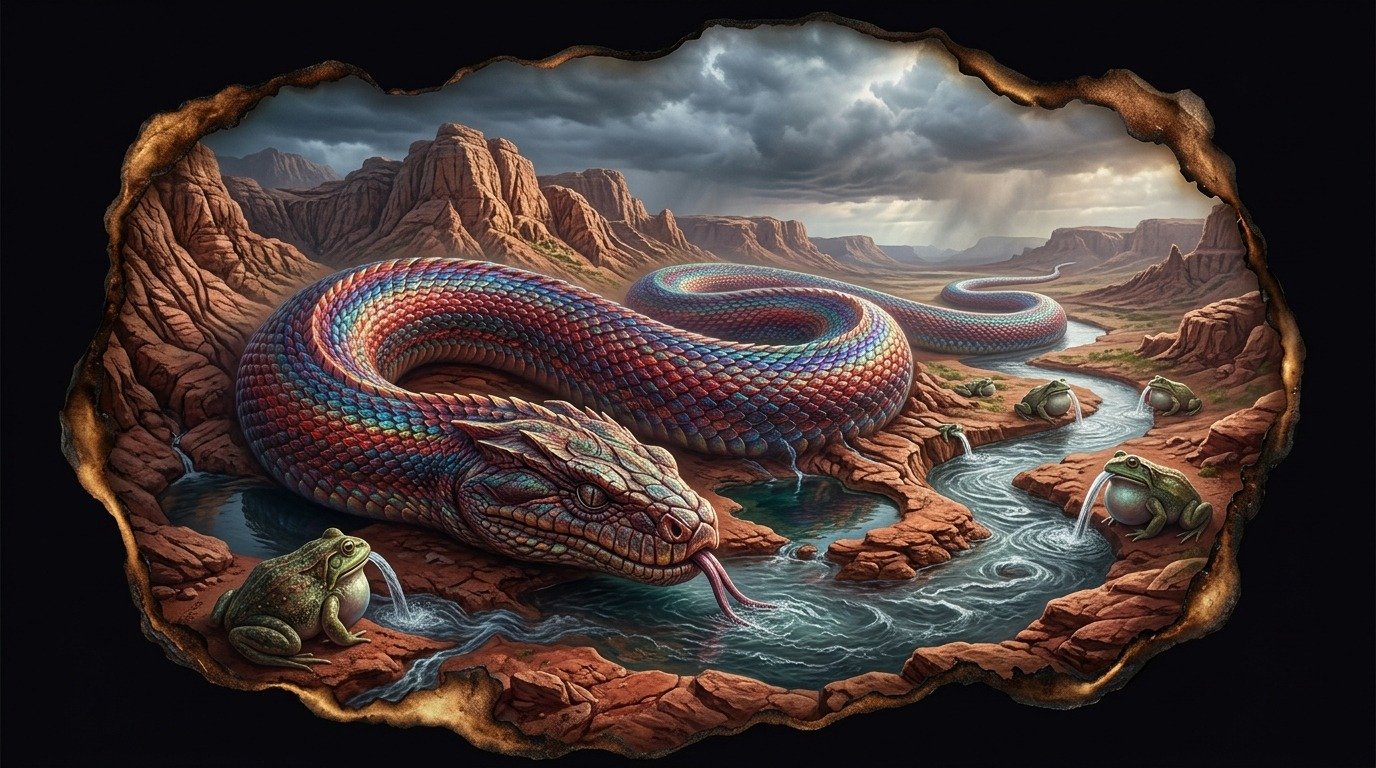
The Rainbow Serpent: The Pulse of Water and Earth that Begot the Dreamtime
The Awakening in the Plain of Nothingness
Before time had a name, when the Earth was a flat, cold, and silent crust, she slept in the bowels of the rock. There were no trees to comb the wind, nor rivers to sing in the valleys, nor claws to tear the earth; there was only the silence of that which is not yet born. She, a creature of colossal proportions and scales containing all the colors of fire and deep water, lay coiled in the womb of the world.
When the time came to awaken, she did not do so with a crash of splitting rocks, but with a sigh that stirred the first breeze. As she rose, her immense body began to slide across the infinite plain. Each ripple of her belly against the ground left a scar that became a riverbed; where her heavy head rested, the earth sank to form lagoons and deep pools; where she coiled to sleep under the sun, the mountains and gorges of red stone rose toward the sky.
As she moved forward, the Serpent called to the beings that still slept beneath the ground. With a low bellow that echoed in the roots of the stones, she summoned the frogs to emerge from the abysses with their bellies swollen with pure water. Touching them with her forked tongue, the frogs poured the liquid over the earth, filling the furrows that the deity's body had carved. Thus were born the rivers, the creeks, and the sacred waterholes that saved the world from eternal aridity. The landscape was no longer a memoryless desert, but a living body, sculpted by the passage of the creator.
The Breath of the Monsoon and the Sacred Springs
This deity does not belong exclusively to the sky or the earth; she is the bridge that unites both worlds. When the sun scorches the desert and the grass turns to ash, she retreats to the depths of the darkest waterholes, the billabongs that never dry up, where she rests hidden from the gaze of mortals. There, beneath the mud and aquatic plants, her breath keeps the water cool and pure.
But when the earth can no longer bear its thirst, the Serpent ascends. She rises from her sacred waterhole, stretching her multicolored body until it touches the clouds, transforming into the rainbow that cuts across the sky after the storm. That bright arch is her arched back, a sign that she is traveling from one waterhole to another to ensure that life continues. Her passage through the heights summons lightning and unleashes the monsoon: the torrential rain that restores green to the cracked plains.
This power, however, is as generous as it is terrible. The Serpent is the water that nourishes, but also the flood that devours. When men pollute the springs, when they hunt more than they should, or ignore the laws of the land, the deity stirs in her slumber. Her scales vibrate and the rivers overflow, swallowing entire camps beneath torrents of red mud. The very element that gives life becomes, under her wrath, a liquid grave.
The Judgment of the Deep Pool and the Law of the Flesh
Purity and order are the obsessions of the Serpent. She does not tolerate the desecration of the sacred nor the breaking of the taboos that sustain the balance of the cosmos. The myth that best defines her relentless and transformative character is that of the two sisters who traveled through the virgin land with their children.
One evening, tired from their journey, they camped near the waterhole where the great Serpent slept. Without knowing it, one of the sisters, who had just given birth, let a few drops of blood fall into the mirror of sacred water. The scent of life and transgression penetrated the depths of the waterhole, awakening the deity from her peaceful slumber.
The Serpent emerged slowly, crowned by a dense, dark mist that hid the stars. With a hiss that mimicked the roar of the wind through the eucalyptus trees, she slithered toward the camp. The sisters tried to appease her by singing and dancing the dances of creation, but the deity was already an unleashed force. With a swift, clean movement, she swallowed both women and their little ones in a single gulp.
However, the Serpent's act is not a mere display of cruelty, but a rite of death and resurrection. After devouring them, she returned to the sky transformed into a gigantic rainbow, and upon descending to the earth once more, she vomited the sisters and their children onto the grass. They were no longer the same: their bodies had been purified in the womb of the deity, stripped of their impurities, and transformed into the first initiates, bearers of the songs and laws that men were to follow forever. From that day on, mortals knew they had to present themselves before her with respect, painting their own bodies with red ochre and white clay to imitate the scales of the sacred monster.
The Eternal Echo in Stone and Quartz
The Rainbow Serpent is not a legend of the past; she is a constant presence that continues to breathe beneath the earth. Her power is concentrated in the quartz crystals that wise men and healers extract from deep caverns. It is said that these shining stones are, in reality, scales shed from her body, fragments of her celestial light that grant whoever possesses them the ability to see inside souls, to call the rain, and to heal sicknesses of the spirit.
In the rock shelters of the oldest mountains, where the wind has sculpted ghostly shapes, her oldest portraits are preserved. Painted with natural pigments that defy the passage of millennia, her serpentine, floating figure watches over those who pass below. For desert travelers, these paintings are not simple representations: they are portals. By touching the painted stone, one can feel the vibration of her colossal body, which continues to dream the world so that it does not fade into nothingness. As long as the Serpent continues to dream at the bottom of her dark waterholes, the earth will continue to bloom after the storm.
Comments
Share information, an experience, or a source to help enrich this entry. They are automatically reviewed before being published.
Loading comments...