Cerro Uritorco
Cerro Uritorco: The Stone Portal and the Underground City of Erks
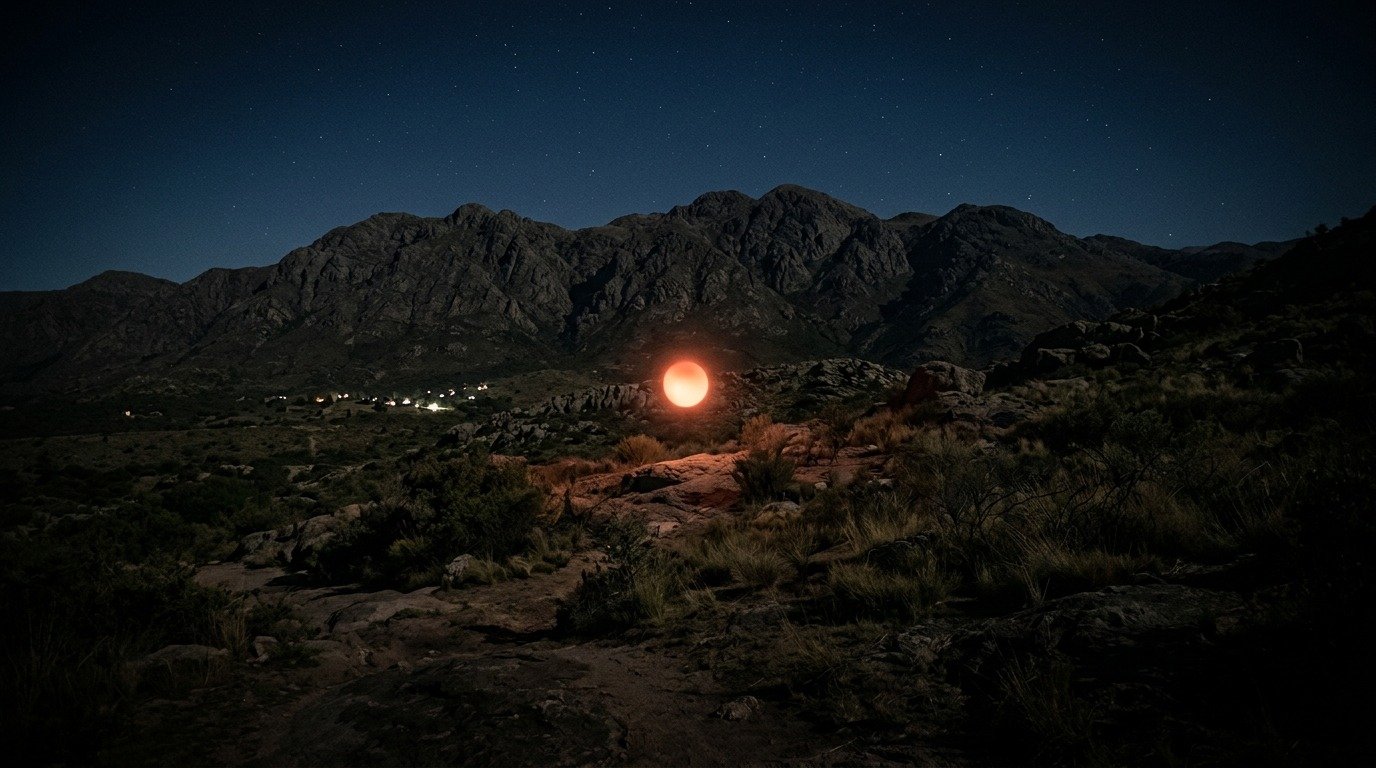
On the night of January 9, 1986, a red light the size of a bus crossed the sky of the Sierra Chica of Córdoba and settled against the slope of Cerro El Pajarillo, a direct neighbor of the colossal Uritorco. The young boy Gabriel Gómez and his grandmother watched the flash from the windows of their rustic cabin. At dawn, neighbors and local police found a perfect mark on the pasture: a burned oval 120 meters (394 feet) long by 70 meters (230 feet) wide. Within that perimeter, insects lay charred and the roots of the vegetation had been reduced to ashes, without the fire having spread a single centimeter (0.39 inches) outside the border. The black spot on the hillside was not just the trace of an inexplicable combustion; it was the starting gun for the modern fever for South America's most mysterious hill.
The Sanctuary of the Stone Men
Long before UFO seekers filled its slopes, the Comechingones ruled these lands. For this ethnic group of tall, bearded warriors, Cerro Uritorco—whose name, in Quechua, means "hill of the parrots"—was a living temple of stone. The natives climbed to the summit to perform initiation rituals and communicate with the entities that, according to their tradition, inhabited the heart of the mountain.
The pre-Hispanic warriors observed lights that welled up from the depths of the rock and crossed the night sky noiselessly; they called them "divine lights" and considered them souls of their ancestors and guardians of the territory. When the Spanish conquistadors, led by Captain Tristán de Tejeda, began their bloody campaign of subjugation in the 16th century, hundreds of natives took refuge on the hill. Before accepting slavery and forced baptism, entire communities threw themselves into the void from the cliffs of neighboring Cerro Ongamira. Since that moment of sacrifice, Uritorco remained imbued with an energy of resistance and mystery that locals respect to this day.
Erks and the Surgeon of Light
In the 1980s, the myth of the hill was transformed forever with the revelation of Erks (Encounter of Remnants of Sideral Kosmos), the inner-earth city that supposedly sleeps beneath the stone roots of Uritorco. The person who gave shape and name to this mystery was the osteopathic physician of Greek origin, Ángel Cristo Acoglanis.
Acoglanis claimed to channel a being named Sarumah and guided groups of initiates through Los Terrones during the early hours of the morning. In the pitch darkness of the Córdoba hills, the doctor chanted in an unknown language, which he called "cosmic," to invoke the lights of the hill. Those who accompanied him on these vigils witnessed huge luminous spheres floating over the pastures and temples of white light materializing for a few seconds among the folds of the mountain. The mystery turned tragic on April 19, 1989, when Acoglanis was shot to death in his Buenos Aires office by his close friend Rubén Antonio, who committed the crime without saying a word and took the motives for the execution to his grave. The death of the channeler of Erks only fueled the certainty that the doctor had opened doors that should have remained closed.
What the Shadows of the Sierra Hide
Today, those who climb Uritorco experience physical alterations that go beyond the routine of a simple hike. Compasses lose magnetic north halfway through the ascent, the batteries of mobile phones and cameras drain completely in a matter of minutes, and recharge themselves once the visitor descends.
Mountain guides and park rangers accumulate stories of small spheres of white or amber light that move at ground level, dodging trees with intelligent movements, before vanishing upon hitting the granite walls. Those who camp on the lower slopes report a subtle but constant hum vibrating beneath the earth during the coldest hours of the night, a low frequency that alters the heart rate and causes an intense feeling of alertness, as if the entire mountain were breathing.
The Physics of the Granite Giant
The most frequently cited rational explanation points to the composition of Uritorco. The hill is an immense block of granite, quartz, and feldspar, materials with extreme piezoelectric properties. The tectonic pressure generated by the underground geological faults of the Sierra Chica mechanically compresses these minerals.
This constant compression generates immense electromagnetic fields and ionizes the air at ground level, causing the physical phenomenon of earthquake lights: floating luminous discharges that react to air currents and the humidity of the sierra. This same electromagnetic activity saturates the components of hikers' electronic devices and distorts local magnetism, rendering compasses useless.
The Sentinel of the Valley
As evening falls in Capilla del Monte, clouds often surround the peak of Uritorco, forming perfect discs that the twilight light tints violet. Below, in the town, portal seekers watch the horizon, waiting for the first sign. Above, the stone colossus remains immutable, hiding beneath its millions of tons of quartz the secrets of those who died on its slopes and the lights that insist on bursting from its cracks.
Comments
Share information, an experience, or a source to help enrich this entry. They are automatically reviewed before being published.
Loading comments...