Dragon's Triangle
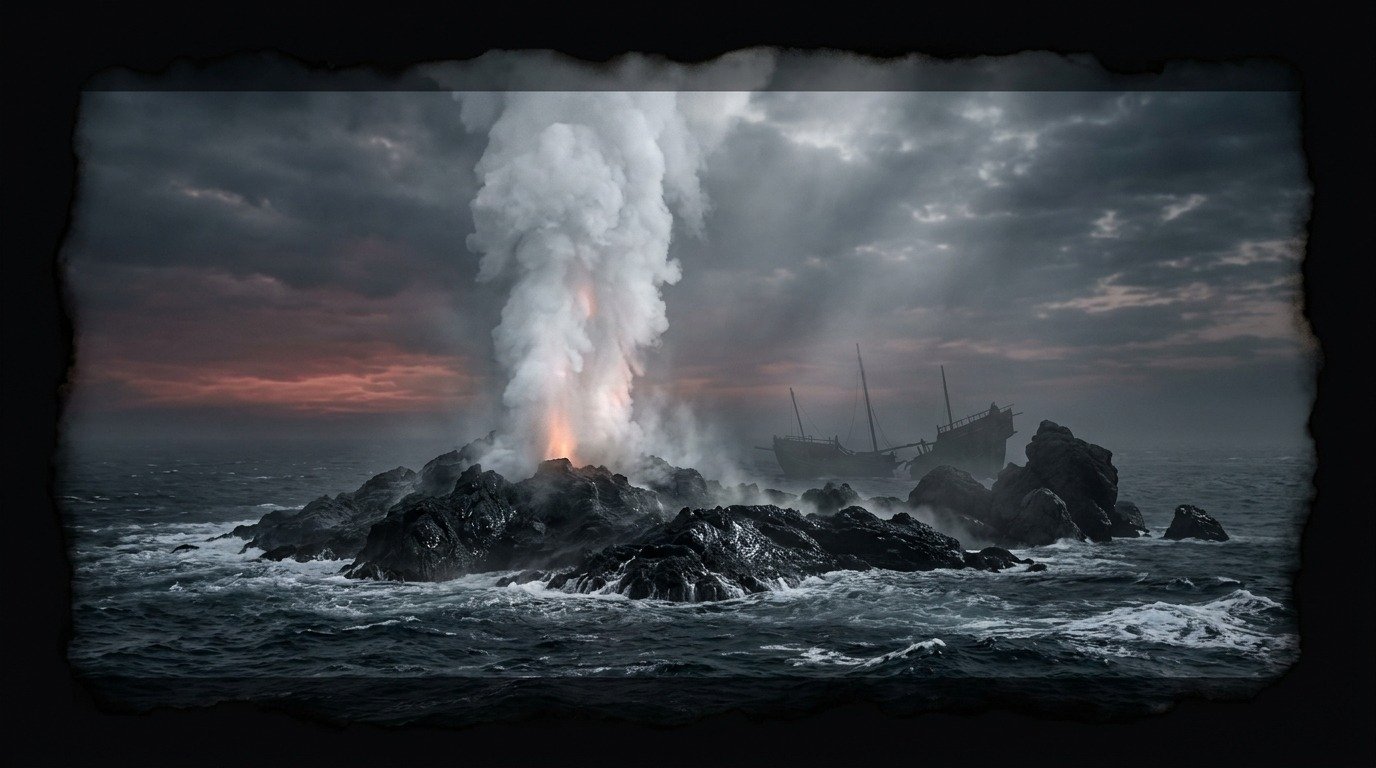
Dragon's Triangle: The Graveyard of Ships in the Devil's Sea
The Boiling of the Izu Sea
In September 1952, the research vessel *Kaiyo Maru No. 5* of the Japan Coast Guard set sail for an unstable area of the Pacific Ocean, about four hundred kilometers (248 miles) south of Tokyo. Its mission was to study an underwater volcano that had just erupted. As the *Kaiyo Maru* approached the Myojin-sho reefs, the sea began to boil violently. A massive column of steam and volcanic ash rose into the sky. The ship, with its thirty-one crew members and scientists on board, vanished from radar at that very instant. Rescue patrols that arrived at the site the following day found no trace of the vessel.
The Lost Ships of the Great Khan
The Dragon's Triangle, known by local fishermen as *Ma-no Umi* (The Devil's Sea), is an area bounded by the east coast of Japan, the Bonin Islands, and the Mariana Islands in the Philippine Sea. Its stories of shipwrecks are ancient, and legend likes to add to them one of the most famous naval defeats in history: in the 13th century, the Mongol emperor Kublai Khan attempted to invade Japan twice with fleets of thousands of ships, and on both occasions typhoons destroyed them, giving rise to the term *kamikaze* (divine wind). Those fleets sank off the coast of Kyushu Island, far from these waters, but mystery hunters incorporated them into the Devil's Sea.
The Dragon Palaces Beneath the Waves
Japanese legends describe the ocean as the dwelling place of colossal dragons that inhabit jade palaces on the seabed. Ancient fishermen swore that these monsters generated gigantic whirlpools and eruptions of fire from the depths to drag down wooden ships and feed on their crews, warning future generations that no man should fish in those dark waters.
The Fog of Sudden Death
Today, the Devil's Sea continues to inspire deep respect among merchant navy sailors. Those who transit the area report brutal weather changes that develop in a matter of minutes: high-intensity storms that arise under completely clear skies and the appearance of "dead seas," areas where the water becomes dense and thick like oil, preventing the progress of ship propellers while communication instruments go completely silent.
The Calderas of the Izu-Bonin Trench
Marine geology reveals that the Dragon's Triangle rests directly atop the Izu-Bonin Trench, one of the most active and unstable tectonic zones on the planet, where the Pacific Plate and the Philippine Plate collide. Underwater volcanic activity is constant, and it was a volcano—the Myōjin-shō reef—that destroyed the *Kaiyo Maru No. 5*. Some scientists propose that eruptions release gases capable of reducing water density and causing a ship to sink suddenly. These same eruptions create islands of ash and lava that rise to the surface and disappear in a few weeks, baffling cartographers.
The Ephemeral Island
A column of white steam crowns a newborn piece of black rock emerging from the waves of the Pacific; by the time the next merchant vessel crosses these coordinates, the island will have returned to the depths of the abyss from which it arose.
Comments
Share information, an experience, or a source to help enrich this entry. They are automatically reviewed before being published.
Loading comments...