Bael
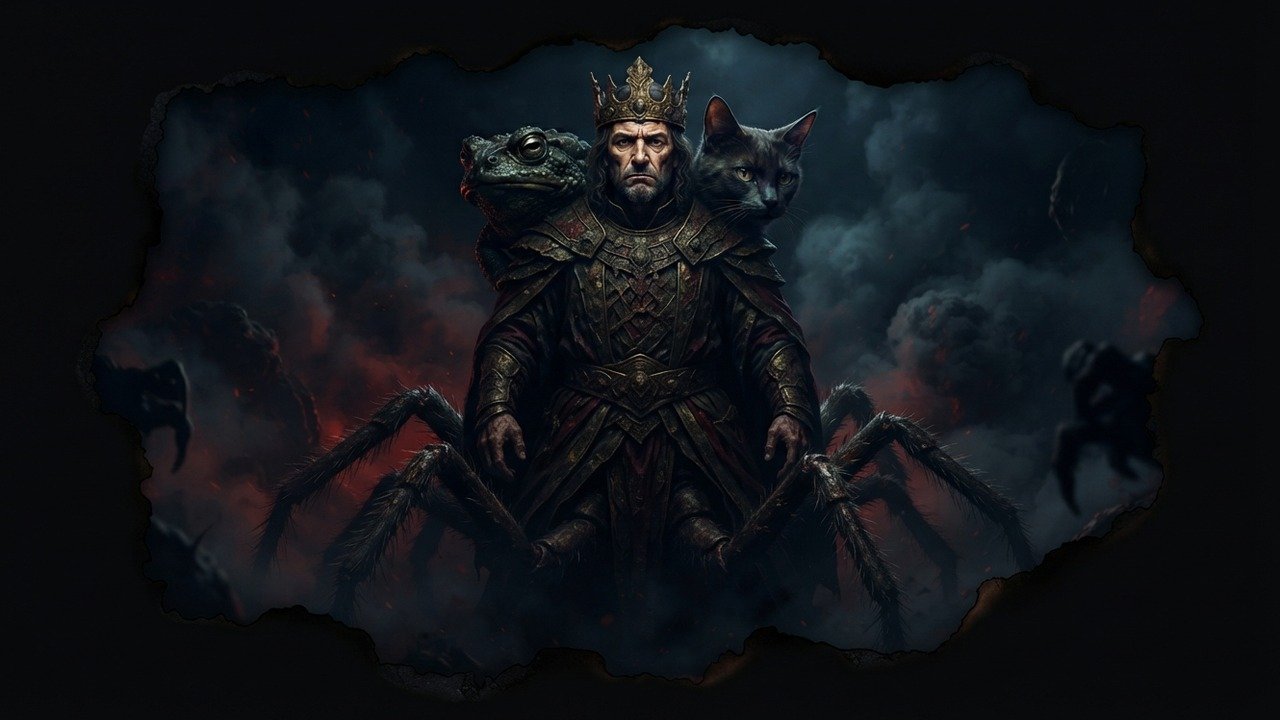
The Legacy of Bael: The First King of the Abyss and the Shadowed Sun
1. The Storm Root: His True Origins
To find the primary substance of Bael, one must scrape away the patina of medieval demonology and venture into the Fertile Crescent of the ancient Bronze Age. Before being reduced to a sigil in the grimoires of Solomon, Bael existed as Ba'al (a Semitic word for "Lord" or "Owner"), not as a singular proper name, but as the supreme title bestowed upon the solar, fertile, and tempestuous divinity that ruled over Ugarit, Canaan, and Phoenicia.
His most prominent manifestation was Ba'al Hadad, the god of rain, thunder, and vegetation, who fought against Mot (the god of death and drought) in an eternal cycle of death and resurrection. For the agricultural civilizations of antiquity, Ba'al was the pillar of existence: the lightning bolt that split the sky to fertilize the earth. However, in the Phoenician Pantheon, the deity possessed a sovereign, regal, and ruthless character when cosmic justice demanded it. Jewish assimilation and subsequent biblical polemics stripped Ba'al of his divine status, reducing him to the antithesis of the Hebrew God. Local titles such as Ba'al Zebub ("The Lord of the High House," pejoratively distorted by the Hebrews as "The Lord of the Flies") or Ba'al Peor marked the first steps in the fragmentation of the regal god into multiple lesser demons.
2. Degradation in the Grimoire: From God of the Sky to King of Hell
With the consolidation of monotheistic demonology in the Late Middle Ages and the Renaissance, the ancient Lord of the Heavens was cataloged, bound, and reorganized within the infernal hierarchy. In Johann Weyer's Pseudomonarchia Daemonum (1577) and, subsequently, in the Goetia of Solomon (17th century), the transformation was complete: Ba'al became Bael, the first Great King of Hell, ruler of the East, commanding 66 legions of infernal spirits.
Demonologists no longer saw him as the king who brings rain, but as a composite, dark, and grotesque entity. He was commonly described as manifesting with three heads on a single body: one of a crowned man, one of a toad, and one of a cat, moving on spider legs or an amorphous torso. This iconography was not accidental:
The head of a man: Represents sovereignty, corrupt reason, and regal cunning.
The head of a toad: Symbolizes primary transmutation, stagnant waters, the underworld, and the patience of the predator.
The head of a cat: Embodies night vision, stealth, and intuition detached from human morality.
In later alchemical and occult language, this visible degradation hid a key of concealment: the bright god of the sky had been buried beneath matter to become the custodian of the light hidden within dense matter.
3. Esoteric Significance: Invisibility and the Throne of the Sovereign Ego
In the system of the Dark Kabbalah and work with the Qliphoth, Bael is intimately linked to the sphere of Thaumiel (the Twins of God, the reverse of Kether) and sometimes operates in the abyss of Golachab (the force of destruction and purifying fire). Bael is the archetype of Absolute Dominion over Perception.
The Gift of Invisibility: Classical tradition claims that Bael grants the ability to become invisible. For the modern mage and depth psychology, Bael's invisibility is not the physical disappearance of the body, but the ability to operate in reality without being detected by the radars of the masses. It is mastery over fascination and astral camouflage; the faculty to pull the strings of an event from the shadows without claiming public credit, dissolving the visible ego to execute pure will.
The Triangulation of Consciousness: The three heads of Bael represent the integration of three levels of perception: the logical/regal mind (man), the instinctive/nocturnal mind (cat), and the somatic/subconscious mind (toad). The spider that supports these three perspectives is the ability to weave one's own web of reality.
While Lilith breaks chains and Baphomet synthesizes opposites, Bael teaches the art of cold sovereignty and the manipulation of form. He is the principle of the Dark Monarch: the steadfast will that requires no external approval to rule its own domain.
4. Practice, Manifestation, and Sovereign Approach
Bael's energy is neither chaotic nor hysterical; it is dense, imperial, resonant, and of a suffocating gravity. When this force approaches, the physical environment tends to feel heavy, with a vibration at the base of the skull and a sensation of being under the gaze of an immemorial majesty that tolerates neither weakness nor faltering.
How he acts in reality: Bael manifests in the individual as an implacable strategic sharpness, the ability to maintain emotional control in the midst of absolute crises, and the faculty to go unnoticed when external attention would be destructive. It is the force that allows one to build a silent empire before the world even notices its existence.
Energy management and protection: Approaching Bael must never be done from a place of submission, desperation, or servility. Treating an ancient King with a lack of dignity is an invitation to psychic crushing.
Sovereignty and Respect: The practitioner must operate as a sovereign in their own microcosm. Protection against the devouring or paralyzing aspect of Bael is not achieved through fear-based exorcisms, but through one's own mental axis: an unwavering will, clarity of purpose, and the elimination of emotional noise.
Balance: The unbalanced influence of Bael can lead to pathological isolation, paranoia of paranoia, or a tyrannical ego dissociated from reality. To counteract this density, the mage must ground the energy by working with the earth element through physical discipline and concrete realization on the material plane (Coagula).
Bael does not hand over his wisdom to the curious. He is the master of strategic silence: he teaches that true power does not need to shout to master the storm.
Comments
Share information, an experience, or a source to help enrich this entry. They are automatically reviewed before being published.
Loading comments...