Asmoday
The King of Raging Wrath and the Alchemy of Unwavering Desire
Origin and Legend: The Daeva of Purifying Fire
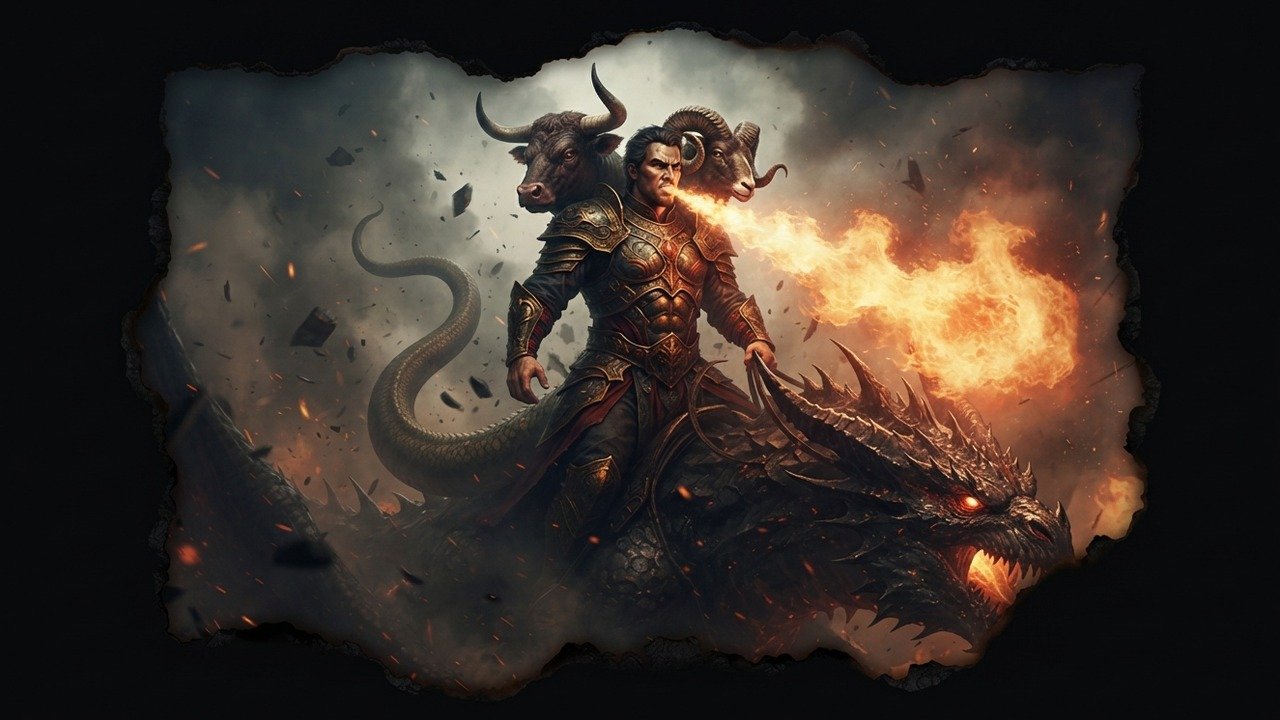
To find the irrefutable origin of Asmoday (Asmodeus), one must go back to the Zoroastrianism of ancient Persia. His name derives from the Avestan Aeshma-daeva: the demon of wrath, fury, and destructive passion. In Mazdean cosmology, Aeshma was the force that drove violence and discord, but also the intensity of the fire that consumes inertia. Subsequently, the Judaic tradition adopted this entity in the Book of Tobit and the Talmud, transforming him into the killer of Sarah's seven husbands and the cunning king who challenged King Solomon himself, snatching his ring of power and temporarily ruling in his place. In the Lemegeton, Asmoday is a Great King, formidable and majestic, who displays three heads (a bull, a man, and a ram), a serpent's tail, spitting fire from his mouth, and riding upon an abyssal dragon.
Historical Evolution: From the Monster of Lust to the Force of Creativity
During the Inquisition and the witch hunts, the Catholic Church constrained the archetypal immensity of Asmoday, pigeonholing him almost exclusively as the ruling demon of the deadly sin of Lust and the cause of possessions in convents (such as the famous Loudun case). However, Renaissance occultism and the grimoires of high magic maintained his status as one of the most powerful entities of the shadow cosmos. He was recognized not only as the lord of earthly pleasures, but as the Great Geometer, the bestower of the Ring of Virtues, and the master of arithmetic and unwavering craftsmanship. The occult current understood that the energy the Church called "lust" was actually the primary force of Creation and the Kundalini Fire in its purest, untamed state.
Esoteric Meaning: The Fire of Will and Creative Passion
In the mysticism of the Left-Hand Path and depth psychology, Asmoday represents the Supreme Vital Fire: libido in its full analytical sense, the overwhelming impulse that drives art, magic, sex, and earthly conquest. His three heads symbolize fertility and stubbornness (the Bull), human strategy and intellect (the Man), and genital and initiatory energy (the Ram). Asmoday is the embodiment of desire that refuses to be repressed by castrating morality. In the Qliphothic Kabbalah, he rules over realms of scorching fire where the false ego is burned away to expose the Will of Steel (Thelema). He is not irrational chaos, but passion channeled with geometric intelligence.
Practice and Manifestation: Vital Mastery and Purifying Fire
Asmoday manifests as a dense heat at the base of the spine, an exponential increase in physical energy, determination, and a magnetic presence in any environment.
Manifestation in the Individual: When his energy touches the practitioner, it destroys apathy, doubt, and false modesty. It awakens a devouring ambition, a fierce creativity, and a sexual and intellectual magnetism before which weak minds bend or are scandalized.
Approach and Sovereignty: Approaching Asmoday without a personal ethical axis or a solid mental vessel is equivalent to throwing oneself into a blazing furnace. This force does not tolerate weakness of character or guilt. The mage must approach this entity from the absolute sovereignty of their own desire, using the fire to transmute their weaknesses into power. Protection against the devouring aspect of Asmoday—obsession, blind wrath, or hedonistic self-destruction—lies in strict discipline: passion must be the steed, but the sovereign mind must always hold the reins.
Comments
Share information, an experience, or a source to help enrich this entry. They are automatically reviewed before being published.
Loading comments...