Vine
The Astrologer King and the Architecture of the Occult
The Specter upon the Wooden Lion: Mesopotamian and Solomonic Origins The nature of the Forty-Fifth King of classical demonology was not forged in medieval monasteries, but in the telluric currents of ancient Lower Mesopotamia. Vine—a phonetic derivation from Aramaic and West Semitic for the grapevine (Gephen) and the forces that weave plant matter with the earth—sank his roots into pre-Neo-Babylonian agricultural and astronomical mythology. Originally, he appeared as a protective genius of viticulture and territorial boundaries, a tutelary entity associated with the demarcation of natural borders and the revelation of underground secrets.
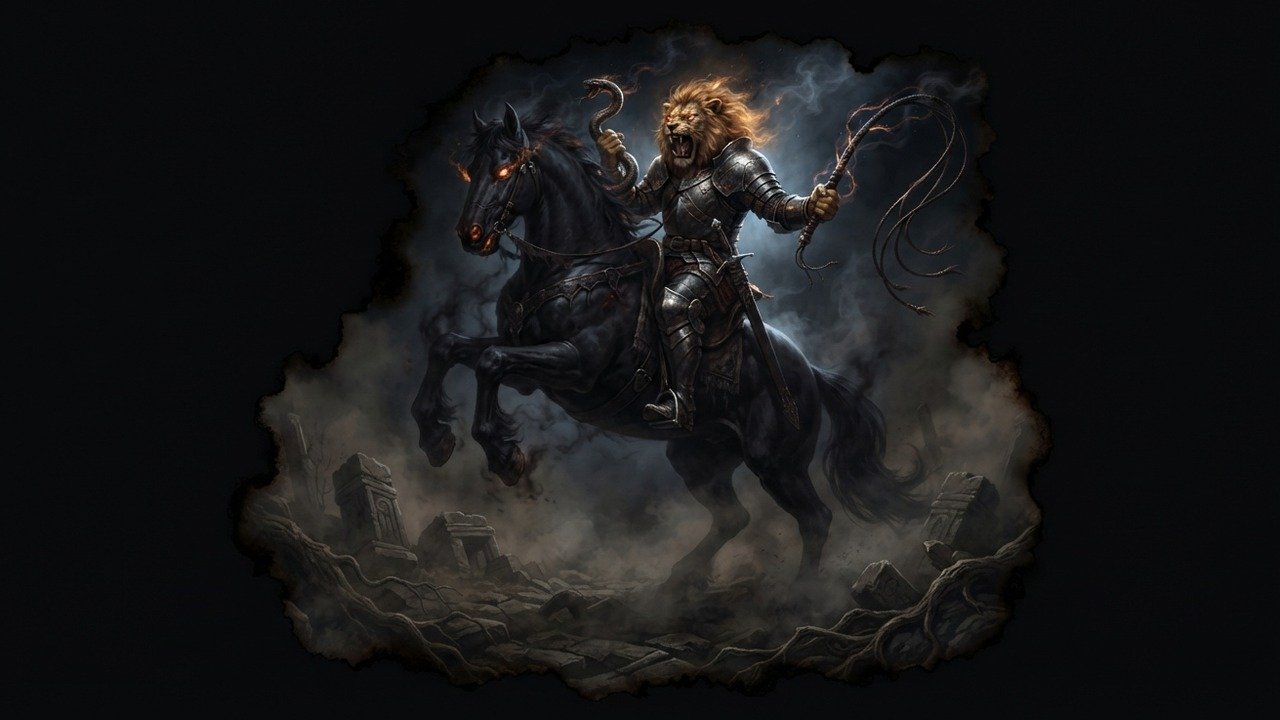
In the tradition of the Lemegeton and the Pseudomonarchia Daemonum, Vine is codified as a Great and Mighty King of Hell. He appears in the form of a roaring lion riding a black horse, holding a whip or a serpent in his right hand. The lion does not represent moral evil, but rather condensed solar force; the black horse symbolizes the vehicle of shadows upon which the will dominates the astral tides.
From Sacred Botany to Medieval Demonomancy With the expansion of Christianity and the structuring of European grimoiric tradition (15th to 17th centuries), Vine's function was refined by clerics and ceremonial magicians. Johann Weyer and the compiler of the Goetia identified Vine as the only demonic entity simultaneously capable of three highly complex tasks: discovering the hidden (witches, conspiracies, and treasures), revealing the past, present, and future, and building or tearing down stone fortresses and spiritual walls.
The Church transformed the guardian of boundaries into the "demon of espionage and ruin." However, alchemical treatises read his symbol differently: the grapevine (Vine) is the plant that extracts the invisible substance from the earth and transforms it, through the sun, into the wine of transmutation. Vine went from being a specter of ruin to being recognized as the Master Architect of the subtle plane.
The Kabbalah of Shadows and the Mirror of Time In the scheme of the Dark Kabbalah and the map of the Qliphoth, Vine aligns with the sphere of Tiphereth submerged in shadow (Thagirion), the black sun where naked truth is revealed without the filters of the human ego. Vine is the archetype of the Panoptic Eye and Sacred Geometry.
He represents the principle of analytical clairvoyance: the spirit's ability to see through the facades of matter. As a builder of towers, he symbolizes the construction of the individual's psychic structure; as a destroyer of walls, he represents the power to collapse the mental and spiritual defenses of enemies or one's own neurotic illusions. He is the architect who measures the solidity of the invisible foundations upon which a life or a work stands.
Manifestation and Sovereign Approach Vine does not operate through hysteria or emotional disturbance. His presence in the magician's sphere is dense, gravitational, and highly lucid.
Mode of Action: He manifests as a flash of absolute insight or through structured visions of past and future events. On the psychic plane, Vine destroys paranoia, replacing it with cold facts; he exposes the hidden intentions of third parties and breaks the magical or psychological protections of those who attempt to act in the shadows against the operator.
Approach and Sovereignty: Working with the energy of Vine demands ironclad mental discipline. He does not tolerate self-pity or vagueness. He is approached through the precise layout of the ritual space (strict geometry) and a clear intention to know the truth, no matter how painful it may be. To guard against his destructive aspect—which can tear down one's own psyche if it is built on lies—the practitioner must anchor their mind in absolute honesty and personal sovereignty.
Comments
Share information, an experience, or a source to help enrich this entry. They are automatically reviewed before being published.
Loading comments...