The Rosenheim Poltergeist
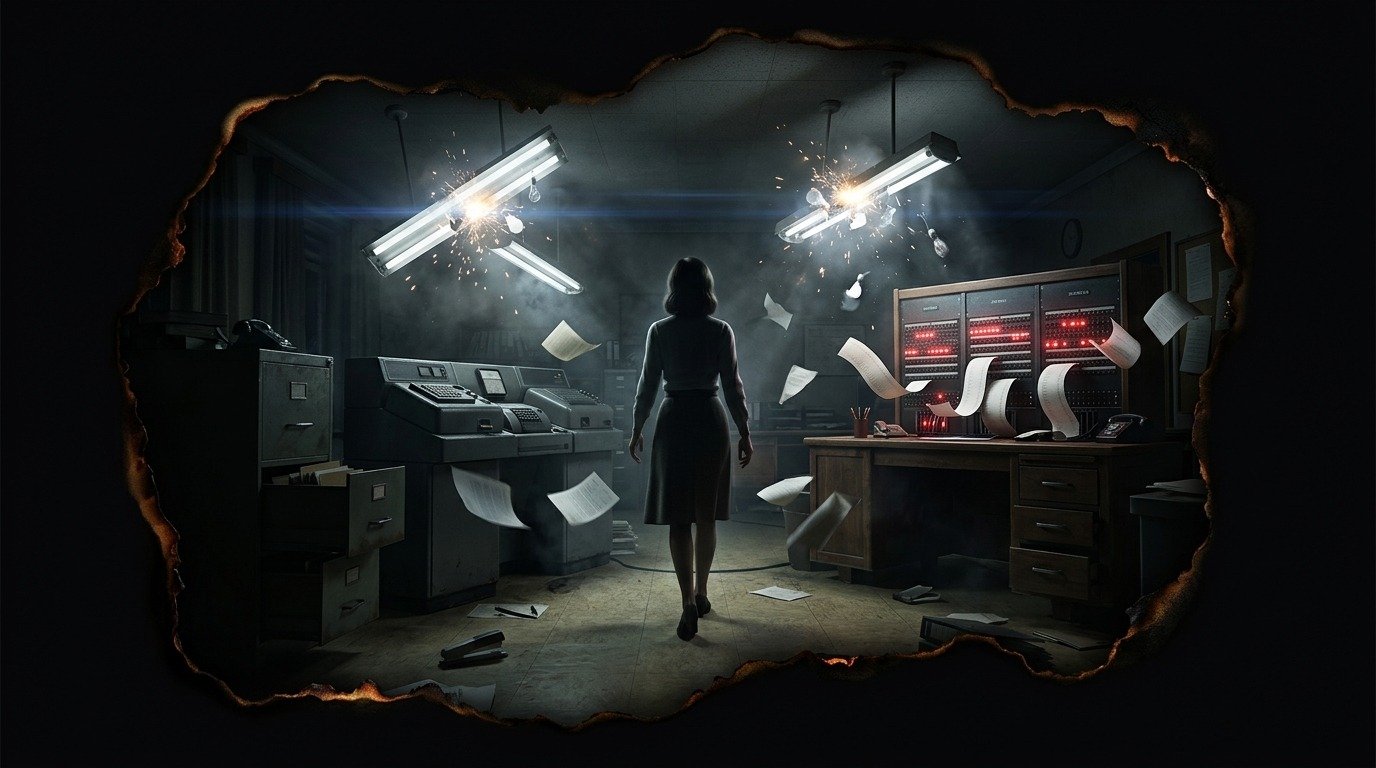
The Rosenheim Poltergeist: The Documented Physical Anomaly
What Happened
The Rosenheim poltergeist is the case of psychokinetic activity best instrumentally recorded by science in modern history. During the autumn of 1967 and the spring of 1968, a law firm in southern Germany suffered massive mechanical and electrical failures, impossible automatic telephone calls, and movements of heavy objects that coincided exactly with the presence of a nineteen-year-old employee.
The Protagonists and the Place
The phenomena occurred in the office of lawyer Sigmund Adam, located on Königstraße street in the city of Rosenheim, Bavaria (Germany). The central figure who acted as the emitting focus of the energy was Anne Marie Schneider, a nineteen-year-old young woman recently employed as a secretary at the firm.
The Facts
The activity began in October 1967. The office ceiling light bulbs began to burst without explanation, and the fluorescent tubes rotated ninety degrees inside their fixtures. The telephone system collapsed completely: the switchboard recorded hundreds of simultaneous calls made within a few minutes to the speaking clock service (the number 0119), billing the firm thousands of German marks. These calls were made at speeds that the analog technology of the time did not allow and continued even when the physical telephones were disconnected from the wall.
The phenomenon evolved into physical telekinesis. Desk drawers opened on their own, ejecting documents into the middle of the room. Photocopier fluid spilled spontaneously without the machine being in use. A heavy painting weighing more than one hundred kilograms (220 lbs) hanging on the wall of the lawyer's office rotated 360 degrees on its nail, leaving the mark of the movement on the wall's paint.
The Investigation
Lawyer Adam initially reported the events to the state electric company and the telephone company, suspecting technical sabotage. The Siemens company sent two of its best engineers, who installed independent generators and precision voltage recorders. The instruments recorded strong deviations in the needle of the current meters that did not come from the public power grid or the internal generators.
Faced with the technical bewilderment, Dr. Hans Bender, director of the Institute for Frontier Areas of Psychology at the University of Freiburg, took over the investigation of the case along with two physicists from the Max Planck Institute in Munich. The scientific team discovered that the physical disturbances and voltage surges occurred only during working hours and intensified drastically when the young Anne Marie Schneider walked through the office hallways.
The scientists verified that when Anne Marie was on sick leave or absent from the building, the electrical and telephone activity returned completely to normal. In 1968, Anne Marie was dismissed from the firm, and the activity in Rosenheim ceased immediately. The final report by the physicists from the Max Planck Institute determined that the phenomena were not due to known physical causes in the electrical grid or mechanical fraud, attributing the activity to a manifestation of recurrent spontaneous psychokinesis (RSPK).
The Legacy
The Rosenheim case is the pillar of German scientific parapsychology. It demonstrated through laboratory instruments that the human mind under severe emotional tension can generate discharges of physical energy capable of altering communication systems and stable electromagnetic fields. The case is studied internationally as physical proof of the existence of the poltergeist phenomenon detached from theological causes.
Comments
Share information, an experience, or a source to help enrich this entry. They are automatically reviewed before being published.
Loading comments...