Ogún
Ogún: The Iron That Forges Destiny
The Pioneer of the Metal Mountain
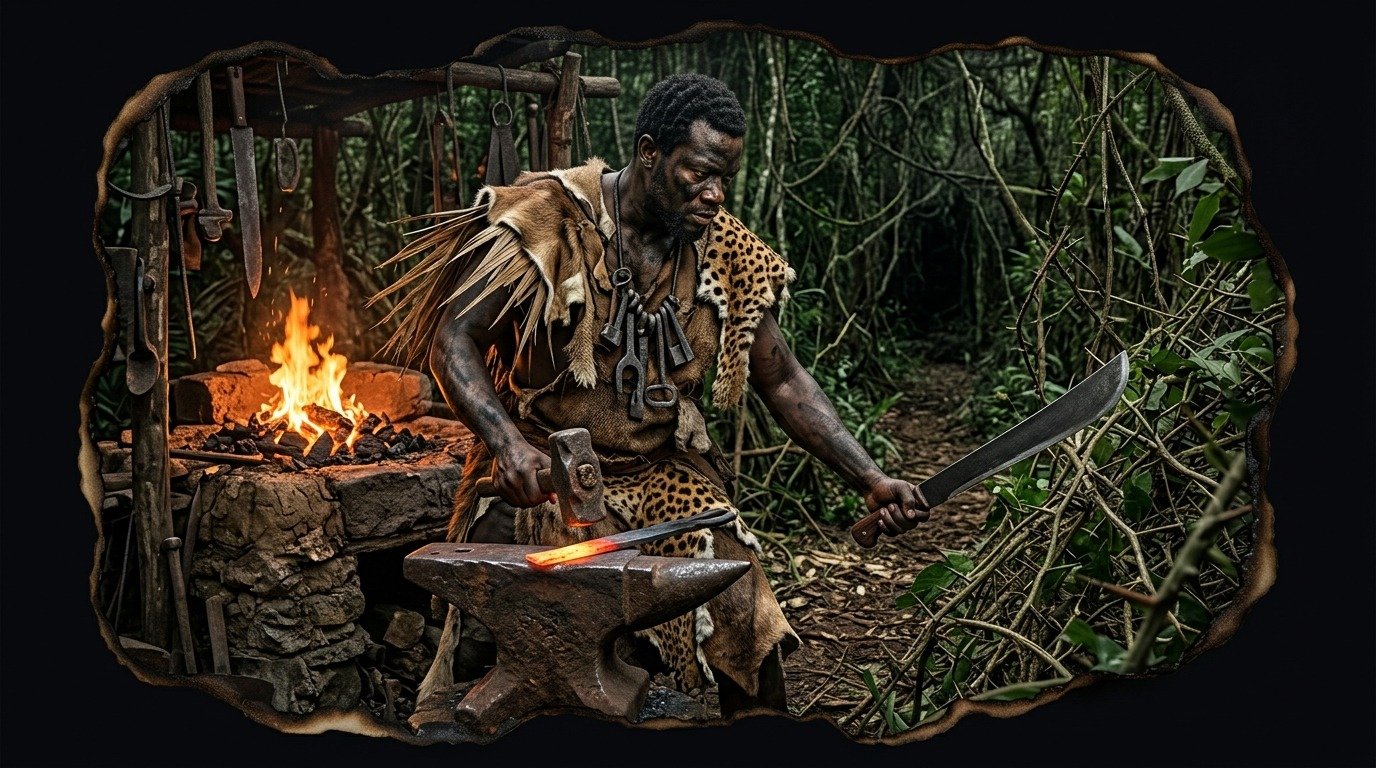
Ogún is the God who smells of sweat, burning coal, blood, and damp iron. He is the solitary warrior, the tireless blacksmith who works in the earth's forges with a heavy mallet and a stone anvil. While other gods dwell in celestial palaces or the golden depths of the river, Ogún prefers the density of the virgin forest and the harshness of the mountains where veins of metal hide. He represents physical labor, technology, the destructive force of war, and the tool that allows civilization to carve its path through the wild wilderness.
He dresses in animal skins and dry palm leaves, and his face is usually covered in the soot from his forge's fire. He does not speak much; his language is the sharp strike of metal against wood or the crunch of his enemies' bones beneath his boot. Without Ogún, the world of men would still be an impenetrable jungle, for he is the one who invented the tools necessary to cultivate the land, build houses, and manufacture the weapons to defend themselves.
The Opener of Paths
When the Orishas descended from Orun to inhabit the Earth for the first time, they encountered an insurmountable obstacle: the world was covered by undergrowth so thick and thorny that no god could advance. Their divine garments were torn and their feet were blistered by the thorns of the virgin jungle. One by one, the gods tried to use their powers of fire, wind, and water, but the vegetation grew back even stronger, trapping them in its green labyrinth.
It was Ogún who stepped forward. Using a secret known only to him, he extracted the first piece of iron from the depths of the mountain, heated it in the living fire, and beat it into the shape of a sharp machete. With his tool in hand, he began to cut through the undergrowth with rhythmic and brutal strokes. He cleared the first path, allowing the other gods to advance and establish their kingdoms. For this achievement, he was acclaimed as the *Awoyé*, the opener of paths, and it was agreed that no deity could receive offerings or begin their work on earth without first asking for the permission and blessing of Ogún's iron.
Wrath in Exile and the Oath of Steel
Despite his invaluable help, Ogún is a god prone to blind and devastating wrath. On one occasion, after returning from a bloody battle, he arrived at a city where a religious festival was being celebrated during which the inhabitants were forbidden to speak. Seeing that no one answered his greetings or offered him water to quench his thirst, Ogún interpreted the silence as an intolerable insult. He drew his sword and, in a fit of warlike madness, massacred the entire population.
When the deity of justice revealed to him that those people were his own subjects and that they kept silent out of respect for the gods, the horror of his actions crushed Ogún. Filled with shame, he plunged his sword into the ground and sank into the earth, swearing never to live among men again. He retreated to the depths of the jungle, where only Oshún, with her sweet honey and songs of love, could soothe his tormented spirit so that he would light his forge once more.
Ogún remains present in every factory, in every surgery where a scalpel saves a life, on train tracks, and in the weapons of armies. He is the protector of blacksmiths, mechanics, drivers, and soldiers. His law is that of constant work and respect for one's pledged word: an oath made upon a piece of iron in his name can never be broken, for the steel that gives life holds the implacable memory of the one who forged it.
Comments
Share information, an experience, or a source to help enrich this entry. They are automatically reviewed before being published.
Loading comments...