Obatala
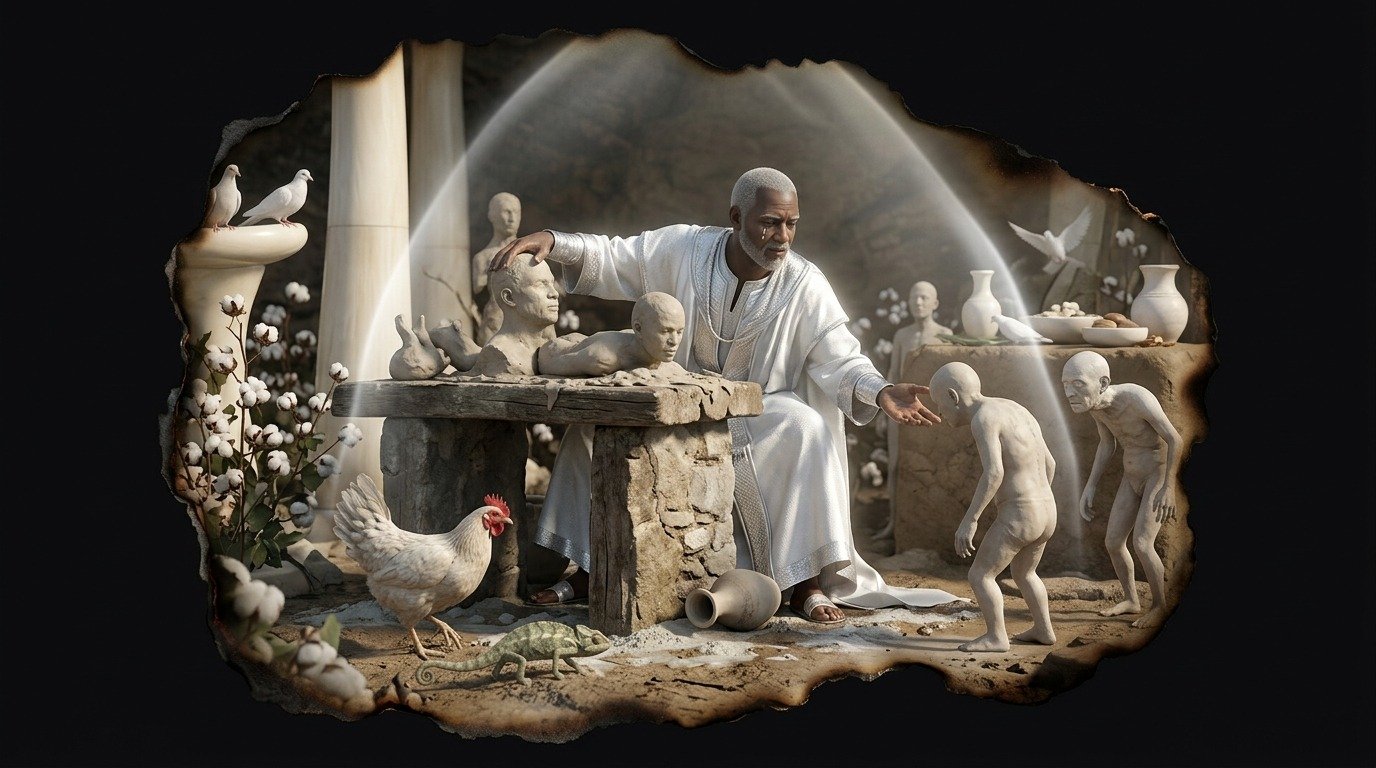
Obatala: The Sculptor of White Clay
The Descent of Purity
When the universe was nothing more than a misty and chaotic swamp under an infinite sky, the great silent maker entrusted the task of shaping solidity. For this mission, he chose the purest of his children, one whose body knows no blemish and whose garments shine with the light of virgin silver and the snow of the peaks. He descended from the firmament, carrying with him a gold chain, a seashell filled with wet sand, a five-toed hen, and a chameleon. Upon reaching the edge of the void, he poured the sand over the stagnant waters. The hen began to scratch and scatter the earth with her feet, spreading it far and wide to create the first continents. Behind her walked the chameleon, moving with that infinite caution that characterizes it, testing with its feet if the newborn ground was firm enough to support the weight of life. Satisfied with the solidity of the world, the god of purity settled on the earth and decided to populate it, bringing with him the stillness of thought and the rule of reason over wild instincts.
The Error of Clay and Wine
The great maker granted him the most sacred gift: the power to mold the bodies of future human beings. With devotion and infinite patience, he began to take the wet clay from the ground, shaping the heads, torsos, and limbs of the men and women who would walk upon creation. But the afternoon sun was scorching, and the effort of creation consumes even the immortals. Feeling a deep thirst, he stopped under a palm tree and extracted its sap to drink palm wine. The liquor was sweet and cool, and the god drank until his senses blurred and his pulse, once steady as the pulse of the stars, began to tremble. He returned to his clay workshop under the effects of drunkenness. His fingers no longer had their former precision; he molded bodies with legs too short, hunched backs, blind eyes, and skin devoid of color, like the very chalk of his garments. Unaware of his clumsiness, he breathed the breath of life into them and sent them to inhabit the earth. Upon waking the next day, with a clear mind and clean sight, he saw what he had done. Far from rejecting his imperfect creatures, he was moved by an immense paternal love. He wept tears of silver and swore that, from that moment on, he would be the absolute protector of all those who had been born with different bodies, special markings, or minds that inhabit worlds of silence. He forever forbade palm wine on his altars and decreed that the whiteness of his cloak would cover the helpless against the cruelty of strong men.
The White Cloak Over Chaos
His presence is the coolness that extinguishes the fever of war. While other gods brandished iron axes and lit fires on the plains, he ruled from his ivory palace, surrounded by white doves and wild cotton. His judgment is the scale that appeases the bloodiest disputes; his voice, though soft as the rustle of a clean sheet, has the necessary authority to bend the pride of the fiercest warriors. On his altar, the blood of traditional sacrifices is not accepted; he is offered cocoa butter, cascarilla, and crystal-clear water in white clay vessels. He is the owner of the human head, the guardian of the mind and understanding. When the world becomes too noisy and the thoughts of men sink into the mire of madness or despair, the only salvation is to invoke his white cloak, the only thing that can restore calm and clarity to eyes clouded by pain.
Comments
Share information, an experience, or a source to help enrich this entry. They are automatically reviewed before being published.
Loading comments...