Animal Rains
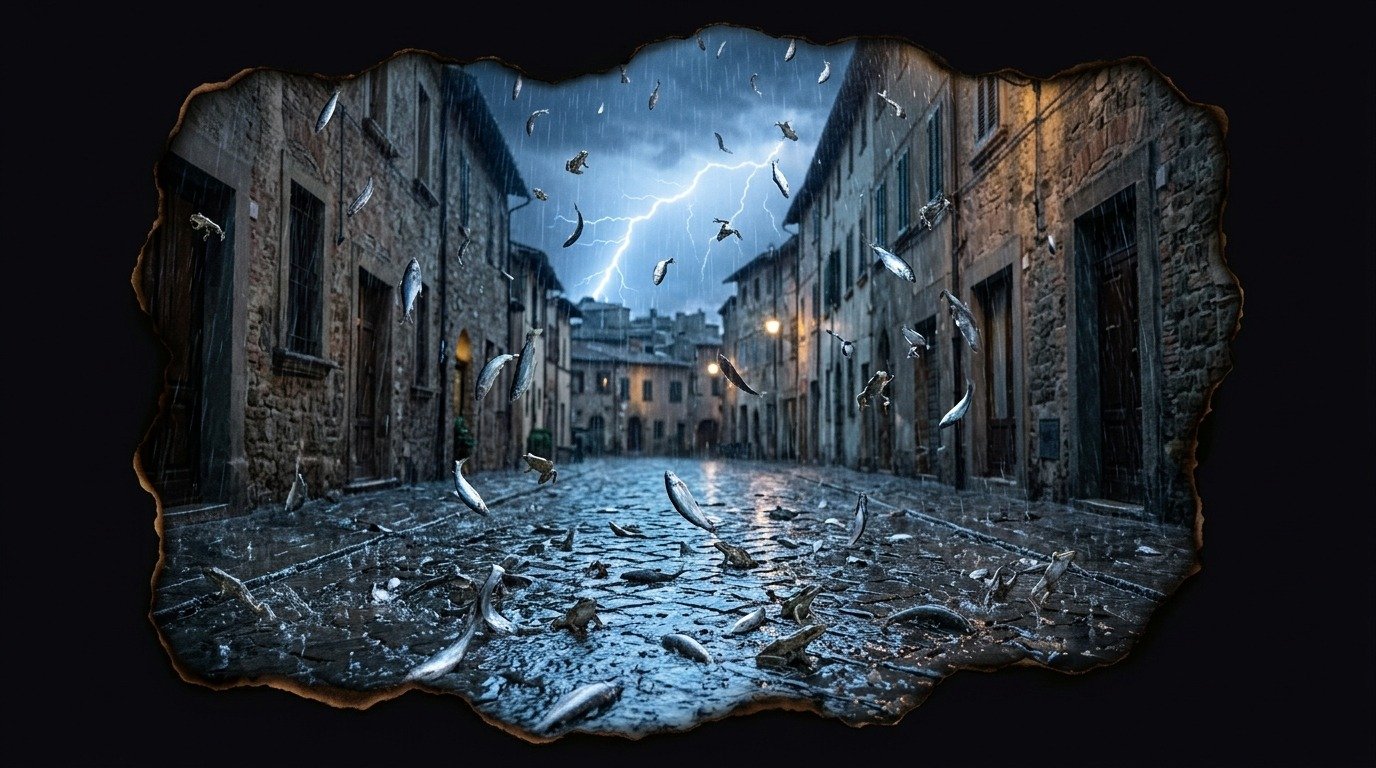
Animal Rains: The Fall of Fauna from the Sky
Animal rain is the precipitation of terrestrial or aquatic creatures from the atmosphere, whether or not it is accompanied by common rain. This phenomenon is characterized by animals falling in large numbers, belonging to a single species in each event, and frequently surviving the fall. It mainly affects fish, frogs, spiders, and small crustaceans.
How the Phenomenon Manifests
The phenomenon begins with the formation of dense, dark storm clouds. The precipitation starts violently. Instead of exclusively hail or water, hundreds or thousands of animals of the same species fall from the sky.
In most cases, the animals fall completely healthy, active, and stable, immediately populating the ground, streets, and roofs of houses. On other occasions, the creatures fall frozen, trapped inside blocks of ice, or torn apart due to the pressure of high-altitude air currents. The phenomenon is highly localized: it can cover a specific street or field while leaving the surrounding areas untouched.
History and Traditions
The fall of fauna has been documented since classical antiquity. The Roman writer and military commander Pliny the Elder described it in his work *Natural History* in the first century, where he recorded storms of fish and frogs in the territory of the Roman Empire. During the Middle Ages, the Catholic Church interpreted these events as divine punishments or omens of plagues and famines.
In the 20th century, the American researcher Charles Fort compiled thousands of these cases in his book *The Book of the Damned* (1919). Fort was the first to systematize the study of these anomalous precipitations, defining the term "Fortean phenomenon" to refer to events that academic science fails to satisfactorily integrate into its frameworks.
Famous Cases
The phenomenon occurs regularly in different parts of the world: * **The rain of fish of Yoro (Honduras):** It is the most consistent case in the world. It occurs every year between the months of May and July in the region of Yoro. After a highly powerful storm, the ground is left covered with thousands of live river fish that local inhabitants collect for consumption. * **Singapore (1861):** Following a three-day earthquake and continuous torrential rains, the inhabitants of the city and the French naturalist François de Castelnau discovered thousands of fish in the puddles and dry fields of the region, which did not belong to local watercourses. * **Lalain (France, 1822):** A dense cloud discharged a rain of small toads onto the streets of the French commune during a summer storm. The animals covered the roads and survived the impact, according to the official record presented to the Paris Academy of Sciences.
Explanations of the Phenomenon
For esotericism and Fortean theories, the fall of animals is explained by a temporary rupture of physical space. This theory proposes the existence of portals or transport anomalies that absorb fauna from a river, lake, or sea and instantly transport them kilometers (miles) away through invisible currents in the upper atmosphere.
Meteorology offers a physical explanation. The phenomenon is produced by the action of waterspouts or high-intensity tornadoes. When these wind vortices pass over shallow bodies of water, they suction the surface layer along with the animals inhabiting it. The force of the wind lofts the fauna up to the storm clouds, where air currents transport them at high speeds until the wind subsides and gravity causes them to fall to the ground.
Paranormal Connections
Animal rains are closely linked to apports (materializations of objects out of nowhere), the spontaneous generation of matter, and alterations in atmospheric electromagnetism.
Comments
Share information, an experience, or a source to help enrich this entry. They are automatically reviewed before being published.
Loading comments...