Amadioha
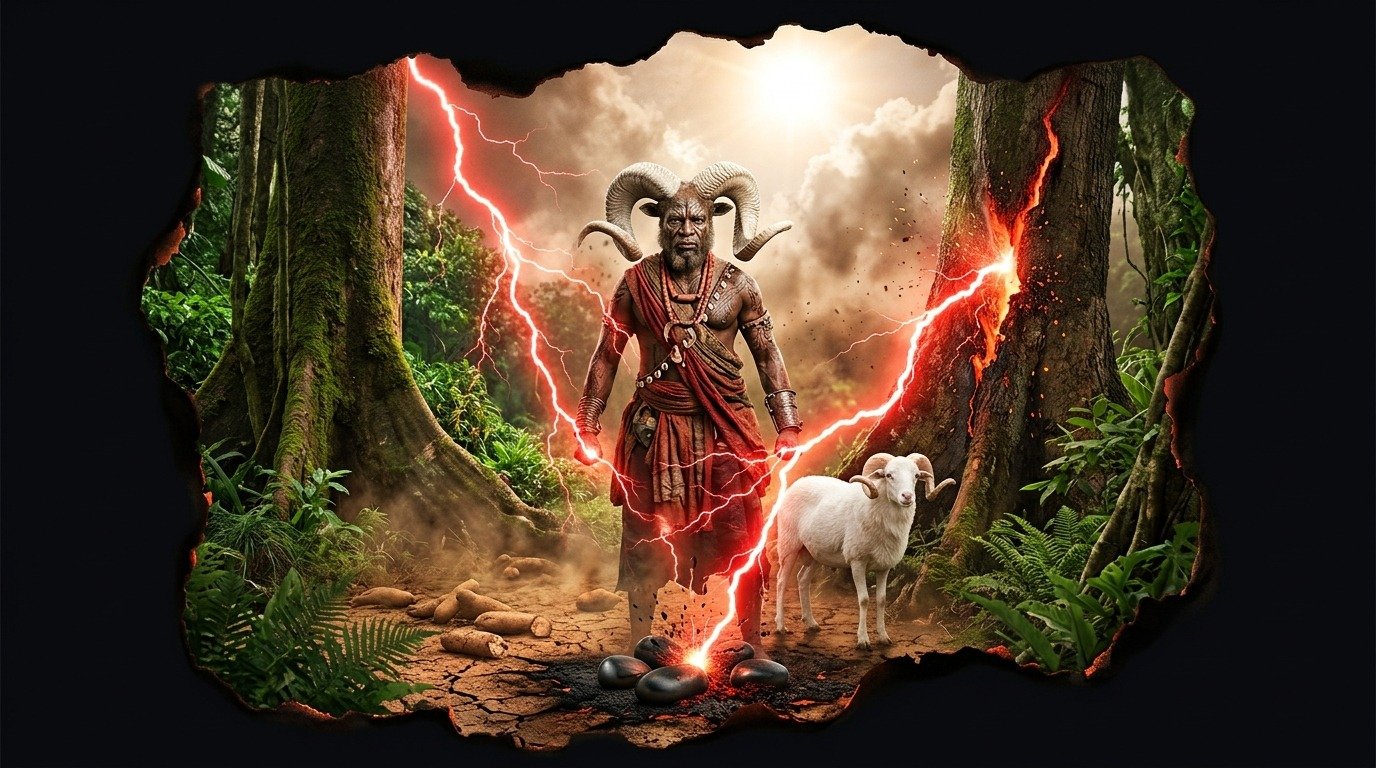
Amadioha: The Judgment of the Red Lightning
The Lord of the Clear Sky
Before the rain soaks the jungles and the yam fields, there is an instant of absolute silence. The wind stops, the birds fall silent in the canopy of the iroko trees, and the humidity weighs upon the shoulders of mortals like a cloak of lead. It is in this suspense, just before the sky is torn open, where Amadioha dwells. He is not the chaotic storm that destroys on a whim; he is the cold, swift, and absolute justice that descends from the firmament when the balance of the world has been desecrated.
While other divine forces claim the darkness of the night or the depths of caves, Amadioha rules from the blinding light of midday. It is said that his dwelling is in the sun itself, and that the suffocating heat that cracks the earth is but a reflection of his watchful gaze. He is the husband of the sky to Ani, the great mother earth. Their relationship is the heartbeat of the world: when Amadioha is at peace, he sends gentle rains that fertilize Ani's womb, causing life to spring forth; but when men break oaths, steal in the villages, or shed innocent blood, the sky god roars and his response is a dry fire that descends to purify the offense.
The White Ram and the Midday Fire
Those who guard his temples know well the paradox of his character. Amadioha's sacred animal, which roams freely through his forested shrines, is a white ram. At first glance, the ram is a peaceful creature, slow-paced with wool as clean as morning clouds. However, anyone who has seen a ram defend its territory knows that behind that gentle appearance lies a devastating strength, capable of knocking down an enemy with a single headbutt. Such is Amadioha: patient, silent, and seemingly distant, until the moment comes to strike.
When the god decides to intervene in human affairs, he does not do so with warnings. His manifestation is the *kamalu*, the bright red lightning that flashes across the daytime sky with a crack that makes bones vibrate. There is no stone wall, amulet, or plea that can deflect that bolt when it has a name written on it. Amadioha's fire does not just burn; it marks. The tree split by his lightning is consecrated to his name, and the wood that survives the impact must never be used by mortal hands, for it retains the heat of divine wrath.
The Judgment of the Black Stone
The myth of Amadioha is written daily through his justice. In the communities where his law is respected, there is no judge more feared or more infallible. When a crime remains unsolved, when a thief denies their guilt, or a traitor swears falsely, the aggrieved party does not reach for swords; they go to the altar of Amadioha and speak his name to the wind.
The god's punishment is direct and leaves a physical mark on the world of the living. Lightning descends upon the guilty party, striking them dead on the spot. At the exact point where the light touches the ground, the priests of his cult dig up the *otigba*, the "thunderstones." These dark, polished, and heavy stones are the physical projectiles that the god hurls from the heavens. To possess one of these stones is to hold a fragment of the cosmos's judicial power; the priests use them in their rituals to swear in chiefs and ensure that truth prevails in village trials.
Death by Amadioha's lightning carries a terrible curse that transcends life. The body of the offender cannot receive burial in the womb of Ani, the earth, for she refuses to harbor what her husband has destroyed. The remains of the sentenced are abandoned in the sacred forests, exposed to the elements and beasts, and all of their material belongings pass into the hands of the temple priests. It is the absolute erasure of an existence that dared to defy the cosmic order.
The Echo in the Treetops
Despite the severity of his judgment, Amadioha is not a god of terror, but of order. Farmers invoke him at dawn so that the sun does not burn their crops and so that the water from the sky arrives on time. Travelers seek his protective shadow when crossing lonely roads, knowing that no bandit will dare to attack under the open sky if they fear the gaze of the lord of thunder.
The worship of Amadioha has survived the passage of centuries, adapting and merging with other currents without losing its essence. In the beat of ceremonial drums that mimic the rumbling of thunder, in the almost sacred respect held for the color red, and in the figure of the white ram that still adorns the altars of modern shrines, the sky god remains present. His name continues to be the last resort of the oppressed and the terror of the liar; an elemental force that reminds humanity that, no matter how high they try to hide their secrets, the sky is always watching.
Comments
Share information, an experience, or a source to help enrich this entry. They are automatically reviewed before being published.
Loading comments...